
My Father’s Pandora’s Box
Stray hairs still nestled in my grandmother’s brush as I unpacked the box of her belongings that my father had sent to me almost a year after she died. As I struggled with my own disastrous marriage, my father did not tell me that my grandmother had left certain items for me, only that her will had been read and I was left out.
This box showed up unannounced, like an uninvited party guest, and I was left to make sense of its contents. My grandmother was a complicated woman; this box yielded both questions and answers.
Along with the hairbrush, she had methodically wrapped her silver mirror and comb set that I had admired for so many years as a child. I could tell from the care with which these items were packed away that it was Grandma who had done it before she died. I could see her sitting alone in her apartment, thinking about her own death and setting these items aside for me.
In many ways, I knew I was like her — alone in an unhappy marriage, wondering if my life was nearly over. Loneliness had inundated the life I had promised to share with Matt as that same loneliness had consumed my grandmother. But she was a widow and solitary in her loneliness. I was not solitary, but I was certainly alone.
My grandmother was a complicated woman, but she exuded a certain vitality that attracted attention. If her hair were not so gray, one would easily have thought she was in her forties rather than her seventies. As a child, I watched her in front of the mirror, on the pink velvet bench, and brushed her hair until it looked like thick, silken threads. She braided it with care, not even looking, but working from habit and put it in an elaborate bun.
I remember as a child, trying to brush my hair the same way with the same brush, but my hair turned into a frizzy red mess. A stark and disappointing contrast to hers, smooth and straight.
Although she never expressed disappointment in my childhood gawky appearance and unmanageable hair, I wonder what she thought of our contrasts. And now, with this box before me, I was forced to consider our similarities.
After my grandfather died, when I was five, she flourished as a social butterfly. Looking back, I see that going out was only a cover for her loneliness. As an adult, I wondered if my grandmother would have had a more content retired life if my grandfather had not died so young. The contents of the box answered this question in a way that I did not expect.
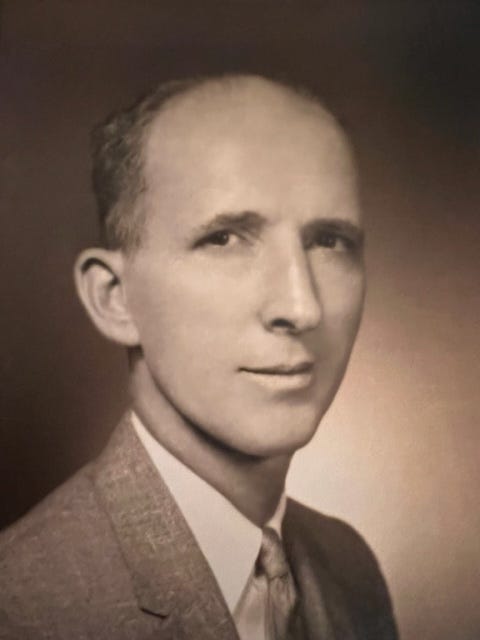
I have a wallet-sized picture of my grandfather in my room. He is a younger version of my father, but there is no mistaking the relation. He is frozen in time, locked in this picture taken at 63, a few months before he died.
I have no pictures of my grandparents together, however, as I do for my maternal grandparents.
When I was in college and my parents spoke within earshot, I realized how complicated the relationship between my grandmother and grandfather had actually been. My mother would replay events in which my grandmother would treat my grandfather with disdain and he would just silently take the punishment.
I often looked to this picture of this gentle man and wondered what had made her so bitter toward him. Did she feel guilty about mistreating my grandfather while he was alive, or did she blame herself for his early death? Perhaps she blamed him for her solitary life?
I had been married to Matt for about six years and we had the two young girls when my grandmother fell in her apartment at eighty-six years old. It took three days of unanswered phone calls for anyone to check on her. I realized, that as she grew older, she had grown into the loneliest person I knew.
When I saw her in the nursing home that was little more than a desolate dumping ground, she looked lost. Her hair was no longer kept with pristine care, and her clothes were tattered hand-me-downs. With this brush in my hands, I touched her silver hair and remembered all the things about her that I loved as a child. She had been dead for a year. Why did my father wait so long to send me this box?
My father grew up an only child and I know that must have been a very lonely time for him. I recall only stories of games of solitaire and reading history books during his free time. The only other knowledge I have of his childhood is second-hand from my mother, and I think she told me these things to try to explain him in some way. The stories my mother tells me paint an unflattering picture of a mother who was very strict and never quite got over the loss of a child during the fifth month of pregnancy.
There was a dark curtain around the details of my father’s childhood, but I do remember my father’s statement that perhaps his mother never should have had children. My father grew up unwanted and, unknowingly, passed those feelings along to my brother and me. Sometimes, I considered the possibility that my grandmother wished my father had been the child whom she lost.
But this is a story of questions and few answers.

My grandmother was a writer. This is something I never knew about her until I unpacked the box. Beneath the brush, comb and mirror that were so familiar to me from childhood memory, there was a large, sealed envelope. I opened it and found yellowed pages filled with stories I never knew she had written. They were typewritten and edited in the familiar hand from letters and birthday cards. I had never known her creative side, in spite of the fact that, as an adult, I had shared my passion for writing with her many times; often sharing stories I was working on with her.
I felt cheated. This love of the written word could have been a bond between us.
But, in spite of the fact that she never told me she was a writer, she had given me the gift of her past. In doing so, she unlocked the mystery of my father’s anger. As a writer myself, reading her work as an adult, I recognized and understood parts of her life in her stories. More importantly, I saw parts of my life there as well.
The first story I read entitled Alone centered on finding the right man to marry three years after marrying the wrong man. This leads main character, Ilse, to swallow a vial of poison after telling her husband’s brother that she loved him and not her husband.
Death enveloped love in my grandmother’s stories, and reading them made me see how closely linked love and death actually were, not only in her life, but in mine as well. She did not sign her real name, as if taking ownership of her work might in some way give something away. This piece was written on October 28, 1927, by Carol Desca, but the handwriting of every birthday card she sent me was unmistakable.
I sat on the bed I shared with Matt reading her history and all the pieces of her I had heard over the years finally began to make sense. These yellowed words on the page were not fiction at all; they were her life.
My grandmother had fallen for the wrong man with no bottom to hit, and I see how this affected her ability to parent. My father was born fairly early in her marriage; did his birth trap her in the marriage? Was she Ilse from her story? Did she need something that she was destined never to have? And whose baby was it that she lost? Did she live nobly for the unworthy cause of a mismatched marriage? Thoreau proclaimed in Walden that “most men lead lives of quiet desperation,” and I wondered if that was her life. I know that was my fathers’ life.
And now I saw it was part of my life.

My grandmother wanted her secrets to be kept. She didn’t want anyone to know that she had married the wrong man, which I suspect is the reason she could never take ownership of her stories; but my father did find out.
When my grandmother went into the nursing home after her fall, my father cleaned out her apartment. I had a conversation with him after the fact, and he explained how the cleaning had gone.
In this conversation, my father paused and stammered over his words. He lost his customary veneer of control and gave way with subtle hints of a confused little boy. His voice was a tentative one that I had not heard since I was very young. As an adult, that voice sounded so vulnerable and painful to me.
I had never thought of my father as vulnerable; I had always been the one vulnerable to him. This realization saddened me, but also helped me understand the complex nature of my father — an understanding that ultimately helped us find a strong and loving relationship in later years.
My father arranged for my grandmother to be transferred to a nursing home in Atlanta so he could fulfill his obligation as her only son, and he stayed behind to clean out the remnants of her apartment, her life, and his memories. He organized a yard sale to get rid of most of her furniture and mementos and he watched his mother’s life slip away in the arms of strangers, fifty cents at a time.
He told me the sink was full of dishes hardened and crusty caked with half-eaten microwave meals. These dishes had clearly been in the sink longer than the three days that she had lain on her bathroom floor with a broken hip. Dirty dishes were piled up on along the counter and stove until the pink Formica countertop was hidden. My father slept in her bed that night, a vodka and coke on the nightstand. He took a sip in the middle of the night and almost swallowed a cockroach. The humiliation of the condition of that apartment haunted my father until his death in 2009.
While going through my grandmother’s belongings, my father found love letters from someone other than my grandfather. He told me about them one Thanksgiving after too many glasses of wine. I don’t think he remembers telling me about them, and I never asked him when those letters were written or the details of what they contained. He wouldn’t have answered me anyway. He did tell me they were from someone named Martin, someone whom my father knew, but he wouldn’t tell me anything else.
He destroyed the letters while he was in her apartment alone going through her things. There was no memory of my grandfather in her belongings, only mementos of Martin.
My family is a family of secrets, of things unspoken and hidden away, as if the hiding keeps the secrets from hurting. I am a writer and a teller of truth, and I am a misfit in my family of secrets. I can only imagine what it must have been like for him to find those letters, but I felt incredibly cheated as well. The secret to my grandmother was locked away in those letters, and, until the box showed up on my door, I had no way of knowing why my grandmother was the way she was. The story of grandmother’s life was one of lessons and unfulfilled dreams.
I understand now, through her stories and her letters, that this quiet desperation of which Thoreau wrote and which my grandmother lived, is not what I want from life. The contents of the box revealed things that I had been avoiding most of my life. In this box, my grandmother told me her story, and, in doing so, she explained things about me that I had never considered.
She explained my own life to me from her grave. She helped me see that if I could be braver than she was, then I would not be doomed to live that life of quiet desperation. And that has made all the difference.


