
My Father Wept
His life was spent in sorrow.
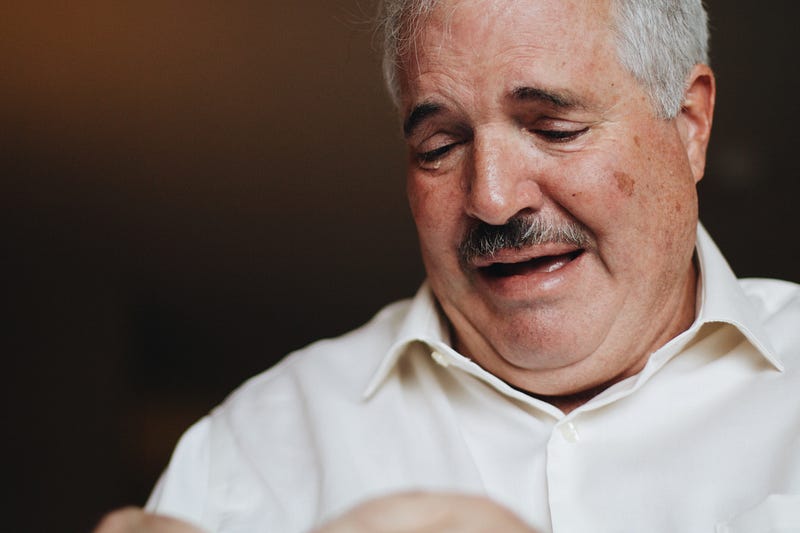
My father wept when five months before I was born, my brother, a cherubic faced toddler of a year and eight months, fell from a second-story window of our rent house.
Of course, I have no memory of that. I was still bathing in amniotic fluid and kicking my mother’s bladder.
Perhaps if I’d been a little less rambunctious that day, she wouldn’t have needed to take that nap. Then maybe she would have been able to keep a closer eye on my brother.
Maybe she wouldn’t have forgotten to latch the window screen my brother leaned against.
My brother lived through the fall, the entire left side of his body paralyzed.
By the time I was born, he had already suffered through two emergency surgeries to keep him alive, and then seven post-operative surgeries as the specialists fought to provide him a semblance of quality of life.
Growing up, my brother was, well, my brother.
I didn’t think the fact he wore a leg brace, or limped, or wore special glasses, or had no use of his left hand was strange.
He was my brother, and that was that.
I accepted what my family could not.
To hear my grandmother tell it, none of the family blamed me for this, of course, but a tragedy of this magnitude evidently had to have a scapegoat. In my grandmother’s mind, there was only one culprit to blame.
My mother.
My grandmother barged in and took over the day to day responsibilities of caring for my brother.
I’m guessing she was convinced it had been my mother’s lack of maternal instinct and overall incapacity of taking care of children in general that caused the accident.
Convinced beyond a shadow of a doubt, and providing my mother no reasonable doubt, my grandmother set about coddling my brother, protecting him from further harm, shielding him from life.
And my father and mother, each stricken with grief and turning their thoughts from the tragedy to their new arrival — me — let her do it.
It seemed no one was willing to lay their emotional playing cards on the table. No one wanted to espouse how they felt because it guaranteed an emotional confrontation none of them was willing or capable of going through.
In essence, my family became emotionally dysfunctional.

My father wept when my mother left us soon after my eighth birthday.
I suppose years of being forced to endure the constant barrage of silent accusations by my grandmother was more than my mother could bear.
My father loved my mother so much, loved her with every fiber of his being.
But as an emotionally dysfunctional human is often prone to do, my father chose to rely on his own mother’s take on the situation and not what he felt in his own heart.
He let the only woman he ever truly loved walk out the door.
I remember the night my father completely broke down. He, my brother, and I knelt at the altar of the church where my grandfather served as pastor, and he began to pray.
Seconds later, I watched my father cover his face with both hands and begin to sob. I began to cry as well, not so much for the loss of my mother because I really didn’t understand what was happening.
I was crying because seeing my father in so much pain ripped the life out of me.
But we learned to survive, with the help of my grandparents. My grandmother was delighted to have her oldest son and his two boys beneath the umbrella of her smothering, over-protective care.
It was a tremendous coup for her.
Interestingly enough, my mother came back into our lives four years later, when I was twelve. Evidently, she’d had time to think about things and decided she was a fit mother and wanted custody.
At the time, I was one of the youngest people ever to testify in a Texas court of law. Imagine the rush I felt being allowed to sit in the witness stand, with all eyes on me, proclaiming versions of truth my dad’s lawyers had concocted.
Don’t get me, wrong folks, my dad still loved my mom with all his heart and soul, and being the dysfunctional misfit that he was, he’d lost her. But he wasn’t about to lose his sons.
My mother’s petition for custody was denied.
My father wept when my uncle passed away.
His younger brother, his only sibling, a successful pilot in the United States Air Force, a test pilot extraordinaire, took his own life.
I received a call from my dad’s third wife. Uncle Paul was dead.
He’d hanged himself in the garage after his wife and two daughters had left for work and school. I was stunned. The reason I joined the Air Force in the first place was because of Uncle Paul. I wanted to be just like him. I was enamored by his success and his poise and his understated mannerisms.
And now he was gone.
I was twenty at the time and desperate to forge a life of my own, but the news of my uncle’s death — especially how it happened — hit me pretty hard.
As hard as it impacted me, it almost destroyed my father.
He tried to keep it together as my grandmother draped herself over my uncle’s coffin and wailed and moaned. He tried to maintain a sense of decorum as his father, my grandfather, offered a brief but stirring and emotional prayer at the end of the service.
But he lost it all on the drive home.
I remember that night vividly. My brother and I were sitting in the back seat. Dad had been drinking most of the afternoon following the services.
With one hand on the steering wheel and another wrapped around a beer, he attempted to guide his vehicle along a serpentine Texas highway as the charcoal blanket of night began to wrap itself around us.
Thoughts of being involved in a terrible car crash flashed through my mind that night. Each time my dad would over-steer the car into a fishtail as he tried to guide the car away from the gravel shoulder of the road, I thought my life would soon be forfeit.
We stopped for gas, and my dad’s wife took me aside and suggested I offer to take the wheel for a while. I saw the haunted look of concern, the fearful apprehension in her expression, and guessed she wanted to stay alive as much as I did.
I stopped my dad as he was coming out of the bathroom and soft soaped the idea of letting me tag in on the driving duties. I knew as proud a man as my father was, there would be no way I could force him to do anything.
I remember suggesting he consider it since he’d been under a lot of stress and was probably running on empty.
I never once said anything about the fact that he was smashed.
With a nod of my head, I climbed in the back seat alongside my brother and waited as my father steered the car in an erratic, wobbly pattern back on the road.
At least we were heading in the right direction. The problem was, we were still weaving on and off the shoulder with more frequency now.
At last, my dad spoke, his voice soft and slurred from too much stress and alcohol. What he said was what his wife and I had been desperately waiting to hear.
“Buster, tell you what. I’m worn out. How about you take it the rest of the way?”
Remember, my brother? The guy that suffered the tragedy and was leading a worry-free life being pampered by my grandmother?
Yeah, that’s the one. Guess what? The minute my dad said that he whined, “why can’t I drive?”
My brother never saw my right hand coming. I smashed my fist into his jaw and then wrapped my arms around him, pinning him against the back seat. As he struggled to get free, I hissed at him to shut the hell up, but the damage was done.
My dad decided to continue driving, continue running off the road, and back onto the road and back off the road again. It was during those times of imminent disaster that my brother began to understand that if one of us didn’t get behind the wheel, we were all probably going to die that night.
Reluctantly my brother conceded, and after another fifteen nerve-wracking minutes, I gently tapped my dad on his shoulder and said, “hey dad, pull over, I got this.”
He did. I took the wheel, and my brother joined me in the front seat. It wasn’t until I pulled onto the road that I heard my father begin to cry. He continued to cry until he exhausted himself and fell asleep.
I got us all home that night without incident, but to this day I remember the gut-wrenching sounds of my father’s sobs.
My father wept when we buried his dad, my grandfather.
My grandfather was a fantastic, spiritual, and loving man. Stricken with diabetes when he was twenty-six, and then Parkinson’s when he was sixty, my grandfather was the true embodiment of a faithful servant of God.
Almost Job-like with his patience, and yet an irascible character at times. Most of the time, my grandfather was a candidate for sainthood. How could he not be? Somehow he managed to put up with my grandmother for over fifty years.
Diabetes took one of his legs, and then the other and finally, my grandfather said his goodbyes and moved on.
I remember bidding him farewell with a kiss on the forehead as he lay in the coffin. The thought which flashed through my mind at that very moment still stays with me even to this day.
It was cold, the touch of my lips against his head was so very cold.
I wept along with my father that day as we bonded together, holding onto one another fiercely as we both tried to steel ourselves against the pain of loss.
Two years later, my grandmother passed away. She was eighty-one years old at the time of her death. For two years, she suffered through advanced stages of dementia and Alzheimer’s.
There were times I had to introduce myself at least ten times within the span of a fifteen-minute visit.
I visited my grandmother sparingly over the last two years of her life, a decision I think about from time to time but never chastise myself about.
I didn’t cry at my grandmother’s funeral.
It wasn’t because I was bitter, or my heart was hard. It was because my grandmother had done everything she could to suck out of me all the love and attention I had. She refused to wait until I, or any member of the family, chose to give it freely.
I remember standing there gazing at her gaunt, almost mummified looking face and thinking that there was nothing left, no emotions remaining to give her.
My father never wept at his own mother’s funeral either. He never cried because he refused to come.
In fact, after my grandfather’s funeral, I never saw my father again.
I’m guessing he wanted to escape the things that had mangled and twisted his life so badly he felt he would never be able to recover.
I don’t know, maybe he just wanted to stop crying.
Let’s keep in touch: [email protected] © P.G. Barnett, 2019. All Rights Reserved.


