
Memoirs and Life Lessons
My Father Taught Me to Swim
The power of muscle memory that the body doesn’t forget
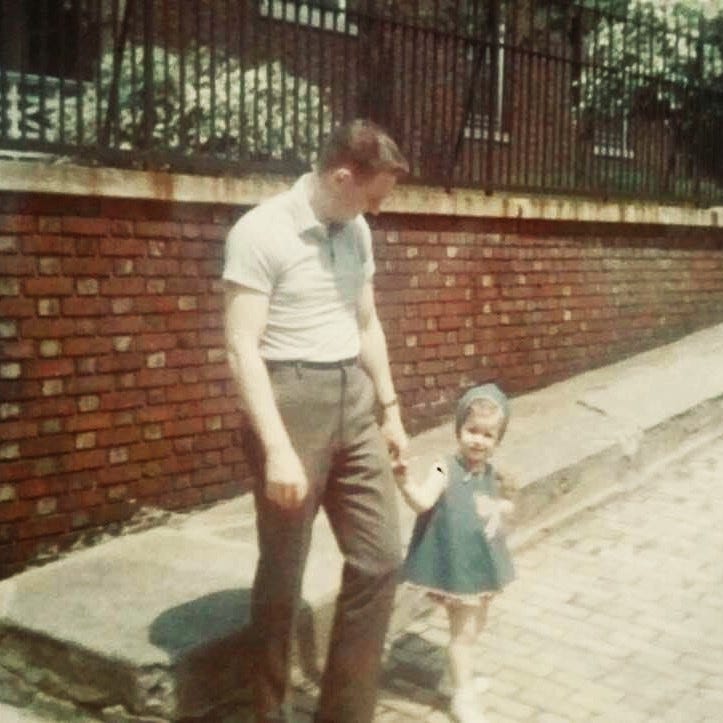
Some people don’t think about their physicality — they’re in tune with their bodies, can push them to their limits, enjoy the confidence that comes in doing without thought — trusting their bodies to do what they want. There’s such freedom in that. I see it in dancers, athletes, gymnasts. Kids at the park. It’s magical. It feels foreign to me now.
But I used to dive. I still remember what it felt like to vault off a board, fly into the air, bend from the waist, touch my toes, and straighten out just in time to slice into the water without much of a splash. Jacknifes. Somersaults. Backdives.
I remember the feeling of spinning through the air, never doubting that I’d land it — a confidence quite unnatural for me. I’d get up early and wait for the pool to open. I could do this all day in the summer.
My father taught me everything I could do in the water. He said I was a natural. It was the only athletic thing I was ever good at before the spine surgery.
When I was 15, it was over. I had severe scoliosis. I had the type of spinal fusions they did in the late 70’s, where you never rotate or bend your torso again. Before they rolled my bed to the OR, the doctor asked if I needed anything.
I said, “I need to do some cartwheels”. The nurses and staff helped me off the bed and applauded while I flipped down the hallway and back.
“I’ll probably never do that again,” I said, even though I knew the answer. They were kind and honest.
“No, but you’ll grow up into a healthy woman and have a normal life.” I knew all this. They helped me back up, tucked the sheet around me, and asked “Are you ready?” I nodded yes.
Despite all, I’m very fortunate and grateful.
Every day I get up, I remember how grateful I am. I am aware of it all the time because I have to do things a little differently than others, but I never take any of it for granted. That girl at the pool was so long ago that I don’t remember her very well. She seems like someone else I once saw on a TV show or something. She has nothing to do with me.
I had 15 years of Before and 45 years of After. The After is who I’ve been most of my life. The After grew up to be a healthy woman with a normal life.
The After made that fusion last 34 years and then went in for a rebuild. That was 12 years ago, and I’m still standing. I can’t even remember the Before.
But a few years ago, for a few moments, I did.
I was visiting a friend in Florida, and I had access to an empty pool at the hotel. While I’ll never dive again, I can still swim.
My father taught me both. I was doing slow laps, trying to remember the types of strokes he taught me, and cautiously trying out which ones I could do safely. Nobody was around to yell at me to stop or remind me what I couldn’t do, so I let myself remember.
My father, a former lifeguard at Jones Beach in Long Island, New York had taught me to swim as a young child. To be an open water lifeguard you need more rigorous training than if you work at lakes or pools.
He could’ve probably been a professional athlete swimming the way he could, but that kind of training involved time and money. Swimming was an elite sport out of reach for most struggling Bronx immigrant families in the 1950s, but he was a natural.
So he swam anywhere he could.
He dove off the Willis Avenue Bridge. Did laps in the East River. He taught me to swim, dive, recognize the way the water changes color in a riptide, and how to get to safety if I was ever caught up in one.
I was swimming in the ocean with him at six years old, at pools even younger. He respected the water and taught me to do the same. He was an expert scuba diver as well. He’d tried to join the Navy when he was younger, but they turned him down for a heart condition.
All he ever wanted was the water.
I remember watching him at our community pool when I was a kid. He’d wait in line at the diving board and then effortlessly perform acrobatics that would stun everyone watching. Then he’d go back to his chair, and his book like nothing had happened.
He could go years between doing things like that. I thought that’s what muscle memory must be. He was 68 years old when I was 45, and even after he’d had a quadruple bypass and a replaced aortic valve —He could still get up there and do it. He would’ve continued, too, but it wasn’t safe anymore. Once again, his heart got in the way.
The Power of Muscle Memory
Alone in that clear pool in the golden glow of the setting sun in southwest Florida, I suddenly remembered. The freedom, the rush, the absence of thought — I sliced through the cool water doing breaststrokes and then reached the wall and flip-turned to get to the other side.
At that moment, I knew I could make it back in one breath. I knew I might not be able to do it next week, or maybe I shouldn’t, but I was doing it now. It was almost like when I was a Before.
It was muscle memory, which is neurological. It’s what one gets from practicing a task so often that you no longer require active thought to do it. If repeated enough, even many years prior, some believe it can be permanent.
It was attached to a sense of joy that was a combination of memories, both physical and emotional — of enjoying years together where we were the happiest — in the water. For him to share what he could to maybe make me be a little bit of what he’d hoped to be…but neither of us could become.
It was a gift from my Dad that maybe I can’t use that much anymore, but it’s still in there. It's just as much as my love and appreciation for that humble, gifted athlete who spent hours every summer teaching me to dive and swim.
He was a man who gave up the ocean to support a family and raise a little girl. Despite his own love for swimming, he sacrificed his dreams to support our family. Watching him swim out into the ocean past the white caps until he vanished from sight or effortlessly performed acrobatics at the pool instilled in me a sense of wonder and admiration.
Even as he aged and faced health challenges, his love for swimming never waned. In that pool, I felt the power of muscle memory, allowing me to swim effortlessly, tapping into years of practice and joyful memories shared with my father.
Though my body has changed over the years, the gift of swimming that he gave me remains an integral part of who I am today.
Muscle memory in science “can be defined as long‐lasting cellular adaptations to hypertrophic exercise training that persist during detraining‐induced atrophy and may facilitate future adaptation.”
In simple terms, muscle memory is the ability to reproduce a particular movement without conscious thought, which is acquired due to the frequent repetition of that movement in the past.
What does my story mean to you?
For me, cherished memories and ingrained muscle memory allow me to persevere when my mind and body are at odds.
Whether it’s swimming as it was for me — or climbing, baking, or running — or any variety of the interests and skills you have or had, even the ones you may not use much anymore —they’re more than just things you used to do. They continue to live on in your mental and physical memories. Tools that can prove to be useful as we age.
It’s sometimes easy to lose focus on who you were before — when so much time is spent being who you are now.
The significance of the power of memory and the profound impact of shared experiences with those we love — the enduring bond between a parent and child — cannot be overstated. It allows us to return and embrace those moments of joy, to pass down traditions and passions from one generation to the next.
Your stories of experiences and connections to loved ones are a lasting legacy that shaped who you became. Ultimately, because of these memories, no matter how much changes as we age —
We are always both Before and After.


