
My Father Struggled for 70 Years to Escape His Foxhole in Korea
We both heard the knock at the door.
It was the morning after my father had passed away.
My mother and I were exhausted. Drained. And grieving.
We had spent the past four and a half months providing hospice care for Dad in our family’s remote cabin in the Sacramento mountains.
There was nothing more that the doctors could do to halt the degeneration that had been relentlessly claiming Dad’s bodily vitality. After years of Fighting the Good Fight, Dad needed to return to his beloved trees. Not only for the peacefulness of their majestic presence but also for the sanctuary they provided him from the demons of Korea.
Born in the 1930s to Chinese parents and raised in the rough and tumble western climate of post-Depression Wyoming, Dad rarely spoke to me and my sisters about the discrimination and trauma that he suffered as an Asian-American child during World War II, and he never spoke of the horrors that he endured leading a communications engineer unit on the front lines of the Korean War.
It was only much later when I read the notes sent to me by his therapist at the Veteran’s Administration, that I experienced his anguished memories of becoming entangled in the tripwire of a hand grenade booby trap, watching helplessly as comrades writhed in agony from phosphorous burns, and coping with numerous near-fatal combat experiences that rival the gravitas, impact, and authenticity of a Tom Hanks-produced HBO series.
No, all I ever heard my Dad say, in a quiet voice charged with equal measures of intense pride and despairing grief, was that he was, and would always be a WolfHound and that, even as his body continued to fail him, he would rise again if called upon to serve his country.
In my eyes, however, my father’s heroism arose not from his actions in Korea but rather from his accomplishments after he came home. He thrived as an aerospace engineer, designing innovative, cutting-edge technology for satellites, drones, and submarines during the Cold War. He declined the recruitment efforts of the CIA. And, most importantly, he handcrafted uber-cool antenna boxes that pirated movies into our house a half-century before Netflix shipped its first CD.
Yeah, Dad was one OG badass, pocket-protector wearin’, slide rule wieldin’ MF.
But these things aren’t what makes Dad a hero. What makes him a hero is that he accomplished these things and supported his family, despite the crushing impact of the Post Traumatic Stress Disorder that he suffered as the price of his military service.
Dad kept his sh*t together (mostly) for decade after decade. But as the years progressed, Dad’s ability to keep the PTSD firmly caged weakened. He never succumbed to physical violence, but the intensity of his volatility, depression, nightmares, and dark ideations was a constant strain, both on himself and our family.
Then, my folks found their cabin in the mountains. It was there, walking for hours amidst the tall pines, cedars, and manzanitas, with hawks soaring high above and hummingbirds buzzing happily below, that Dad could lose himself in the perfection of Nature’s beauty and gain precious moments of peace.
But even that could not last. He persisted valorously while vision, hearing, continence, and mobility steadily failed him. When his body started poisoning him from the inside, he reluctantly returned to the city, where the VA’s medical facilities could sustain him.
It was then that the PTSD struck its cruelest, deepest blow.
It was there, in the confinement and unfamiliarity of his hospital bed, that Fear, Despair, Paranoia, and Delerium seized my father. Possessed him. Tormented him. His rapidly escalating combativeness rendered continued hospitalization unsustainable; his clinically-mandated regimen of sedation would have robbed him of his last reserves of human character and dignity.
Ultimately, we all agreed there was no choice but to bring Dad back to the mountain one last time.
But as I boarded my plane from Tampa to San Jose, I was beset by the paradox of the hospice care that my mother and I were about to undertake.
I knew there was nothing I could do to stop the final decline of my father’s body. What vexed me, though, was the daunting challenge of freeing Dad’s mind from the dark demons of Korea.
I’ve studied and practiced Buddhism for ten years, but, to be honest, I’ve always struggled with Buddhism’s core teachings on death, rebirth, and the Tibetan concept of Bardo. Bardo is considered to be a transitional state between death and rebirth, and, according to some teachings, a dying person whose heart and mind have not been properly prepared is entering a place of potentially extreme spiritual peril.
I don’t know how or why, but at some point, between my leaving Tampa and landing in San Jose, I knew exactly what I needed to do to help my father. The world of science, medicine, logic, and reason had done all it could to help him. Now, he needed a radically different kind of help, and I knew, intuitively, precisely, how to provide it.
Dad no longer needed a doctor. He needed a magician. A shaman. A storyteller. A Dreamweaver. And that is what I would become for Dad. I would conjure and fabricate for Dad the sacred Bubble of blissful reality that he needed and deserved. When the demons of Fear, Despair, and Paranoia arose, I would summon the angels of Calm, Hope, and Clarity. When the specter of Delerium took Dad by the throat, I would vanquish the dark visions and use the malleability of Dad’s fragile mind space to create a restorative Pure Land of peacefulness, safety, and tranquility. A safe place where Dad could abide and return to his true, loving, and caring self.
Being so resolved, I landed in San Jose and hit the ground running. Mom and I discharged Dad from the hospital, brought him to the mountain, and together, we dedicated ourselves to the single purpose of creating and nurturing Dad’s Bubble of Bliss.
We took Dad on wheelchair rides through dirt paths on the property so he could be with his precious trees (he knew many almost by name and had elaborate plans for their care and upkeep). We told and re-told cherished family tales, like how his father (my grandfather) had ridden shotgun on stagecoaches, had mysterious (and chronologically improbable) connections with the Hole-in-the-Wall Gang, and had sheltered “Wild Bill” Carlisle from a posse after the Wyoming train robber had escaped from prison.
I found my mother’s old violin and played Irish jigs, reels, and hornpipes on the porch while Dad sat in his wheelchair. An avid folk dancer in his youth, the music brought a smile to his face, a distant look in his eyes, and a joyful, dancing motion to his feet that showed that the Bubble was real, it was working, and it was glorious.
Against all odds, in the blissful, imaginal ether of our precious Bubble, Dad was once again a happy, strapping, proud young man in the prime of his life.
Whenever Delerium, Fear, or Paranoia did return in the dead of night, Mom and I soothed them away with Reassurance and Love. When he saw his fallen comrades standing outside the window beyond his bed, we nursed his mind and heart back to a place of peace and safety.
The Bubble worked. And, thanks be to almighty God, it held fast.
When, at last, the time for Dad’s passing came, I think he was as ready as anyone can be. Though he fought to his last breath for every precious moment of Life, in that indescribable moment, I felt that the potential perils of a tragic Bardo passage had been mercifully avoided.
And yet, in the eerie emptiness of the following day, after Dad had been transported to the mortuary and Mom and I were silently absorbing the finality of the moment, the doubts returned.
Was Dad really OK? Had I done enough? Was he really, truly at peace? Had his immense burdens truly been lifted?
That is when I heard the knock at the door. We both heard it.
Mom and I looked at each other, nodded at each other, and I rose to answer the door. We both instinctively expected that it was a hospice nurse who hadn’t yet learned of Dad’s passing.
When I opened the door, I was stunned.
Nobody was there. No one.
Then I looked down at the doormat.
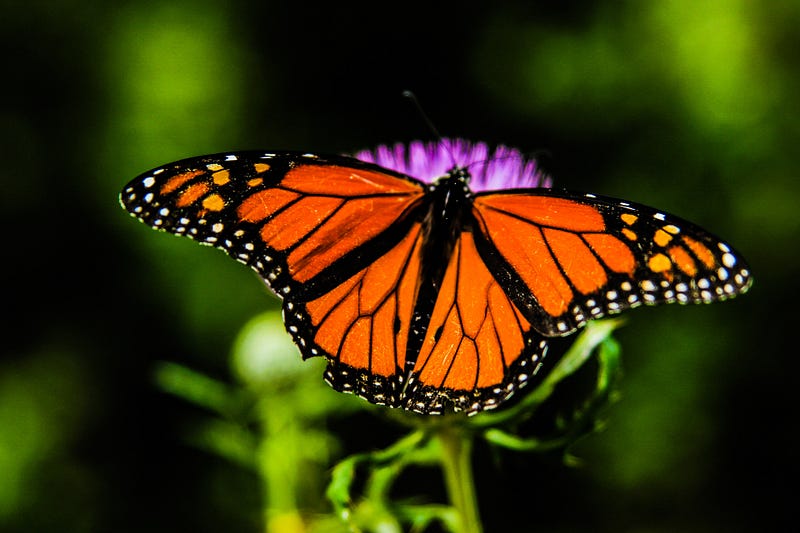
There, on the mat, at the entrance to our house, was a single butterfly.
A single, serene, radiantly beautiful butterfly.
It slowly, calmly opened and closed its wings, as if waving to me.
I do not have the words to describe the impact of that moment. I can only say that the presence of that butterfly, the image of it, the reality of it, was like a sledgehammer blow of meaningfulness, presence, and sacredness.
I cried out something unintelligible. Mom came to the door and, without a word passing between us, she saw what I saw, and felt what I felt.
And then, at that precise moment, the butterfly rose from the ground. It fluttered and danced, lightly and joyfully before us. It lingered there for a precious, long while, and then it slowly fluttered away. Into the trees.
I do not know exactly what my father experienced during and after his passing. Philosophers, academics, and spiritual leaders have debated the mechanics of Life and Death (to little or no practical effect) since the dawn of time.
What I do know, I know deep, in the marrow of my bones.
I know it not from the wisdom teachings of Jesus or Buddha but from the precious, profound, fairy tale Truth of a single butterfly’s wings.
I know that, at long last, my father is finally at peace.
I know that he is flying. Joyful, light and free.
P.S. I know it goes without saying, but I will say it anyway. This is not a work of fiction. Every word of this story is true.