
My Fast-Food Philosophy of Life
A simple approach to successfully navigating life’s little challenges.
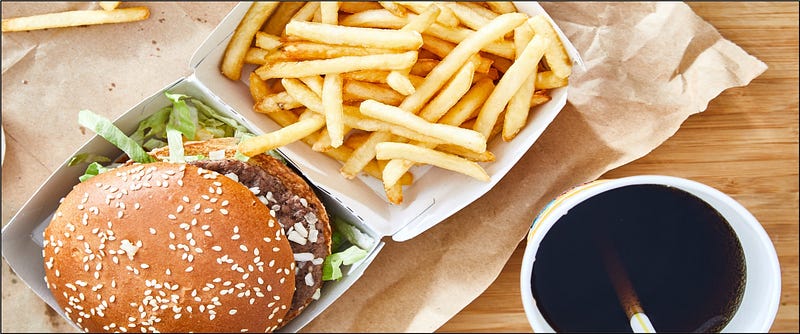
Several years ago, I began formulating what I have come to call my “fast-food philosophy” of life. Allow me to explain. First, I suppose it is essential for me to establish exactly what I mean by the term “philosophy of life.” For the purposes of this discussion, the term “philosophy of life” refers specifically to the beliefs, assumptions, thoughts, and practices individuals employ in an effort to get through life and its never-ending assortment of challenges. In other words, one’s philosophy of life helps to guide (or at least influence) their thoughts and actions. For some individuals, their philosophy of life is thoughtfully contemplated, consciously articulated, and possibly even written down to formalize its concepts and precepts. For other individuals, their philosophy of life is not formally defined but is more of a set of subconscious guidelines that help them to go through life without exploding, losing their minds, or ending up in prison. In most cases, the latter situation holds true, with very few people stopping to think through questions such as the following: — How do I know when enough is enough? — How much am I willing to take before getting angry? — What is my limit before I yell, complain, or protest? — How far am I willing to go to protect my family? Now, back to explaining my fast-food philosophy of life. If I happen to be going through a fast-food drive-through in an attempt to acquire nourishment (an inherently futile effort in and of itself at such an establishment), I automatically assume that something about the meal I receive from the establishment will not be correct. Either the fries will be cold, the soda will be flat, or the restaurant will not fix the sandwich as requested. I know this going in and always anticipate this to be the result of such a culinary establishment transaction. Unfortunately, this proves to be the situation more often than not. As a result of this conscious awareness that the meal will in some way be flawed, when something is indeed wrong with the order, I do not tend to get too upset about it. After all, I fully expected this to be the outcome going in, and I consciously decided to proceed with the food-purchasing transaction regardless of the anticipated outcome. However, if everything about the gastronomic package I receive from the establishment is correct, I will have reason to momentarily be somewhat pleased with at least a small part of the universe and my place or status in that universe. Unfortunately, the feeling rarely lasts much longer than the time required to consume the meal and move on to the next event in life. This fast-food philosophy or approach to life tends to work with virtually every situation I encounter. For example, if a mechanic tells me my car will be ready in two hours, I automatically assume it will take at least four hours. If someone sends me a written item of some sort to review, I automatically assume that I will find some spelling and grammar errors. If I try to knock out a household repair that usually should only take a couple of hours, I automatically assume that the project will take me all day. One could easily describe me as a textbook pessimist, although I prefer to think of myself as a realist. However, I believe it is much, much more than that. It is a complete lifestyle (which somehow sounds better than describing it as a desperately overblown, self-imposed defense mechanism that helps me get through life). If he were still alive, I would probably be able to send Frederick Herzberg screaming into the night as my approach to life tends to go contrary to that of virtually everyone else on the planet. We commonly encounter numerous little annoyances during any given day, week, or month, and that’s what this discussion is all about. After all, as rational and civilized individuals, how we choose to respond to the little day-to-day annoyances is most certainly an indicator of how well or how poorly we are likely to respond when confronted with critical life events. Our responses to the minor annoying occurrences in life serve as a dress rehearsal for more significant events that potentially await us. My approach to life tends to serve me well and acts as a thermostat by helping me to determine what life events should legitimately warrant a strong or aggressive response on my part and what events are truly insignificant in the bigger scheme of things. So, for example, those cold fries, that flat soda, or the auto repair that takes two or three times longer than promised are generally not worth yelling about, complaining about, worrying about, or losing sleep. Author Richard Carlson captured this sentiment in his 1997 book Don’t Sweat the Small Stuff… and it’s all Small Stuff. Unfortunately, I would not go as far as to say that my approach to life results in any degree of happiness on my part. I am not the type of person that anyone would even begin to describe with adjectives along the lines of “happy,” “perky,” or “bubbly.” I can honestly say that the only thing bubbly about me is probably my digestive tract, particularly following the consumption of one of those aforementioned fast-food drive-through meals. I gave up on ever hoping to achieve happiness years ago. Instead, I find it easier to navigate the ups and downs of existence by striving to avoid the downs and let the ups take care of themselves. In the long run, I find that the stabilizing effect of this perspective tends to serve me well.
Copyright © J.K.Hammond, 2023 - — — — — — — — — — — — — — — — — — — -
Thank you for reading! Please respond to this article if you care to add to the discussion. Insightful thoughts and opinions are always welcome. Here is another article that you might enjoy:
J.K.Hammond is a disabled wartime veteran, a grandfather, a professional mentor, and an advocate for autistic individuals. You may reach out directly to the author at [email protected]


