
avatarAlex Garrett

Free AI web copilot to create summaries, insights and extended knowledge, download it at here

4991

Abstract

</figcaption></figure><p id="79fd">I paid special attention to the Adairs when I researched my ancestors, because their name lives on in my family.</p><p id="ae66">“Adair” is my mother’s maiden name and my younger sister’s first name.</p><p id="3671"><a href="https://books.google.com/books?id=tFYxAAAAMAAJ&amp;pg=PA181&amp;lpg=PA181&amp;dq=thomas+benjamin+adair+south+carolina+%22margaret%22+and+%22joseph%22&amp;source=bl&amp;ots=1iFy0NIfCH&amp;sig=ACfU3U3kMg8EmyrjN6GQVMi9CfpuRsVa8w&amp;hl=en&amp;sa=X&amp;ved=2ahUKEwiziIidhsXqAhVEmuAKHcCYA9EQ6AEwB3oECAoQAQ#v=onepage&amp;q=thomas%20benjamin%20adair%20south%20carolina%20%22margaret%22%20and%20%22joseph%22&amp;f=false">Joseph Adair</a> fought alongside his son, his grandson, and his granddaughter’s husband in the Revolutionary War.</p><p id="294a">At the age of 70, he was one of the oldest combatants on the American side.</p><p id="8508">One of his sons, <a href="https://en.wikipedia.org/wiki/John_Adair">John</a>, would become the 8th Governor of Kentucky, but James — my ancestor — was not destined for greatness.</p><figure id="baca"><img src="https://cdn-images-1.readmedium.com/v2/resize:fit:800/0*uT45kPmVD7oRltMb"><figcaption>Photo by <a href="https://unsplash.com/@joshappel?utm_source=medium&amp;utm_medium=referral">Josh Appel</a> on <a href="https://unsplash.com?utm_source=medium&amp;utm_medium=referral">Unsplash</a></figcaption></figure><p id="1845">A veteran of the so-called French and Indian War, James Adair spent the latter years of his life preoccupied with… “social science,” I guess….</p><p id="9121">He traveled far and wide to study, document, and debate the history of the Natives, culminating in a 1775 book: <a href="https://www.familysearch.org/service/records/storage/das-mem/patron/v2/TH-904-77958-254-23/dist.txt?ctx=ArtCtxPublic"><b><i>The History of American Indians</i></b></a>.</p><p id="59b8">His thesis?</p><p id="f730">That all Native Americans are direct descendants of the “Ten Lost Tribes of Israel.”</p><p id="7b32">I can’t find a copy of the book online. For all I know, it’s not remotely anti-semitic; maybe Jews and Natives alike were even flattered by the supposed connection.</p><p id="9357">But I did find <a href="https://www.wikitree.com/wiki/Adair-356">his will</a>, which disbursed “horses, cows, hogs, sheep, waggon [sic], household and kitchen furniture, corn, fodder, cotton and” — of course — some “negros.”</p><h2 id="e147">The Pickenses of South Carolina</h2><figure id="7779"><img src="https://cdn-images-1.readmedium.com/v2/resize:fit:800/1*6Sn-qE-Xr9MBMBrkLwXkng.jpeg"><figcaption>Governor Israel Pickens of Alabama. His brother’s great-granddaughter — May Belle Pickens — was my great-great-grandmother. (Photo: <a href="https://en.wikipedia.org/wiki/Israel_Pickens#/media/File:Pickensisrael.jpg">WikiMedia Commons</a>.)</figcaption></figure><p id="c5ce">In the early 18th Century, as African slaves came to comprise the majority of the Province of South Carolina, the Pickenses left Pennsylvania for Anderson and the Low Country.</p><p id="749e">After they arrived in South Carolina, they likely established rice and indigo plantations.</p><p id="5ff7">One of my ancestors — William Pickens (1775–1830) — was the brother of Israel Pickens (1780–1827), who served as the 3rd Governor of Alabama.</p><h1 id="be5f">19th CENTURY</h1><h2 id="28ff">The Adairs of Mississippi</h2><figure id="fcf5"><img src="https://cdn-images-1.readmedium.com/v2/resize:fit:800/0*4Cz6-70Smm1GkrYq"><figcaption>Photo by <a href="https://unsplash.com/@jentheodore?utm_source=medium&amp;utm_medium=referral">Jen Theodore</a> on <a href="https://unsplash.com?utm_source=medium&amp;utm_medium=referral">Unsplash</a></figcaption></figure><p id="1466">Remember the Adairs of South Carolina?</p><p id="a6ed">Well, in first few months of the Civil War, an act of God <a href="https://www.wikitree.com/wiki/Adair-1874">led Mr. Bazell Adair to relocate</a> to The Hospitality State:</p><p id="6f5d"><i>Bazell married Elizabeth Canady around 1840. They moved from Laurens Co SC to Graham Mississippi in 1840, along with Bazell’s father Robert.</i></p><p id="be73"><i>Bazell impregnated a girl and then fled town and joined the Confederate Army.</i></p><p id="41ea"><i>Bazell caught smallpox or measles and died in Hopkinsville, Kentucky.</i></p><p id="8c8b"><i>He left town in August and died in October! It was rumored that Elizabeth ended up raising Bazell’s illegitimate child.</i></p><p id="b8da">Yep. Bazell died for the Confederacy, but he never saw a single day of combat.</p><p id="6d8f">I checked, and it looks like I’m not a descendant of Bazell’s illegitimate child. The next forebear I found in the Adair line is one of his older sons: a man named George Washington Adair (<a href="https://wchsutah.org/people/george-washington-adair2.pdf">who tried to become Mormon?</a>).</p><figure id="1cdf"><img src="https://cdn-images-1.readmedium.com/v2/resize:fit:800/1*UGP6dg2blnyT8KDQt3KdTw.png"><fi # Options gcaption>George Washington Adair — possibly my great-great-great-grandfather. (Photo: <a href="https://wchsutah.org/people/george-washington-adair2.pdf">Don Smith</a>.)</figcaption></figure><h2 id="6a36">The Cawthons of Alabama</h2><figure id="7683"><img src="https://cdn-images-1.readmedium.com/v2/resize:fit:800/1*TgxqubI5TUYyfJ0kXBjhFA.jpeg"><figcaption>Stephen and William Cawthon. (Photo: <a href="https://www.ancestry.com/mediaui-viewer/tree/6491791/person/112049900538/media/1ffdabde-a267-4bb1-b3b5-2b91b7309f07?usePUBJs=true">Ancestry</a>.)</figcaption></figure><p id="bef2">The Cawthons are another oddly storied branch I uncovered in my research. Cawthons have lived in Virginia and South Carolina for at least 300 years.</p><p id="2768">Stephen Ashley Cawthon fought alongside Bazell Adair in the Civil War, but he lived another 50 years — <a href="http://www.bakerblockmuseum.org/florala1913-18.htm">long enough to receive</a> a Confederate artifact from his grandson:</p><figure id="2d94"><img src="https://cdn-images-1.readmedium.com/v2/resize:fit:800/1*zAm9G2t5kQgVWe83lg5dCA.jpeg"><figcaption>The <b>Battle Above the Clouds</b>. Also known as the <b>Battle of Lookout Mountain</b>. (Photo: <a href="https://commons.wikimedia.org/wiki/File:Lookout_mountain.jpg">WikiMedia Commons</a>.)</figcaption></figure><p id="80b5"><i>Thursday, January 1, 1914</i></p><p id="765c"><i>…</i></p><p id="190a"><i>Captain S. A. Cawthon was given a hickory walking stick by his grandson, Ernest Manning. The stick contains a view of “<a href="https://en.wikipedia.org/wiki/Battle_of_Lookout_Mountain">The Battle Above the Clouds</a>.”</i></p><p id="50e1"><i>Captain Cawthon[,] a Confederate veteran[,] did not participate in this battle but viewed it from a distance.</i></p><h1 id="13cd">20th CENTURY</h1><h2 id="b1e7">The Mannings of Alabama</h2><p id="8326">My great-great-grandfather, Ernest Manning, was 23 years old when his walking stick gift made the local news. Ernest would’ve known about the 1860s in the same foggy, secondhand way that I know about Watergate, <i>A Clockwork Orange</i>, and the Moon landing. To him, the Civil War was relatively recent history.</p><figure id="99fa"><img src="https://cdn-images-1.readmedium.com/v2/resize:fit:800/1*eQKbCi1WkrrqeTle0uJvqA.jpeg"><figcaption>Ernest “Ernie” Manning. (Photo: <a href="https://www.baseball-reference.com/players/m/mannier01.shtml">Baseball Reference</a>.)</figcaption></figure><p id="6712">“Ernie” later <a href="https://en.wikipedia.org/wiki/Ernie_Manning">became a pitcher</a> for the St. Louis Browns.</p><p id="0a4a">A few months after his 81st birthday, his granddaughter gave birth to my mother.</p><p id="8030">Ernie’s long life makes the second half of American history — a 130-year epoch that stretches from Benjamin Harrison’s presidency to Donald Trump’s — feel like a flash in the pan.</p><figure id="8c7f"><img src="https://cdn-images-1.readmedium.com/v2/resize:fit:800/1*z1V0uz_hHbyyRdRxfh7C3Q.png"><figcaption>Screenshot/Author. From <a href="http://ancestry.com">Ancestry</a>.</figcaption></figure><p id="e70a">He gave a gift to a Civil War veteran, pitched 7 games for the Browns, and held my mother — all with the same hands.</p><p id="99c2">His 82 years almost feel like a portal between me and the Old South — an incontrovertible link to some kind of parallel antebellum universe.</p><p id="4128">I can’t pretend he’s a distant, remote relative; his son’s daughter was my mom’s mom. But it seems impossible that <i>his </i>great-great-grandfathers — the men Ernie remembered as distantly as I remember him — were born in the 1700s.</p><p id="b530">It is not pleasant for me to study these people’s lives, especially when I inevitably uncover evidence that my mother descends directly from them: Southerners complicit not only in chattel slavery, but also in the short-lived Confederate cause, which lives on in statues and other memorabilia.</p><figure id="9517"><img src="https://cdn-images-1.readmedium.com/v2/resize:fit:800/1*Dy4IM9ZjLfcGavjm0JOjiw.jpeg"><figcaption>(Photo taken in June 2020.)</figcaption></figure><p id="a66d">But I feel an obligation to understand how they spent their years and why. I can no more disown them than my posterity will be able to disown me.</p><p id="926f">I am an heir to the nation they helped build — the same state apparatus that will someday police my mixed-race children and grandchildren.</p><p id="1d20">I try to remember how recently my forebears fortified white supremacy in the South — and how soon my offspring will encounter its vestiges.</p><p id="f89d">Now, I hope you’ll ask yourself: <b>How do you want your great-grandchildren to remember you?</b></p><p id="72b4">There are a lot of moving parts at this moment in our history — elections, protests, and other shared experiences that have undetermined outcomes. Remember always that your choices will outlive you.</p><p id="b064"><i>Alex Garrett is a writer from Atlanta.</i></p></article></body>
Photo by Hussain Badshah on Unsplash

HISTORY

My Family’s 400 Years In The South

Slavery, war, and the debts we owe to ancestors as well as descendants

Most of my ancestors who immigrated to America were born in Elizabethan England (1558–1603). Their journeys would lead to pain, rebellion, suffering, death, and also incalculable joy. Remembering their lives is uncomfortable and disturbing, but I think it’s important to audit and understand the best and worst of one’s forebears — especially for white Americans, and especially in the South.

Here’s what I found when I researched my family’s four centuries in America.

17th CENTURY

The Mannings of Maryland
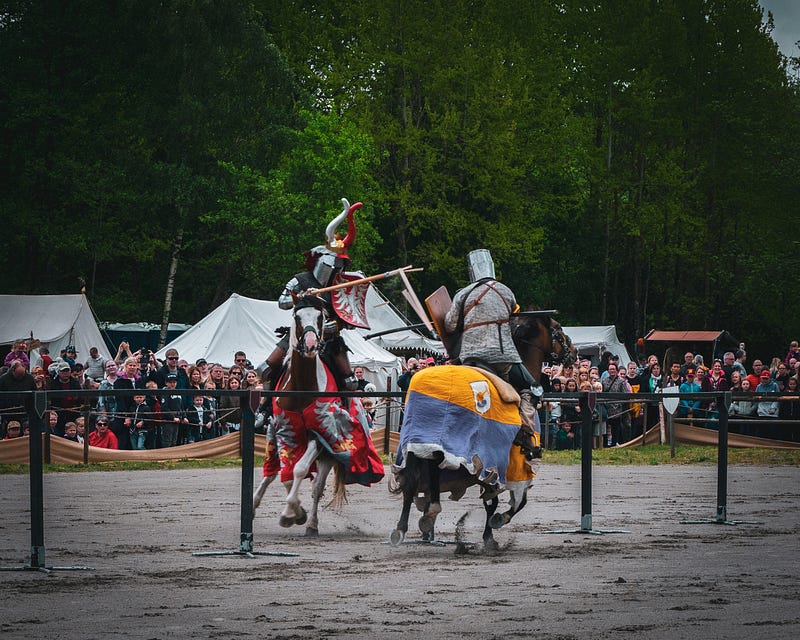
Photo by Casper Johansson on Unsplash

My middle name — “Manning” — came from my maternal grandmother, who was born Martha Geralyn Manning.

I’ve traced her paternal great-grandfather’s English lineage across nearly five and a half centuries — all the way back to the Wars of the Roses.

The Mannings were among the Puritan migrants who poured across the Atlantic Ocean in the early 1600s.

Beginning with Joseph Manning, four generations of Mannings would live and die in Charles County, Maryland — the site of burgeoning plantations so shockingly cruel that some of its survivors would become characters in Uncle Tom’s Cabin.

The Powells of Virginia
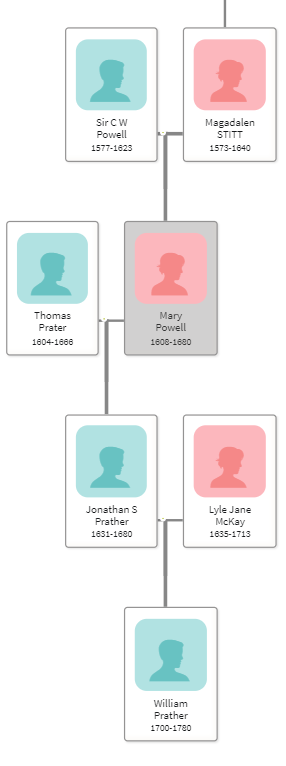
Screenshot/Author. From Ancestry.

Other early arrivals I found include the Powells.

Their immigration to Virginia coincided roughly with the importation of the first African slaves there in 1619.

In fact, William Powell — dubbed “Sir Captain Powell” in most of the records I’ve found — sat in the Virginia House of Burgesses during the 1619 session.

For all I know, he fought zealously for these importations.

With some help from his children, Powell had a hand in establishing Denbigh Plantation just north of the James River.

He was ultimately killed in an attack on Native Americans.

The Moytoys of Tennessee

Photo by Deb Dowd on Unsplash

I had a harder time tracing my indigenous ancestors. Not only are there fewer extant records of Native Americans on the books; but also, a long tradition of legends makes it difficult to sort out the truth.

A WikiTree page summarized the mythos surrounding the Moytoys as follows:

… Amatoya was taught by his father to “witch” for water with a willow stick. He had become so adept at water witching that the Cherokee called him “water conjurer” or Ama Matai…. It was later shortened to “Moytoy.” …

At that time, the Cherokee had no central chief but rather small town chiefs. Amatoya is considered to be the founder of a family of chiefs which ruled for over a century.

18th CENTURY

The Adairs of South Carolina

Photo by Matt Briney on Unsplash

I paid special attention to the Adairs when I researched my ancestors, because their name lives on in my family.

“Adair” is my mother’s maiden name and my younger sister’s first name.

Joseph Adair fought alongside his son, his grandson, and his granddaughter’s husband in the Revolutionary War.

At the age of 70, he was one of the oldest combatants on the American side.

One of his sons, John, would become the 8th Governor of Kentucky, but James — my ancestor — was not destined for greatness.

Photo by Josh Appel on Unsplash

A veteran of the so-called French and Indian War, James Adair spent the latter years of his life preoccupied with… “social science,” I guess….

He traveled far and wide to study, document, and debate the history of the Natives, culminating in a 1775 book: The History of American Indians.

His thesis?

That all Native Americans are direct descendants of the “Ten Lost Tribes of Israel.”

I can’t find a copy of the book online. For all I know, it’s not remotely anti-semitic; maybe Jews and Natives alike were even flattered by the supposed connection.

But I did find his will, which disbursed “horses, cows, hogs, sheep, waggon [sic], household and kitchen furniture, corn, fodder, cotton and” — of course — some “negros.”

The Pickenses of South Carolina
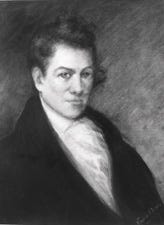
Governor Israel Pickens of Alabama. His brother’s great-granddaughter — May Belle Pickens — was my great-great-grandmother. (Photo: WikiMedia Commons.)

In the early 18th Century, as African slaves came to comprise the majority of the Province of South Carolina, the Pickenses left Pennsylvania for Anderson and the Low Country.

After they arrived in South Carolina, they likely established rice and indigo plantations.

One of my ancestors — William Pickens (1775–1830) — was the brother of Israel Pickens (1780–1827), who served as the 3rd Governor of Alabama.

19th CENTURY

The Adairs of Mississippi
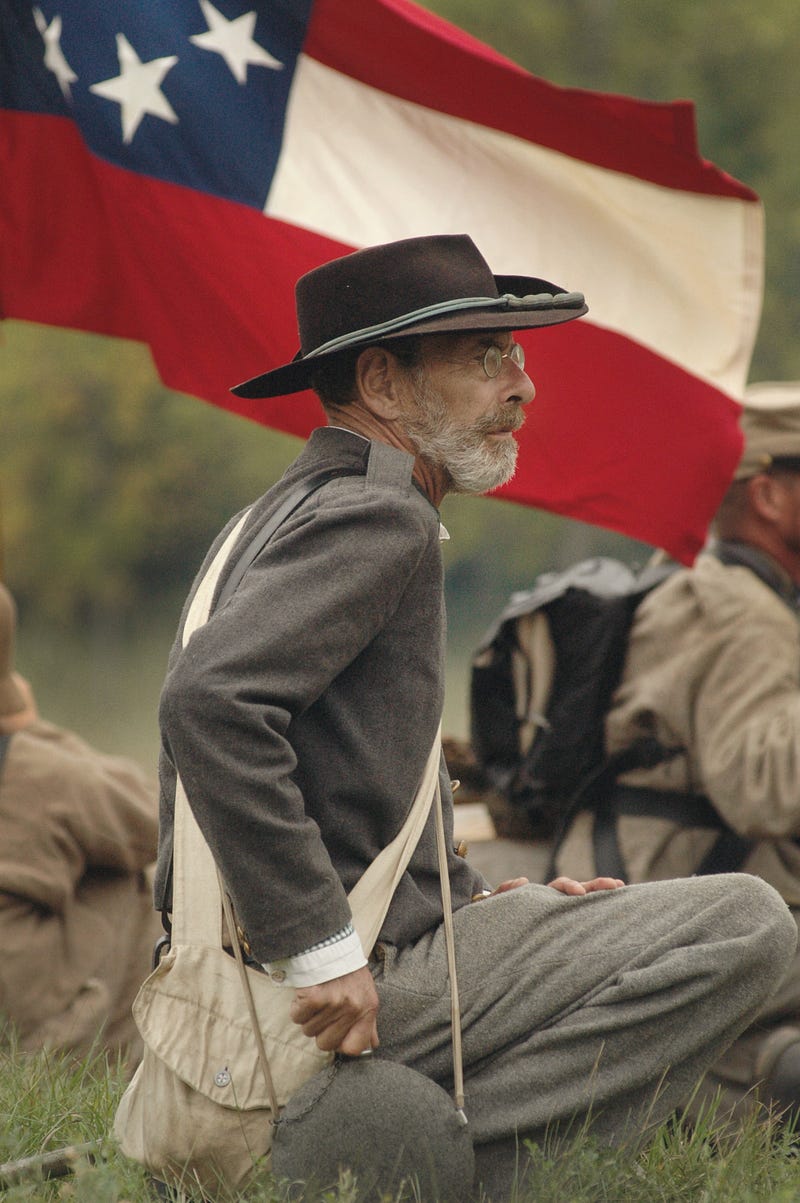
Photo by Jen Theodore on Unsplash

Remember the Adairs of South Carolina?

Well, in first few months of the Civil War, an act of God led Mr. Bazell Adair to relocate to The Hospitality State:

Bazell married Elizabeth Canady around 1840. They moved from Laurens Co SC to Graham Mississippi in 1840, along with Bazell’s father Robert.

Bazell impregnated a girl and then fled town and joined the Confederate Army.

Bazell caught smallpox or measles and died in Hopkinsville, Kentucky.

He left town in August and died in October! It was rumored that Elizabeth ended up raising Bazell’s illegitimate child.

Yep. Bazell died for the Confederacy, but he never saw a single day of combat.

I checked, and it looks like I’m not a descendant of Bazell’s illegitimate child. The next forebear I found in the Adair line is one of his older sons: a man named George Washington Adair (who tried to become Mormon?).
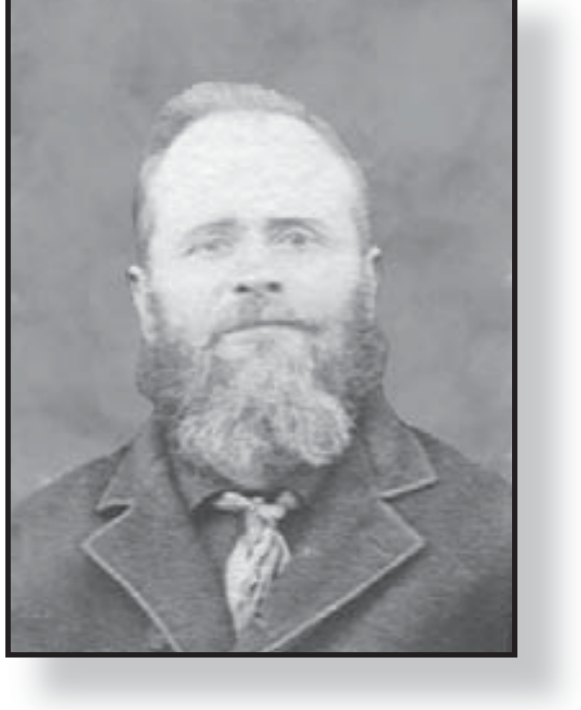
George Washington Adair — possibly my great-great-great-grandfather. (Photo: Don Smith.)

The Cawthons of Alabama

Stephen and William Cawthon. (Photo: Ancestry.)

The Cawthons are another oddly storied branch I uncovered in my research. Cawthons have lived in Virginia and South Carolina for at least 300 years.

Stephen Ashley Cawthon fought alongside Bazell Adair in the Civil War, but he lived another 50 years — long enough to receive a Confederate artifact from his grandson:
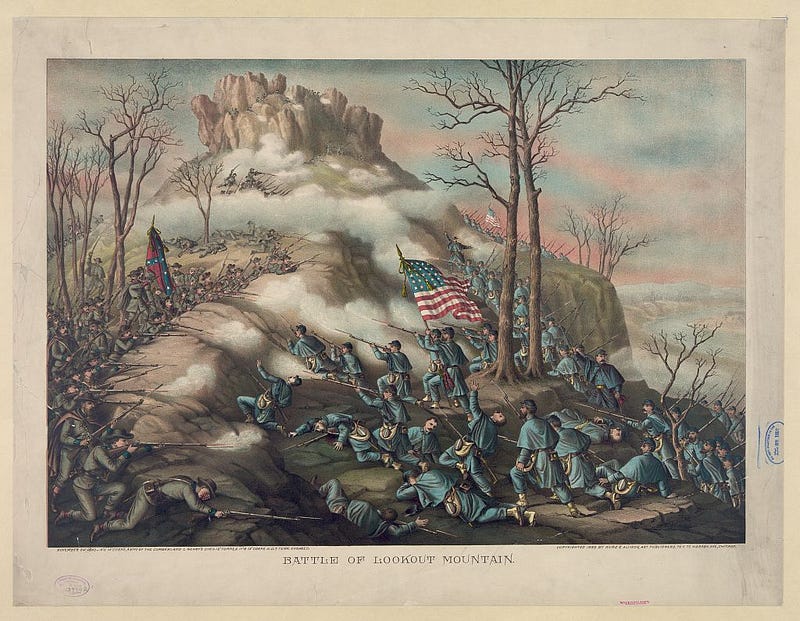
The Battle Above the Clouds. Also known as the Battle of Lookout Mountain. (Photo: WikiMedia Commons.)

Thursday, January 1, 1914

Captain S. A. Cawthon was given a hickory walking stick by his grandson, Ernest Manning. The stick contains a view of “The Battle Above the Clouds.”

Captain Cawthon[,] a Confederate veteran[,] did not participate in this battle but viewed it from a distance.

20th CENTURY

The Mannings of Alabama

My great-great-grandfather, Ernest Manning, was 23 years old when his walking stick gift made the local news. Ernest would’ve known about the 1860s in the same foggy, secondhand way that I know about Watergate, A Clockwork Orange, and the Moon landing. To him, the Civil War was relatively recent history.

Ernest “Ernie” Manning. (Photo: Baseball Reference.)

“Ernie” later became a pitcher for the St. Louis Browns.

A few months after his 81st birthday, his granddaughter gave birth to my mother.

Ernie’s long life makes the second half of American history — a 130-year epoch that stretches from Benjamin Harrison’s presidency to Donald Trump’s — feel like a flash in the pan.
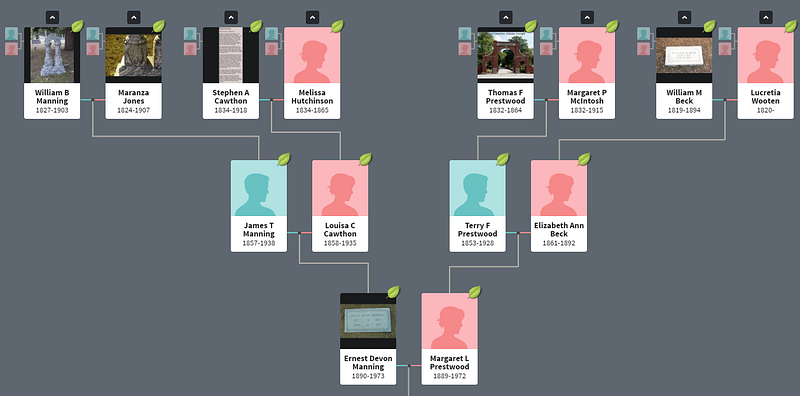
Screenshot/Author. From Ancestry.

He gave a gift to a Civil War veteran, pitched 7 games for the Browns, and held my mother — all with the same hands.

His 82 years almost feel like a portal between me and the Old South — an incontrovertible link to some kind of parallel antebellum universe.

I can’t pretend he’s a distant, remote relative; his son’s daughter was my mom’s mom. But it seems impossible that his great-great-grandfathers — the men Ernie remembered as distantly as I remember him — were born in the 1700s.

It is not pleasant for me to study these people’s lives, especially when I inevitably uncover evidence that my mother descends directly from them: Southerners complicit not only in chattel slavery, but also in the short-lived Confederate cause, which lives on in statues and other memorabilia.

(Photo taken in June 2020.)

But I feel an obligation to understand how they spent their years and why. I can no more disown them than my posterity will be able to disown me.

I am an heir to the nation they helped build — the same state apparatus that will someday police my mixed-race children and grandchildren.

I try to remember how recently my forebears fortified white supremacy in the South — and how soon my offspring will encounter its vestiges.

Now, I hope you’ll ask yourself: How do you want your great-grandchildren to remember you?

There are a lot of moving parts at this moment in our history — elections, protests, and other shared experiences that have undetermined outcomes. Remember always that your choices will outlive you.

Alex Garrett is a writer from Atlanta.

Government
Future
History
Politics
Racism
Recommended from ReadMedium