
WHAT DO C.J. STROUD AND HAMLET HAVE IN COMMON?
My English Class Learned Valuable Life Lessons From C.J. Stroud
After a few clicks led me down a rabbit hole
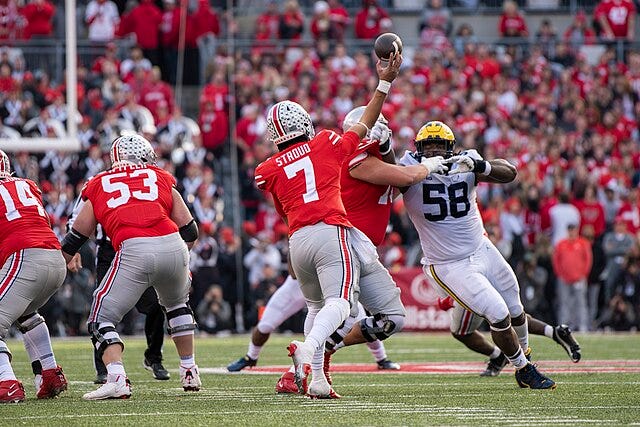
Trying to hold the attention of a classroom full of 36 teenagers for 54 minutes is no easy feat.
Sort of like a quarterback avoiding a blitz.
A wide receiver running a route at midfield.
Or a catcher blocking home plate to a baserunner.
Most of the stories in our textbook, you see, seem as detestable to Gen Z students as a whiff of a jug of milk with a 50-year expiration date.
So what’s a high school English teacher to do?
Follow the curriculum plan or call an audible?
I decided to call an audible for our last unit. It was on freedom of speech for students. That sounds nice, but the texts put me to sleep.
I wanted a more relevant topic. Something like mental health issues that students could relate to or how social media is addictive and a click on the internet led me to … C.J. Stroud.
See, I was watching the Houston Texans rookie quarterback complete 17 of his first 21 passes against the Tennessee Titans last Sunday. I opened a tab on Stroud’s Wikipedia page during a commercial break to learn about him.
A story in the referenced articles caught my eye, “I’ve Been to Hell and Back:” C.J. Stroud’s Roller-Coaster Upbringing Taught Him How to “Scratch and Claw Through Life.” Hmmmm.
I found my next unit for my English classes.
What do an NFL quarterback and a Danish prince in a Shakespeare play have in common?
C.J. Stroud and Hamlet
If you’re a college football fan, you recall Stroud was a Heisman Memorial Trophy finalist for two years in a row as quarterback at Ohio State.
Not bad for his only two years playing college football after redshirting in his first year and being lightly recruited at first in high school.
Stroud was selected as the number two pick in the 2023 NFL draft by the Texans. He has passed for almost 4,000 yards, 21 touchdown passes, and just five interceptions and is the odds on favorite to win Rookie of the Year.
Hamlet, you recall from his “To be or not to be” monologue (if you were awake in English class) where he contemplates killing himself for 33 lines after he “suffers the slings and arrows of outrageous fortune” from his uncle killing his father and marrying his mom to become king.
What could be worse than that situation?
C.J.’s dad stopped showing up when he was 13.
After a divorce from C.J.’s mom, his father developed a substance abuse problem — to the point C.J. didn’t want to even be around him.
It was bad enough to watch his dad’s decline.
But it got worse when he found his dad had been arrested for carjacking, kidnapping, assault, and burglary from a drug-related incident where he tried to escape from the police by jumping into the San Diego Bay.
Sound like a Jason Bourne action movie?
No, it was C.J.’s life as he became a teenager.
His dad’s arrest for carjacking was his fourth. It was his first in more than 20 years. From 1989 to 1992, C.J.’s. dad was convicted of felony drug possession, receiving stolen property, unlawful taking of a vehicle, and armed robbery. He was sentenced to 10 years in prison for the latter.
Then he got his life together, got married, and became the pastor of a church … but his fourth arrest ended up giving him a longer sentence.
C.J.’s dad got 38 years to life in prison for his fourth arrest because of the controversial California three-strike. It required a mandatory minimum sentence of “25 years to life” for offenders arrested on their third strike-crime.
(Sidebar: In 2012 Proposition 36 adjusted the law so that, to be classified as a third strike, the offense must be a “serious or violent felony” to avoid sham cases like Leandro Andrade being sentenced to 50 years to life for stealing $153 worth or video tapes or Curtis Wilkerson being sentenced 25 years to life for stealing … a pair of socks.)
I included this sidebar because it shows the longer sentences that people of color often receive within our criminal justice system.
And how it affects kids like C.J. and his siblings.
Imagine This
Imagine learning that your dad … your best friend who introduced you to football and was on the sidelines for every practice and game … had committed four felonies … and would be locked up until he turned 74 … and no longer be an active part of your everyday life?
Wow. Just wow.
As a pastor, C.J.’s dad often invited him to share a thought at the end of a church service. But after he developed a drug problem, his father became just one bad choice away from being snatched out of his son’s life for 40 years.
My students saw what C.J. Stroud and Hamlet have in common is they both went through trauma. The trauma they experienced at a young age tested their inner fortitude to not get knocked down by their outrageous fortune.
Many students also said they had “dad” issues.
We read Hamlet’s soliloquy first after watching a YouTube video. He expresses the dilemma that we all experience when encountering difficult life events in the opening lines:
“To be, or not to be, that is the question: Whether ’tis nobler in the mind to suffer The slings and arrows of outrageous fortune. Or to take up arms against a sea of troubles And by opposing end them.”
In other words, we can give up and surrender or fight through hard events — fight or flight — and, yes, it’s true, some would say a wise third option is to sometimes just be still and do nothing until some action may be necessary.
After loudly exhorting my students to not be intimidated by Shakespeare’s language, I asked my students to draw or write what the key lines meant on marker boards and they responded with very insightful answers and drawings.
They got inside the thoughts of Hamlet.
The next day, my students reflected on the different ways Hamlet and C.J. dealt with the trauma through quickwrites and discussion.
My best student said Hamlet chose to talk to himself about his troubles. She had written a narrative essay previously about nearly taking her life at age ten. A K-pop band helped her to cope with a trauma event she had experienced.
She said Hamlet had to acknowledge and work through his feelings of wanting to kill himself and, once he did this, he could grieve his dad’s death and sort through all of his overwhelming emotions — and try to get back to his old self.
Most of my students mentioned that Stroud became quiet when his father went to prison, and we talked about how this seems a logical response if a traumatic event is too painful.
It’s what I did for 12 years after my dad died of a heart attack when I was a high school senior.
Life lessons
In the article we read, it said on The Pivot Podcast that C.J. didn’t talk to his father for five years after he went to prison— a measure of how difficult it must’ve been for him to cope with the diverse range of emotions he felt.
C.J. said he has forgiven his dad, and he is a part of his life again— a good life lesson in forgiveness for my students — and they talk regularly.
“When I talk to him now, I don’t hold any ill will … I told him, ‘I love you.’ He made his mistakes. I’ve made mine. It’s not about the bad.”
I’m sure it was a long road to reach that point — with many painful emotions to work through — and my students and I discussed how Stroud had to let go of the anger, resentment, and feelings of betrayal he felt toward his father.
I’m sure some of my students may be going through the same issues as C.J. — who at 23 is someone I imagine they can relate to more than wandering Odysseus — and probably want to read about more than freedom of speech.
We highlighted key examples of how Stroud demonstrated resilience. His mom and siblings nearly being homeless. C.J. playing in a football game with only one contact lens, and his mom noticed him squinting to see his receivers.
Stroud and his family received food from the school cafeteria when they were in dire need. Stroud watched YouTube videos of Drew Brees to hone his skills since his mom couldn’t afford to hire a quarterback coach like the majority of other top Division I quarterback prospects.
Dealing with trauma
C.J. and Hamlet’s stories reminded me of how important it is to talk about the hurts that we experience in our lives and not just suppress them as is often common among teenagers who haven’t learned how to deal with trauma.
We talked about how there is a time to binge-watch a Netflix series to cope with the stresses of life. But unless we learn how to deal with the difficult events in our lives, we’re just one bad choice away from going down the wrong path.
Like C.J.’s dad.
In my sample conclusion that many students parroted in their essays, I said C.J. and Hamlet’s stories show that you can’t heal a wound you pretend doesn’t exist, and part of being human is to experience the good, the bad, and the ugly in life. To be open to experiencing all aspects of the human condition, and not just good ones.
That’s what I learned falling down a rabbit hole on Wikipedia with a couple of clicks.
I hope our unit made my students realize trauma is a universal experience we all go through whether you’re a sixteenth-century fictional prince, an NFL quarterback, or a person who enjoys reading sports online.
Wink, wink. That’s you.
And I hope they remember how Hamlet and Stroud overcame their trauma by channeling their pain into an outlet like football or talking (even if only to themself like Hamlet) to get out the painful events they may have experienced.
Thanks for reading my story.
Sources: Sports Illustrated, Eleven Warriors, and teaching Shakespeare.