
My Embarrassing Reminder to Never Remove Running From My Exercise Routine
There are some things resistance training doesn’t prepare you for

Why do you exercise?
My answer to this question has changed over the past 10 years. It has included preparing for competition, adding muscle, losing fat, improving overall health, and building a relationship with my future wife (she was a big runner).
The competition preparation has changed drastically. Ten years ago I started prepping for the Marine Corps Marathon. Over a 3 year span, I built up my running capacity from 5Ks to 20-mile long runs. After breaking my 4-hour goal, I stopped running regularly and took the opposite approach — I started powerlifting. Prepping for powerlifting meets involved a primary focus on lifting very heavy things.
Now I prepare for slow-pitch softball.
I’m not kidding.
Last year I pulled a hamstring in the third inning of a softball game while chasing down a fly ball (I caught it). I hobbled through the rest of the game but sat out the latter half of the doubleheader. Sitting out due to injury was frustrating. Being the youngest person in the dugout by almost 10 years was borderline demoralizing.
That was when I realized I needed to change my training habits.
Time to run again
That softball game was a wake-up call that strictly lifting heavy will not prepare me physically for all of the activities I enjoy. If I want to play an impromptu game of tag with my kids, I am putting my hamstrings in harm's way.
That’s ridiculous and unacceptable.
It took about 2 weeks to fully rehabilitate from my hamstring strain (perks of being a physical therapist). Once I recovered, I added interval training on my treadmill. I also re-examined my approach to exercise.
I am no longer interested in powerlifting competition. Partly due to the scheduling demands, partly due to the need to focus aggressively on my weight, and partly due to past injuries.
That doesn’t mean I will stop resistance training or lifting heavy things. I enjoy strength training and there are many health benefits to being strong and building muscle. But I want to be aerobically fit and prepared for any physical demands.
Our bodies are remarkably adaptive and resilient. If you push your body to its limits and allow for adequate recovery (sound programming, optimal sleep, and good nutrition), you will enhance your body's performance capabilities. That was my initial goal with implementing interval runs and sprint drills into my programming.
I also considered my overall health and wellness and realized injury prevention was not the only reason I needed to add running into my fitness routine.
A simple path to longevity
If you want to improve your lifespan, one of the best strategies is to improve your physical fitness. We have three primary markers that are strongly associated with all-cause mortality: VO2 max, strength, and muscle mass.
VO2 max has the strongest relationship. While anecdotal, these data are interesting and highlight the strong relationship found in more robust research.
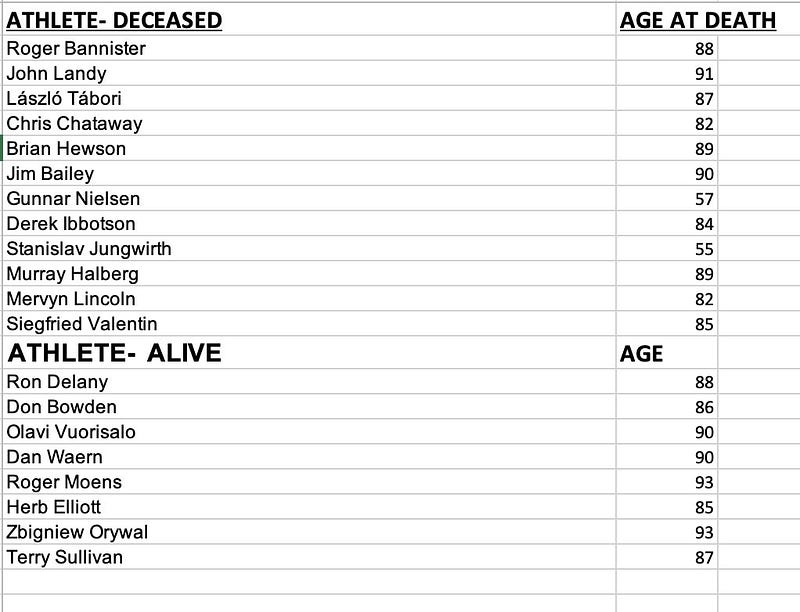
This is a list of the first 20 sub-4-minute milers in history. These numbers far exceed any country's average life expectancy. This data does not mean you can’t live long without running a 4-minute mile or that you are guaranteed to hit 80 if you add 400m repeats to your training program. It just highlights people who focus on aerobic fitness, even if they don’t focus on all the biohacking nonsense you see on social media, can live a long time.
Step out of the ice bath, put down the metformin, testosterone & resveratol & just get more aerobically fit! — Alan Couzens
No amount of biohacking will replace consistent exercise. If you want to get strong and build muscle, you have to resistance train regularly. You should aim for at least two sessions a week, pushing each set to 1–3 reps short of failure and compiling 12–20 sets per muscle group.
Resistance training has cardiovascular benefits as well, but resistance training will never match prolonged endurance training for cardiovascular benefits.
If you want to improve your VO2 max, find the aerobic training (running, cycling, swimming, etc.) that works for you.
Cycling and running are the easiest for me to build into my schedule. I tend to use HIIT training due to scheduling challenges, however, I will try to find time once a week to build in prolonged zone 2 training. HIIT often pushes you to zone 5 and takes longer to recover from. Zone 2 training carries many health benefits, can enhance VO2 max, and is easier to recover from.
Polarized training — spending most of your aerobic training in low-intensity zones (1 and 2) — is a popular training method used by most elite athletes. It is an effective approach for building a strong aerobic foundation.
There are a few strategies for determining your zone 2 range. The most accurate is to use a lactate meter. I go by subjective feel, which isn’t the most accurate but can provide a rough estimate.
Iñigo San Millán, an exercise physiologist who works with elite cyclists, describes zone 2 training as the level when you can hold a conversation and it feels a little strained. I typically use a stationary bike for zone 2 training.
I currently don’t have specific running or cycling goals. I’m not preparing for a race so I am not worried about optimizing my programming. I’m simply aiming to improve my overall health and resilience.
I want to participate in the activities I love and not be worried about getting hurt. I want to be physically fit and healthy for as long as I can. I want to play hard with my kids and future grandkids.
That’s why I started running again.
For more health and fitness content, check out the Clinical Gap Podcast. I release episodes weekly. For short health and fitness research summaries, subscribe here.