
My Earnings Keep Going up, and It Surprises Me Every Time
I love earning money, but I do it for love.

Being a writer is a difficult path to pursue. You’re putting your ideas and personality out there for people to like, or not like. Oh…and the judging. Let’s not forget about that. It takes guts. You gotta have heart to be a writer.
Yet, so many people want to write, even for pennies per story.
This is confirmed by the number of writers joining Medium searching for the writer’s life and some extra cash.
Even Obama is in on the action.
I don’t look at my earnings at all during the month. I find out what I earned from stories published when the email from Medium lands in my email box dedicated specifically to Medium — an email account I rarely check.
(To my readers, I will be getting to your comments soon, my apologies for the delay).
So I was shocked this past Wednesday when I saw the following stripe payment — my highest amount yet since publishing on Medium just a little over a year ago.
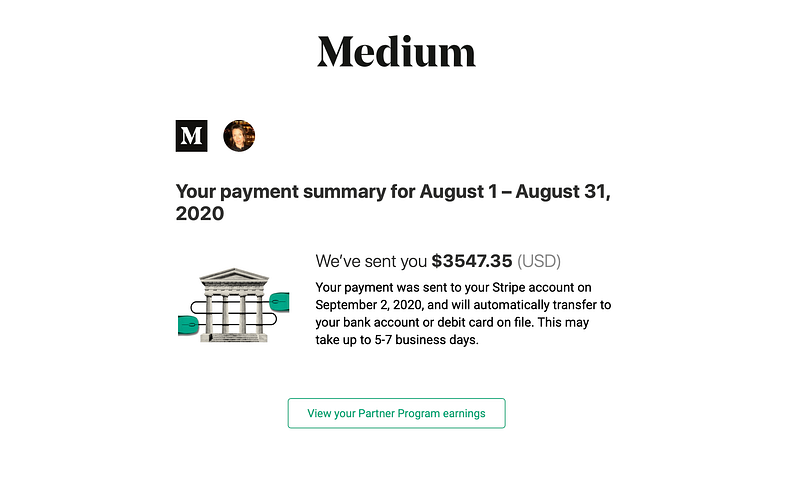
Now, it isn’t the 20k that some writers make per month, but I’m getting there — and I will. My earnings are going in the right direction every month — UP!

I’m thrilled.
The money motivates me.
But, if you averaged out how much time I spend writing, editing, curating against how much I earned, I’m probably barely making minimum wage.
That’s OK. I love to write.
I’m also practical when it comes to money. We all need it to eat and put a roof over our heads.
A few years ago, when I read Medium was paying writers, I jumped on the platform in mid-2019 and started publishing. I’m spending less time on sites like Twitter and Facebook because they don’t pay for my words; they use me for my content — I’m a product to them, and I don’t like being someone’s product unless I share in the profits. Facebook isn’t good for my health either; I can feel my blood pressure rise as soon as I log on.
Same for Twitter. I share my work on both of those platforms — so they help me earn a buck or two.
Medium is now the social media platform, where I spend most of my time.
Psychology of writing
Why I don’t obsess over stats.
You may be different, but I can’t think about writing for money, or I wouldn’t write. I don’t know what this glitch in my psyche is about, but I have difficulty writing when I think I need to earn.

If I obsessed over my stats and tried to reproduce a story that went viral, like the one I wrote that has made over 4k and counting, it would take all the joy — and whatever it is I need to call on every morning to write — away.
If I obsessed over stats, it would kill the curiosity I need to produce the volume of daily content that I can produce.
I’ve tried to obsess over my stats like some of the more successful writers on Medium, and I’m incapable of doing it. It may take me longer to get to a full-time income but I’m OK with that.
Maybe a year from now, I will have a better understanding of my writer-self. But for now, this is all I’ve got.
I write for the challenge of writing.
Writing is hard. Rewriting is even harder (for me), and I love it. Clear writing is the result of a lot of tinkering. I guess I love to tinker. But I don’t like looking at stats. I don’t want to churn out the same content in different ways — although I sometimes do. I want to write about all kinds of subjects that interest me.
If I didn’t love it, I would not do it.
There’s not enough money in it to make it worthwhile if I didn’t have the love for it that I have. So, you have to love it, or you won’t get past the part when you’re barely making anything, and that part, can last for a while.
Even if you publish a novel backed by a publisher, there’s no guarantee of financial glory. I have many friends who have written published books under a known publishing house; they’ve spent more time and energy marketing their books than writing them with little financial reward.
You’ve gotta love to write.
The strategy that got me this far
- In June 2019, I started a 30-day challenge of writing and publishing once a day. I didn’t miss a day of publishing for 30 days.
- I turned it into a 60-day challenge. By 60 days, I was making at least $600 per month.
- I had one advantage. I’ve been reading Medium for years before I became a writer. I know the content here, and I try to emulate what does well. Read writers in your niche and write similar stories. But don’t obsess; you are you, and your journey will be different. Bring your view and personality to your stories, and you’ll be different from anyone else.
- Took an online writing class that gave me ideas on what content to write about and made me more confident as a writer.
- Started two publications.
- When larger publications came to me and asked me to write for their publications, I realized you can submit to larger publications (I didn’t know this for a month or so). Ignorance was bliss in this case. I had more confidence in my writing when a few of the larger pubs asked for my writing.
- Started contributing to The Startup, P.S.I Love You, OneZero, The Ascent, Mind Cafe and Publishous.
- While I wrote for larger publications, I added to my own.
- I sent out a newsletter to my publication followers every time I add to my publications.
- After three months of publishing at least once per day, sometimes two (rarely did I post twice a day), I went down to publishing only Monday — Friday. I started concentrating more on quality, and I could do that more effectively by taking Saturday and Sundays off.
- I paid an editor for a few stories, but I mostly edit my own work. If I could find an editor to keep up with my content, I would hire them. I’m a better writer when I work with the right editor. It gives me another perspective.
- The most important thing to making it on Medium is consistency. You need to publish quality articles at least three to five times per week. Quantity leads to quality.
- I established a habit by writing during the same hours every day, usually, in the morning.
- I edit later. There needs to be some space between writing and editing because when you edit, you use a different part of your brain.
- Reading your story aloud will make the greatest impact in editing your work. It is easier to fix flow and continuity and any areas that drag when you read aloud. Your ear can hear the clunky parts that just don’t work more easily than when reading in your head. It is amazing how true this is. All good writers do this.
- When a publication passes on a piece of mine, I rework it and publish it to my own publication. If it didn’t work for the editor of a publication, it just isn’t good and most likely won’t work for the audience. Take the information and use it to your advantage. It just needs another rewrite. Do that. My stories that were rejected from publications do well in my publications.
- Keep writing. You will succeed if you keep at it. You will not succeed if you quit.
I started researching what compels writers to write when such little financial gain is made, and I found a few ideas from famous writers that struck me. Erica Jong, author of Fear of Flying — one of the first books I credit with turning me into a reader, offered this in 1997, “The truth is we write for love. Do it for love, and you cannot be stopped.”
According to psychologytoday.com,
At its most basic level, some have argued, writing is about someone sharing something with someone else, making connection a key component of the pursuit. Through their work, writers have the potential of having a bond with far more people than they can in real life.
It is about connection.
Researcher and author Brené Brown frequently says that humans have a biological need for connection — we are hardwired for it. If that is true, that would compel people to write, even though the financial rewards are often sparse.
Connection makes it worth the pursuit.
Medium takes work. But if you are willing to put in the writing time, you can find success here.
If I can, you most certainly can.
Write on.
Jessica is a writer, an online entrepreneur, and a recovering type-A personality. She lives in Los Angeles with her extrovert daughter, two dogs, and two cats.


