My Dislike Of My Current Job Led Me To Use Job Search Funnel To Change My Situation
Job search is a crazy process. But, there’s a method to this madness.

I needed to get out.
I took a job with information that turned out to be misleading. The job offered me a higher salary but never paid me on time. The environment was toxic.
But the job market is never easy. I never felt I was any good at job searching. I needed to devour the beast.
Before I started, I scheduled a call with one of my professors and shared my career situation. He gave me very strong advice, The 25% Rule.
What is the 25% Rule?
Years ago, he was in the same situation as I. He didn’t like his work and ultimately that impacted his life. To ensure that he was not giving too much weightage to the negative portions of a job, he used the 25% rule.
In any job, it is likely that there will be elements an employee would dislike. But that dislike should not go over 25% of the whole job. We should take mental notes about this. We can also look at it from a micro point of view. It is ok if we have 1–1.5 tough days at work and 3.5–4 days that we enjoy.
I wanted to go macro so that I don’t miss any of my top priorities.
What exactly do I want from my job/career?
I opened a document and started listing.
In the past, I had given more priority to one or two parameters while job-searching. This led me to favor jobs that were ahead of those criteria. This time I wanted to cover the big picture.
I started by thinking about the times when I truly enjoyed it. I wrote down about good times and what exactly I enjoyed. After a couple of days, I had a list of things that made me excited about a job.
Then I create a story with that list. I wrote down what an ideal week at work will look like.
That was my starting point. I knew what I was searching for.
Shortlisting companies based on the list & 25% rule
Let’s assume I looked for 10 things from a job including 4 non-negotiables.
If a company could offer me 7–8 things including 3 non-negotiables, that would be a good starting point. Ideally, I would like to have all non-negotiables covered but I was willing to let go of even one of them.
How would I cover for the missing non-negotiable? I’d have to find other avenues. For example, if I seek creativity, I would start a creative outlet where I can nurture my creativity, like writing for Medium or making videos on YouTube.
I knew what I wanted. How would I get it? Using the Job Search Funnel
One step at a time.
The job search can be a mammoth project. Firstly, I needed to notify recruiters/hiring managers that I was open to switching. Then, I would find roles that suit my need. Sometimes, the order of these two steps changed. Then I would submit a resume (and cover letter if needed), track interviews (3 interviews on average/role), negotiate the first offer, and accept the offer. So, I had outlined 8 steps.
In short, I created the following funnel to help me in my progress. Let’s call it the Job search funnel
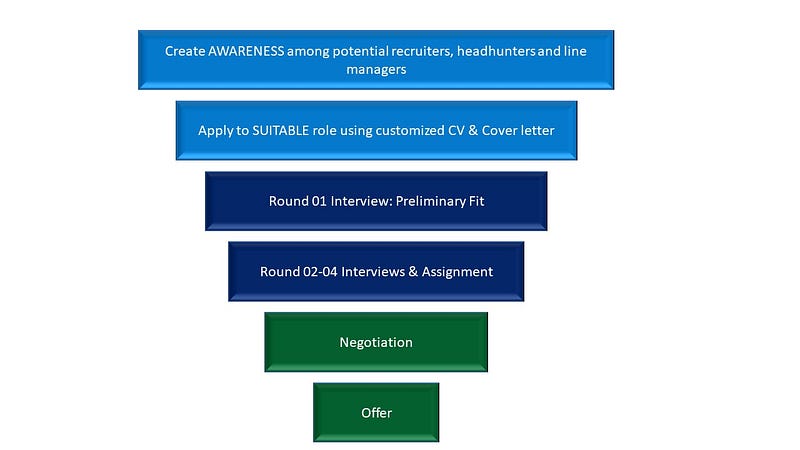
Step 01: Letting people know that you are looking
I started by calling ex-colleagues to check if they know of any openings. They also provided me numbers of headhunters. I called them up and share my background & CV.
Additionally, I became active on Linkedin. I didn’t write about job search but I started writing & engaging more. I also kept Linkedin’s “Open to Work” option on.
Step 02: Find the role
The Headhunters would get back with roles from time to time. As I knew what I wanted, I could reject some of them. But I didn’t do that as I wanted to keep good relation with the headhunters and also wanted to practice the whole interview process.
I would also keep checking Linkedin and a local job portal. Very few companies post authentic job postings on Linkedin but it was also a good way to find a hiring manager.
Interestingly, after I became more active on Linkedin, some connections from my network reached out. Some of them also wanted to talk about an opening.
I continued this process throughout the journey. It took me over 4 months to finally select an offer. During these months, I pursued 16 job leads that came from these sources.
Step 03: Acing the Interviews
Usually, the first round of interviews was with HR or Hiring Manager or Potential Line Manager or Headhunters. For startups, it would be with founders as I looking for top-level positions there.
They wanted to either check if I would be a good fit for the organization or department. The Line Managers would be more willing to find out if I had what it takes for the role.
So, I needed to be very clear about what I can bring to the job and organization. My story needed to fit the organization’s culture.
Roughly 60% of the leads I opened led to Round 1 interviews.
Step 04: Subsequent interview rounds & assignments
Once the organizations felt I might be a good fit, they invited me to further rounds of interviews. Some companies asked me to submit assignments based on a case they provided.
I carefully prepared answers about myself, the role, why the company, etc. The assignments took some time. I made sure to dedicated extra time to get them right.
As I was following the Job Search Funnel, my objective was to move to the next level. Even though landing a suitable job was the ultimate goal, I was not thinking too far ahead. This approach ensured that I took every interview, assignment, team socialization, office visit, etc. seriously.
I managed to convert half of round 01 interviews into final interview & negotiation.
Step 05: Negotiation
In my experience, I have seen that employers usually like my work. But sometimes I may not be able to communicate my strengths over the recruitment process. So, in case my asking salary was more than what the employer would be able to pay, I also offered a short-term consultancy option.
Regarding negotiation, it is important to know what I want from it. I started the entire process by doing that so I knew what I wanted in terms of salary, benefits, etc.
It’s also good to understand what the employer might want and you can use that as a negotiation chip. For example, if they want you to join early, you may want to negotiate a signing bonus or compensation for the lost salary & benefits in your existing company.
Step 06: Final Offer
At the end of the process, I was grateful to have few offers (25% conversion rate) including 2 great ones. I had to do multiple rounds of negotiation with them as none of them were willing to let me go.
Ultimately, it came down to the non-negotiables and which company was giving me more.
And with that, I concluded my job search
Throughout the process, I made sure I did my best but in job search, not all is up to you. I kept faith in God and kept trying. That was my biggest learning.
Keep faith and keep trying. Doors will open up.
Read how I got into INSEAD MBA.