
My Dentist Voted for Trump — Twice. I Needed to Find Out Why.
QAnon conspiracy theories are just a symptom of what is driving Trump’s base. It’s much more basic than that.
We’ve been seeing each other for 25 years. And while our relationship is limited to him poking around my mouth with blunt instruments, my dentist and I have a lot in common.
We’re both well-educated.
We both have well-paying careers.
And we both have friends in the community.
Neither of us is a disaffected outcast who has lost a job or been marginalized socially or economically.
Yet on a recent visit, just days after the Capitol Hill insurgency, he revealed that he had voted for Donald Trump not only once, but twice. He added, “You have to be careful where you get your news from.”
I was stunned.
How could a seemingly rational, well-educated man — a man of science — support a racist kleptocrat who actively encouraged the spread of a deadly pandemic?
Had he been radicalized by Trump’s lies?
I didn’t expect miracles
I knew it wasn’t all going to change on January 20. I knew it would take time to restore faith in government. And I knew the xenophobia was a key part of the Trump narrative — one of the few parts that was true to who Trump really is.
Remember, he came to power questioning President Obama’s citizenship, and he only ran on one policy in 2016: building the wall. In 2020, he had no platform at all.
He’s always been a racist and an anti-Semite. And he’s always spoken to his base in those terms.
What I didn’t understand was how far into society Trump’s white nationalist tentacles reached. I still held onto the belief that the people who supported him were people who were voting their pocketbooks.
Certainly, this could explain his popularity in 2016 . Yet it could not excuse voting for a corrupt, incompetent white nationalist in 2020.
It never occurred to me that someone could support Trump, while still enjoying all the spoils of a high status position and zero threat to his economic security.
Still, the numbers don’t lie.
A whopping 74 million Americans voted for Trump in the 2020 election. That’s 11 million more than voted for him in 2016.
And according to Pew Research, 76% of them still believe he won the election.
Even worse, his messages of hate had real consequences. After Trump was elected in 2016, the number of hate incidents jumped 88% the following year, according to the Anti-Defamation League. And that number has continued to grow every year since.
Why good people would support a bad wannabe dictator
When you talk to experts about how the Trump phenomenon came about, they cite various forces converging in a perfect storm, from latent racism and white entitlement to changing demographics and a raging pandemic.
Social media, of course, magnified the problem, making it easy not only for white nationalists to connect with each other, but for their voices to be amplified, too.
Yet beyond these social and political factors, there’s something else that enabled Trump to take hold of the Republican psyche. And it explains why facts don’t work when trying to reason with Trump supporters. It has to do with the way humans construct beliefs and make decisions.
When you talk to experts about how the Trump phenomenon came about, they cite various forces converging in a perfect storm, from latent racism and white entitlement to changing demographics and a raging pandemic.
Why smart people fell for Trump’s lies — twice
It turns out the human mind is not designed to prioritize rationality. Rather, it’s designed for self-preservation.
Dr. Joanne Miller is an Associate Professor of Political Science and teaches courses on propaganda, misinformation and conspiracy theories at the University of Delaware.
“We like to think highly-educated people who are stable in society would be more likely to use their logical, critical thinking skills to discern fact from non-fact,” she says. “But when we’re motivated to believe something or protect a belief we already have, we all too easily can throw out our critical thinking skills in the service of that motivation.”
The psychological term for this is motivated reasoning. It leads humans to process information in a way that confirms pre-existing beliefs.
“If you voted for Trump in 2016, and you’ve spent the last four years talking about how great Trump is, you may be motivated to believe that he lost the 2020 election because the other side ‘cheated,’ rather than because he wasn’t a good president,” she says.
Social media further keeps people entrenched in their beliefs.
“People who supported him on social media may have lost friends and family because of that,” Miller says. That makes it harder for them to come back and say, ‘maybe I was wrong.’ So rather than do that, they dig deeper into social media communities of like-minded people.”
The psychological term for this is motivated reasoning. It leads humans to process information in a way that confirms pre-existing beliefs.
Being forced to stay home because of the pandemic only enhances our feelings of uncertainty, isolation and anxiety. That’s another factor causing people to seek refuge on social media.
When they find that online community, it’s powerful because it meets so many basic human needs:
- The need for connection.
- The need to feel significant.
- The need for control over complex situations.
- The need to make sense of an uncertain world.
These are some key reasons why scapegoating and conspiracy theories are so attractive to people now.
What Trump supporters fear most
But there’s something else — something so basic, it seems impossible that it could be the core motivator for supporting Trump. Yet it’s the real root of why he came to power and why so many continue to support him, despite clear evidence he has none of their interests at heart.
In short, they fear change.
Consider this: Trump was able to ride the white nationalist sentiment to the presidency and give life to it in overt, mainstream ways, where others like Pat Buchanan, failed to do so in the past.
Why?
It’s simple: progress. Trump supporters are terrified of it.
According to Dr. Joseph Vitriol, a social and political psychologist who teaches at Stony Brook University and Harvard, “Among the more robust predictors of support for Trump is a resistance to social change.”
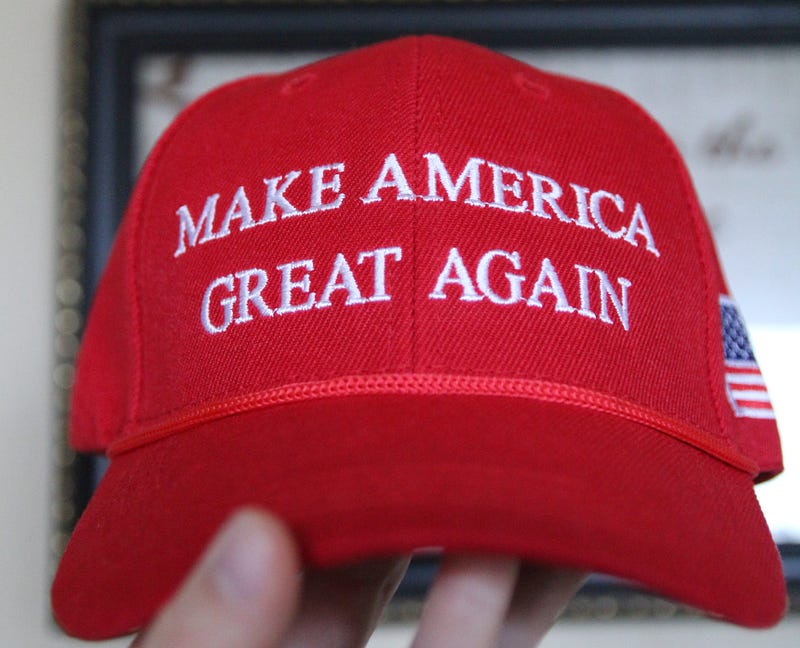
“MAGA stands for Make America Great Again, not Make America Great Anew,” Vitriol says. “He’s affirming the belief among his constituents that their America has been taken from them illegitimately by liberals, social justice warriors, Black people who are ungrateful, immigrants who are undeserving and Muslims who are a threat to their safety. They are referring to a time when minorities knew their place.”
This sentiment resonates with Trump supporters, because we’ve seen incredible social change in the last few years — progress that wasn’t possible just four years ago.
Consider the changes we’ve witnessed in just the last year:
- Somewhere between 15 and 26 million people participated in Black Lives Matter protests, making it the largest protest movement in U.S. history.
- Over 28 million people posted black squares on their Instagrams last summer.
- Support for same-sex marriage has grown dramatically across nearly all demographics, including evangelical Christians (29% approved in 2019, up from 11% in 2004).
- President Biden became the first president to call out white supremacy in his inauguration speech acknowledging “a rise of political extremism, white supremacy [and] domestic terrorism that we must confront, and we will defeat.”
- Police departments from Miami to Texas have banned chokeholds and taken other steps to reform, including eliminating no-knock warrants, requiring police to wear body cameras and ending qualified immunity for police officers.
- Confederate statues have been removed.
- Spotify, Nike, Twitter, Adobe, J.C. Penney, Postmates, Lyft, and the NFL now treat Juneteenth as an official paid holiday.
- Aunt Jemima and Uncle Ben were retired.
- Pete Buttigieg became the first openly gay Cabinet member, and Fox News ignored his sexual orientation in reporting the event, discussing only his credentials for the job and his plans for the Transportation Department.
- The Bachelor finally chose a Black man to be its lead.
- NFL Commissioner Roger Goodell admitted he should have listened to Colin Kaepernick and that the league was wrong in trying to stop players from peacefully protesting.
Those are all signs progress is being made.
Yes, it’s long overdue. Of course, it’s not enough. Sure, some of it is performative.
Now think about that for a second. If you’re being performative about racial progress, it means you feel that in order to fit into society, you have to publicly commit to rejecting racism and hate.
That’s a huge shift. And it’s scaring the daylights out of Trump supporters.
Now think about that for a second. If you’re being performative about racial progress, it means you feel that in order to fit into society, you have to publicly commit to rejecting racism and hate.
The good news is there are far more Americans who want progress than those who seek to thwart it.
Consider the facts:
- President Biden won the 2020 election with a record 81 million votes.
- It was not a close election. Biden had the second greatest margin of victory of any U.S. president in history (President Obama had the greatest margin of victory).
- The 2020 election saw the largest voter turnout in U.S. history.
- Though it may seem like a huge number of Republicans supported the insurrection, that isn’t the case. A CBS News/YouGov poll found that 87% of Americans disapprove of what happened on January 6, the majority of those strongly disapproving.
- Trump had the lowest job approval rating in his presidency — 29% — in the week after the insurrection. And the number of voters who rated his conduct since the election as “fair or poor” was a whopping 76%.
- In that same poll, 68% of Americans said Trump should not remain a major national political figure for years to come, and 64% expressed a positive opinion of Joe Biden’s conduct since winning the election.
- While it may seem like the nutty QAnon conspiracy theories have taken over the Republican party, that isn’t the case either. A February 2021 Civiqs poll of 18,000 registered voters found that just 5% of voters supported the constellation of wild conspiracy theories known as QAnon.
So while a majority of Republicans still incorrectly believe Trump won the 2020 election, the majority of Americans do not.
The majority of Americans do not support the violent insurrection/coup attempt.
The majority do not want Trump to be president now or in the future.
And the vast majority do not believe the crazy QAnon conspiracy theories.
They are scared
The fact is Trump’s base is acting out of fear. They don’t want to be left out, marginalized in their own country. They desperately fear change. And they resent having to give up their privilege.
This could lead to more extremism, as so many experts warn. But it doesn’t have to.
Here’s what we can do to prevent more radicalization and more violence:
1. Hold Trump and those who committed crimes at his behest accountable for their actions.
This is not a political issue. This is a matter of law.
2. Establish truth commissions to identify human rights violations and create a culture of accountability.
We can learn from what Germany did after World War II. Dr. Lily Gardner Feldman is a senior fellow at the American Institute for Contemporary German Studies at Johns Hopkins University. She suggests we need accountability on both an individual level and an institutional level.
“You must have an institutional framework, so that the effort is seen to be serious and lasts awhile and is deep and inclusive,” she notes. “That can happen through truth commissions at the national level and the regional level.”
Senator Cory Booker called for the formation of a Commission on Truth, Racial Healing and Transformation even before the Capitol Hill insurrection.
Gardner Feldman says there should also be a truth commission for the events of January 6. “And it shouldn’t just focus on what happened on January 6,” she says, “but what led to it.”
On a regional level, she suggests holding town halls where local leaders can discuss the issues that led to the rise of the alt right in America.
3. Ask public figures and thought leaders who are respected by Trump supporters to speak out against hate and conspiracy theories.
“What leaders say changes what the supporters believe,” says Vitriol.
He points to the willingness of Trump’s followers to forgo masks in the middle of a pandemic as evidence that people listen to their political leaders — even when that advice could kill them.
The reverse is also true. Just days after the Capitol insurrection, Governor Arnold Schwarzenegger, a Republican, released a moving video condemning the insurrection and sharing his experience growing up in Austria just after WW II.
He denounced Trump as “a failed leader” who will “go down in history as the worst president ever.” And he condemned the spinelessness of his fellow Republicans who refused to stand up for democracy and acknowledge President Biden’s win.
Likewise, former Attorney General William Barr accused Trump of “orchestrating a mob to pressure Congress” and called his conduct a “betrayal of his office.”
4. Don’t expect to change everyone. Instead, commit to changing policy that makes everyone’s lives better.
Experts agree that trying to debunk conspiracy theories or use facts to argue with Trump supporters doesn’t work.
“The psychological reasons that got these people to believe these things still exist,” Miller says. “There is no society-wide answer to how to remove uncertainty.”
But we can try to change those beliefs through satisfying the psychological needs that underpin them.
“People want to feel special, unique, important, valuable and esteemed,” Vitriol says. “We can address those needs through better public policies and more responsible political leadership.”
5. Use social proof.
The images of right wing radicals and QAnon followers storming the Capitol has dominated the news. And frankly, that isn’t wrong.
We’ve never witnessed an event like we saw on January 6, and we’ve never had members of Congress support insurrection or spout insane conspiracy theories. These things need to be brought to light.
But the constant coverage has an unwanted effect: People believe the extreme right and their racist ideas represent more of America than they do.
It is also important to remember that the very reason these things are newsworthy is because they are extreme and unusual.
I am not suggesting that racism and discrimination aren’t still widespread — they absolutely are. What I am suggesting is that there are many more people who are striving for a more equitable and just society than those who seek to hold others down in an effort to maintain privilege.
Millions wept when Amanda Gorman spoke at the inauguration. Millions more want to see our country change for the better. In fact, the majority do.
Consider these statistics:
- A whopping 68% of Americans believe strong anti-discrimination policies would benefit their communities economically.
- 72% of Americans believe in raising the minimum wage.
- 63% of Americans believe the government should provide health care coverage for all.
- 64% believe the wealthy should be taxed more.
“The whole marketplace of ideas is predicated on the notion that good ideas will crowd out bad ideas,” Miller notes.
Now, even as we remain aware of the horrors the alt right has unleashed on our society, we can move forward with the knowledge that the forces of good are many. We need only join together to prevail.
Like this story and want more? Sign up for my newsletter now!
You may also like:


