
My Daughter Started at a (U.S.) Pre-school, and Here’s What Shocked Me
Cheerios on napkins and other European parents’ worst nightmares
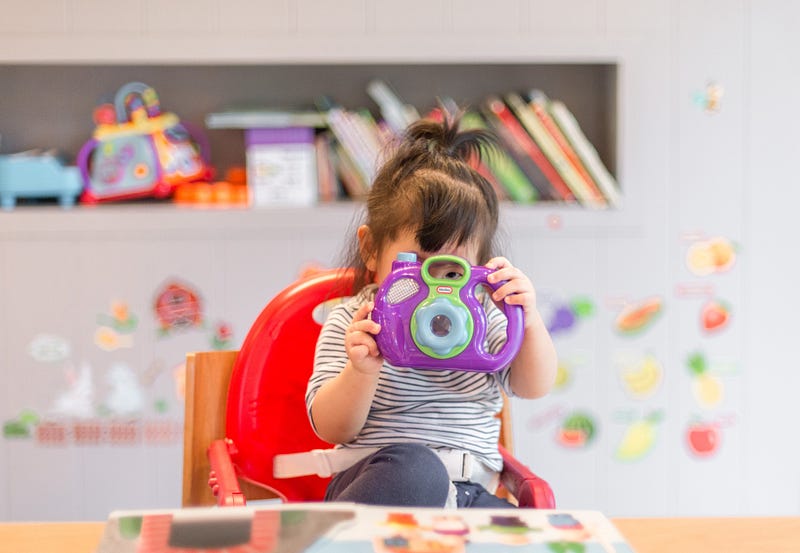
This week, our two-year-old daughter started her part-time attendance at a local pre-school in Santa Monica, California. My Danish husband and I opted for a middle-of-the-road option which still costs fifteen hundred dollars a month — a shocking price for a European family like ours but “affordable” by local standards.
I was lucky to be invited to stay and observe my daughter for the first few days, to make her transition easier.
Here are just a few things I learned and was surprised by.
Paperwork
Before school even started, I found myself frustrated beyond belief when a thick pile of paperwork was handed to me to be revised and signed.
“For a two-year-old?” I double-checked, defeated.
I counted nine forms of various lengths that needed to be signed, including a “sunscreen release form” — to give permission to teachers to apply sunscreen on my daughter. This one was particularly funny to me.
If I can’t trust my daughter’s teacher with sunscreen, how can I trust her with my child at al?
I also had to write an elaborate description of my daughter’s personality and daily routine, just to see the paper filed away without any teacher actually looking at it.
And a doctor’s visit had to be arranged just to fill in the questionnaire that I’m sure was just another formality.
Why do we consider this waste of parents’ (and all people’s) time a norm in the U.S.?
(Lack of) food education
Both my husband and I spent our early years (and later years in his case) in Europe, raised in public schools in Denmark and Russia, where lunches were cooked, hot, and served by a big lady in an apron. You took what was given, and you didn’t complain. For the most part, the food was good and it was “real.”
You picked up your metal fork, plate, and a glass, and you sat down to eat at a table “like a normal person.” Talking during meals was strictly discouraged. Eating, we knew, was a serious business.
Later in life, influenced by the French approach to “culinary education,” which hit close to home, I tried to introduce my daughter to as many different foods as possible as early as possible. For the large part, I’ve succeeded (though I’d never dare to bring my food-throwing toddler to France).
In the U.S., as my Danish husband learned, food as a culture doesn’t exist. Instead, it’s always a source of either guilt or shame, not pleasure.
Still, I held on to my hopes of our daughter sharing a bowl of freshly-made soup with her playmates. Instead, I was told to pack a lunch box.
“A lunch box?” my husband raised his eyebrow.
“What are we paying for?” he continued.
I shrugged and continued packing, disappointed.
It got worse when an hour into our first day, the kids were hurried to a large table to celebrate a birthday… by being fed Cheerios on paper napkins, luckily (for my daughter) followed by brownies. My heart sank. Thank God, I thought, I packed her own lunch.
My dreams of my daughter getting any kind of culinary education in the U.S. ended right there.
Maybe we’re naive, but both my husband and I expected more from a private school. Yet, sadly, preparation and consumption of food is rarely a part of the school curriculum in the U.S.
To plate or not to plate
My daughter was the only child to arrive at her pre-school with a (plastic) plate and a fork packed with her lunch. Other kids were eating out of whatever: compartmentalized lunch boxes, Tupperware, or even a metal jar.
The next day, I debated whether I should pack the plate or just let my daughter eat out of plastic containers. I went back and forth between feeling weird and “European” unpacking her plate the day before and worrying that other parents and teachers would think I’m treating my daughter like a “princess.”
I stuck to my guns. My daughter was going to continue eating from the plate (even if with her hands) both in and outside our house.
Later that day, I saw something called Child’s Bento Box for sale in a store and, for the first time, I understood what it was. I felt sad. Clearly, eating out of a lunch box is the way American children are being raised.
Underlying anxiety
It seems like no matter what the environment, one always finds an opportunity to stay a bit on edge in the U.S.
Even in my daughter’s pre-school, the (sweet and loving) teachers often communicated between themselves with urgency and nervousness. Everything, from a broken diaper genie to a fifteen-minute schedule delay, seemed to stress them out just a bit more than (I find) normal.
I couldn’t work out what kept them ever-so tense and wrote it off as cultural differences.
When, with a smile, I told my daughter’s teacher that my too-independent toddler escaped the classroom and headed for the building’s (secured) exit while none of us was looking, she nearly had a heart attack. What I saw as my daughter simply exploring and showing off her independence, her poor teacher assumed as a personal failure to “safeguard a child.” She apologized profusely and assured me that children’s safety was her number one concern. Of course, I would never assume otherwise.
It was then clear to me just under how much pressure teachers are in the United States.
Fear of lawsuits and demanding parents, germs, and nut allergies, on top of just kids being kids, probably sucks the life out of them, turning warm nurturing human beings into walking stress balls. I feel for them.
Bring your own… everything?
You’d think a private pre-school would supply a proper meal and a diaper, but no, before the first day of school, we were given a list of everything that needed to be brought with us: food, water, diapers, wipes, bed sheets, pillows, sunscreen.
“What ARE we paying for?” my poor Danish husband sighed.
I was slightly embarrassed, as if I should have found a place that would provide all those for our daughter. But so far the only kindergarten that came close to our expectations cost a whopping $30,000 a year in tuition, plus fees.
“What a scam,” my husband repeated, his favorite phrase to describe our life in the U.S.


