My Dark Tour
Question from Dachau: is everyone rewriting history except the Germans?
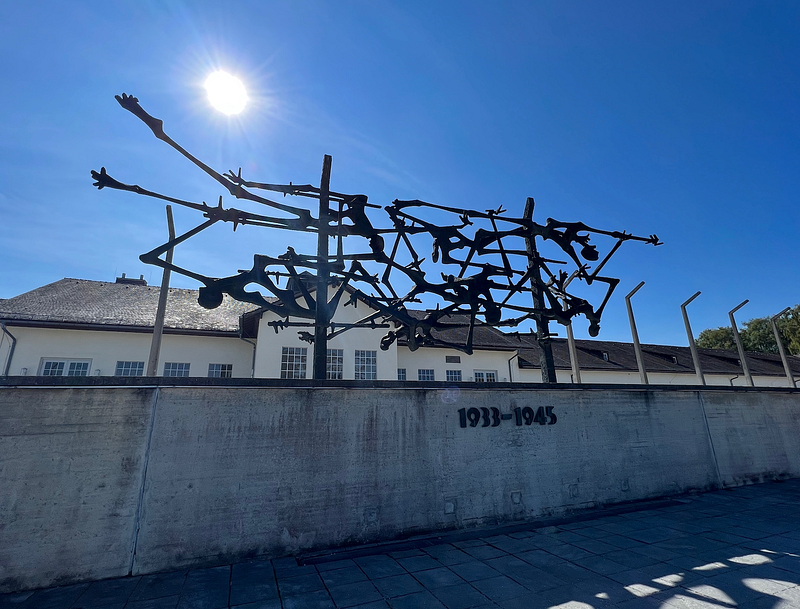
I was in Munich for Oktoberfest, and as I often do when traveling in Europe, indulged my fascination with World War II by spending a sobering morning at the former concentration camp at Dachau.
The first Nazi forced-labor camp and a model for all those that followed, Dachau retains the essence of evil. The camp was liberated in 1945, converted into a memorial in 1965, and restored in 2003. It is among seven preserved Nazi death camps, including the larger and more notorious ones at Auschwitz and Buchenwald.
At Dachau, visitors enter as prisoners first did 90 years ago — through a metal gate, missing for years but recovered in 2017, that infamously reads “Arbeit macht frei” (work sets you free). It’s a cruel hoax, and the visit only gets more wrenching as you move on to the gas chamber and crematorium.
Why would I put myself through this depressing detour? I had come to Bavaria to take part in a beer-soaked carnival full of singing, dancing, and other merriment. My group was in hearty spirits, looking forward to donning our lederhosen and dirndl and spending serious time inside a big tent clinking liter-sized mugs with people we’d never met. Oktoberfest in Munich is a bucket-list event, and we were going full tilt.
Yet setting foot inside a former concentration camp had been on my bucket list even longer — for reasons I didn’t understand until I had done so.
I’ve never been to war. The brutality is impossible to comprehend. But I keep trying, partly because we humans continue to serve up new case studies. I had just begun writing this essay when Hamas moved on Israel. Russia has been committing war crimes in Ukraine for two years. The atrocities in these two wars are still unfolding.
“The past was erased, the erasure was forgotten, the lie became the truth”— George Orwell
The record is essentially complete with earlier wars, which makes them easier to contemplate. You can’t watch a World War II film like Saving Private Ryan without gaining some understanding of what it’s like to be under live fire. The World War I book All Quiet on the Western Front brings to life the physical and mental trauma inflicted on soldiers. Yet these are just pictures and words. As such, they come with a degree of detachment that allows them to be viewed as entertainment.
Museums and memorials, on the other hand, are visceral. In Paris, I felt in my bones the defiance of the French people as I walked through the catacomb-like bunker of resistance leader Jean Moulin and, for the first time, appreciated the suffocating nature of an occupying enemy.
In London, I toured Winston Churchill’s bunker far underground in the middle of the city, and more fully grasped his courageous leadership. In Berlin, I walked a demolished city block preserved as it, and all of Berlin looked after the fall of the Reichstag in 1945.
At Dachau, I felt the savagery from deep inside. My knees weakened in the gas chamber. This is history you can breathe in. All of these disparate moments are, for me, elements of a calculus equation I can never solve; they tell a story way over my head.
I am of the first generation of American men since 1940 where none were forced to serve. The draft in the U.S. was abolished when I turned 17. I felt, and still feel, blessed by such timing. I had a draft number, just in case. The just-in-case draft lottery went away the following year.
Many Americans choose to serve. They have their reasons; there are ample good ones. Some see the military as a path to opportunity and a better life. Some are driven by patriotism, like Pat Tillman, the NFL star who joined the Army Rangers after 9/11 and perished in Afghanistan. This much is clear: they all have more courage than me. I’m not just indebted to them; I’m in awe of them.
As a kid, I “played army” with my friends virtually every summer day. Sometimes it was with helmets, canteens, and toy guns; other times it was with plastic soldiers in a sandbox. My set of soldiers, a gift at Christmas, came in a box named for the famous battle in the Pacific, Iwo Jima.
I was raised in an environment where it was practically a given that young men would be called to serve. My uncles served in World War II. My dad was drafted during the Korean War. Long after his discharge, we used to dress up in the uniform he had brought home. I still have his collapsable green army bag. That was some quality thread.
Vietnam would have been my war. I had cousins and neighbors forced into this unpopular conflict. I missed conscription by inches and therein, I suspect, lies the root of my feeling something akin to survivor’s guilt. Why me? Why did I have a choice? So many who came before me were — and so many around the world still are — required to risk everything. Today, 85 countries have a draft.
Now in my 60s, with major wars raging in two theaters and the Chinese obsession with Taiwan threatening to ignite a third, I think about this often because the lessons of Dachau are not universally accepted. Reflection comes more naturally at this age; it allows me to appreciate, say, the words of Jack Nicholson’s unhinged Colonel Nathan Jessep in A Few Good Men, when he declared, “You want me on that wall. You need me on that wall.”
My interest in World War II led me to visit the Museum of the Great Patriotic War in Victory Park in Moscow when I was there in 2018. Westerners may not be welcome in Russia again in my lifetime. I feel fortunate to have been there when Putin was a better global citizen, and I was allowed to tour this expansive, compelling memorial.
Everything is big in Moscow. Let me start there. Lenin’s bronze head weighs 42 tons, the largest such monument in the world. Peter the Great’s statue soars as high as a football field is long. It must have been a Russian who first asked if size matters.
Big isn’t just for shrines. They tell whoppingly large lies in Moscow too. Most recently, of course, they have been spinning the tale of modern-day Nazis running Ukraine. When I was there, the Kremlin’s propaganda was more focused on past events. At the war museum, Joseph Stalin is given near-total credit for defeating Hitler; Stalin’s barbaric reign is reimagined as necessarily tough but restrained.
On a guided tour, I cringed at this revisionist narrative, which along with rebranding Stalin incorporates only a slight nod to the contributions of the West in Hitler’s defeat. My too-evident incredulity led the tour leader to stop, peer around as if searching for spies, and, seeing none, whisper to me, “Look, they make me say this. I could lose my license.”
Scholars have documented this kind of historical airbrushing dating to the Roman Empire when Tacitus outed the “falsified” record of Claudius and Nero. In more recent times China, Japan, Hungary, India, France, and many more have been found to whitewash their past in self-serving ways. The practice has been so common for so long that it is a biting theme in George Orwell’s classic Nineteen Eighty-Four, where he writes, “The past was erased, the erasure was forgotten, the lie became the truth.”
Being forthcoming about your past isn’t easy. My first concert was with Neil Diamond. I don’t know how many times I’ve said it was Neil Young. We’re all a little revisionist, I suppose. As a friend recounting tales of his prowess in high school once told me: “The older I get, the better I was.”
The U.S. massages history too. Only last year, Florida outlawed school teachings that might make a white student feel “discomfort” in a discussion of slavery or racism. Thirty-seven states have banned books including To Kill a Mockingbird and The Adventures of Huckleberry Finn over their portrayals of race.
Stifling the conversation is a step toward a gentler reimagining of America’s formative years, which included wiping out natives and building an economy around imported slave labor. There have been only mealy-mouthed apologies for these cruelties and today presidential hopeful Ron DeSantis is rebranding slavery, as he recently suggested, as an opportunity to learn valuable skills. Please don’t put him in charge of a museum.
As far as I can tell, Germany is taking a different approach. The former chancellor, Angela Merkel, formally apologized for the holocaust more than a decade ago and reiterated the country’s contrition many more times during her tenure. The people were quickly on board.
Some years ago, I was walking in circles in a park in Berlin trying to find Hitler’s bunker. There were no signs that might help a foreigner. I asked a local for directions and she pointed the way, but only after telling me in a hushed tone, “We don’t like to say. You know, we aren’t proud of it.”
They aren’t proud of it in Dachau either. Locals once wanted to tear down the camp but were not allowed to because families of those who died in the camp fought to restore it. Those families wanted a permanent reminder. For a while, city officials rerouted bus lines so that the camp was less visible and more difficult to find. Later, they came to accept the value of not erasing this ugly part of history and today the German state of Bavaria foots the bill for maintaining the camp.
The Germans have done a different sort of scrubbing of history. Not a single memorial celebrating the Nazi armed forces still stands. Such shrines were seen as too painful; they were ripped from the landscape. In the U.S., some Confederate monuments have been removed. Virginia just melted down a famous statue of General Robert E. Lee that once towered over Charlottesville. Give them some props.
Yet many hundreds of Confederate shrines still sit proudly in public spaces across the South. This includes Stone Mountain, a kind of Mount Rushmore of secessionist leaders who fought for all sorts of atrocities and which is the most visited tourist attraction in the state of Georgia. Barbecue and funnel cake are served nearby.
Some argue that knocking down statues is its own version of rewriting history. What happened, happened. You can’t erase the past by taking apart what’s been left behind. There is some truth to that. But this viewpoint is dead on arrival in Germany, where they have done a far better job of moving on from their violent past.
Back in Munich, we put on our Trachten and joined the festival. I got tipsy and sang with strangers while standing on my chair. It was exactly the rollicking good time I had envisioned.
Historical markers like Dachau aren’t there to ruin your day. That’s not the point. Dachau had grounded me; it shed some light on my deepest feelings, and offered a hint of clarity. It provided balance in a world where I have been fortunate, but which continues to dish up unfathomable inhumanity.
This balance is the point, and a flood of people that appear to seek equilibrium has given birth to what’s called “dark tourism,” an exploding part of travel where people flock to historical sites of suffering. Dark tourism totaled $30 billion worldwide in 2022. At Dachau, which has no entry fee, yearly visitors have doubled in the last decade.
Young people far removed from the macabre sites they visit account for much of this trend. In a study, 91% of Gen Z said they had engaged in some form of dark tourism. I like to think they are searching for a better understanding of the world they will inherit so that when their time comes, they can act — as opposed to waiting 60 years to reflect, like me.
Dan is a former columnist at TIME. Saving Private Ryan is his all-time favorite war movie and he still really likes Neil Diamond. Dan is writing a memoir of his early career as a small-town newspaper reporter.
Related content from Dan: