avatarNeeramitra Reddy

Free AI web copilot to create summaries, insights and extended knowledge, download it at here

8359

Abstract

s on the crucial daily actions. Define them to be…</p><ol><li><b>Easy enough to stick to but hard enough to create progress.</b> Editing for 4+ hours was draining. But 2 hours led to article spillovers. So, I finalized 3.</li><li><b>As specific and unambiguous as possible — </b>to avoid doubt and misinterpretation.</li><li><b>Easy to “Plug-and-play” for your daily ToDos </b>— so you minimize daily decision fatigue, avoid procrastination, and maximize momentum.</li></ol><p id="0493">While point 1 is straightforward, points 2 and 3 have nuances I’ll flesh out with examples.</p><p id="6bc0"><b>Point 2: “</b>Specificity” has different levels — aim for Precise.</p><ul><li>Vague — 90 minutes of daily Vipassana.</li><li>Better — 1 hour of Vipassana in the morning and 30 minutes at night.</li><li>Specific — 1 hour of Vipassana first thing after waking up and 30 minutes last thing before bed.</li><li>Precise — Vipassana meditation from 6:30–7:00 AM and 9:00–9:30 PM</li></ul><p id="b43e"><i>P.S. Time-link your daily actions (or don’t) based on your schedule and preference. My mornings and nights are fixed — but noons and evenings are flexible. So, I’ve time-linked Vipassana, but not writing and editing.</i></p><p id="bac4"><b>Point 3: </b>Like time-linking, duration-linking isn’t compulsory. Contrasting my P1 and P2 daily actions:</p><ul><li><b>P2 — “1 unit business task" instead of “1 hour”<i> </i></b>as<i> </i>those tasks are <i>homogenous. </i>Choosing to write 1 email or rewrite 1 copy section is easier than puzzling over what to “fit into” 1 hour.</li><li><b>P1 — “1 hour of writing” instead of “1 article”</b> as some articles are 3 minutes short and some <a href="https://betterhumans.pub/the-most-powerful-morning-routine-ive-found-after-3-years-of-experimenting-5ce320dda731">18 minutes long</a>! Writing 1-hour daily irons out this difference over a week.</li></ul><p id="86b2">Wondering,<i> “Why all this fuss over simple daily actions?”</i></p><p id="3ecd"><b>Because it’s the daily rowing that’ll build your boat’s momentum! </b>What use is a priority compass and goal destination if the boat doesn’t set sail?</p><p id="8bc9">Now that we’ve crafted our oars, the next step is to ensure seamless rowing.</p><h1 id="fd3c">Build Momentum on Autopilot with 3D Systems</h1><p id="160f">Ever notice the ASMR-like synchrony of Olympic <a href="https://youtu.be/DSYFXe2jcH8">rowing</a> teams?</p><p id="a538">If the angle or timing of even a single rower or oar is off, the momentum breaks— it’s the same with your daily actions.</p><p id="447e">That’s where systems come in — to lock in and streamline your daily actions for peak momentum.</p><p id="3887"><i>P.S. In our context, systems are for SINGLE-action consistency — not to be confused with SERIAL systems that synergistically combine multiple actions/habits.</i></p><figure id="baac"><img src="https://cdn-images-1.readmedium.com/v2/resize:fit:800/1*3r-lJ1jfQyhkq-Y-r6BU-g.gif"><figcaption><a href="https://tenor.com/en-GB/view/rowing-australia-mens-four-rowing-team-nbc-olympics-paddling-riding-a-bowloader-gif-22851956">Tenor</a></figcaption></figure><p id="7677">Unlike most think, systems aren’t rigid concrete-glued bricks…</p><p id="850a"><b>They’re more like well-oiled combustion engines</b> — with tiny moving parts frictionlessly interacting. These cogs can be segregated into 3 dimensions:</p><ul><li><b>Environment Design (ED)</b>— to leverage tools, devices, blockers, and object placement in our favor.</li><li><b>Habit/Behavior/Self-optimization</b> <b>(HBS)</b>— using habit-stacking, self-conditioning, planned leisure, bio-hacking, etc.</li><li><b>Accountability Maximization (AM)</b> — via intentions, <a href="https://rebrand.ly/rk0zwgv">journaling</a>, mentoring, tracking, and accountability partners.</li></ul><p id="7031">No need to “connect” them with complex sequences — oil (aka optimize) each part and let it be. The system’s power stems from this disjoint dynamism.</p><p id="2961" type="7">“A system is never the sum of its parts; its the product of their interaction.”</p><p id="39ae" type="7">— Russel Ackoff</p><p id="6023">Let me illustrate with the 3D cogs of my P0-Vipassana system:</p><ul><li><b>ED </b>— Phone on DND and out of sight. Physical alarm clock. Meditation cushion on the bed. Ambient night bulb. No devices after 8:00 PM and before 8:00 AM. Locked bedroom door.</li><li><b>HBS</b>— light dinner for alertness and easy digestion. Pre-dinner shower to avoid bean-bag inertia. Minimal nightly water intake to prevent Nocturia. <a href="https://neeramitra-reddy.medium.com/30-days-of-taking-ashwagandha-before-sleep-the-results-were-surprising-c14dfb3c4117">Ashwagandha</a> for deeper sleep. No post-dinner family banter.</li><li><b>AM</b>—rehash Vipassana’s priority via daily <a href="https://rebrand.ly/rk0zwgv">bullet journaling</a>. Keep my Vipassana mentor updated. Rediscover Vipassana’s power with each session.</li></ul><p id="1359"><b>Beware of the over-optimization trap — </b>excess “optimization” can make the system harder than the daily action itself! A simple rule to avoid this?</p><p id="21e7" type="7">Prefer distraction-blocking apps/tools over “focus-enhancing” ones.</p><p id="3c5d">My P1-writing system illustrates this well:</p><ul><li><b>ED</b>— Distraction-free writing with <a href="https://getcoldturkey.com/writer/">ColdTurkeyWriter</a>. Water bottle within hand’s reach. <a href="https://getcoldturkey.com/">Block social media</a>, Slack, and email while editing. <a href="https://betterhumans.pub/3-nuanced-tweaks-to-make-any-daily-routine-more-effective-29209abc16d6">Persisting alarms</a>. Phone face-down on DND. <a href="https://ublockorigin.com/">Block ads</a> at the source. Block <a href="https://juliety.com/social-feed-blockers">social feeds</a>. Clutter-free desk. Single <a href="https://youtu.be/iRA82xLsb_w">looped song</a> for trance-like focus.</li><li><b>HBS</b> — finish 1st editing session before my family wakes up. Brief breaks with Blitz chess. Stick to a single-tab policy. Long break with a sunlit terrace walk. Write right after lunch.</li><li><b>AM</b> — Promise article(s) beforehand to my email family. Check-in with my accountability partner, <a href="undefined">Akshad Singi</a>.</li></ul><figure id="8701"><img src="https://cdn-images-1.readmedium.com/v2/resize:fit:800/1*TN7bQUj0yxo1WwEcsH89gQ.jpeg"><figcaption>My bedroom and work desk (Photos by the author)</figcaption></figure><p id="6262">Robust systems guarantee smooth sailing — but what about storms, pirates, and leaky holes?</p><p id="00da">Let’s tackle them next.</p><h1 id="5d35">Buttress Your Systems with Antifragility</h1><p id="0660">If daily actions are shrubs, systems are oaks — but storms uproot both.</p><p id="e600">It’s the flexible <a href="https://www.businessinsider.in/science/news/palm-trees-bend-in-high-winds-and-are-hard-to-uproot-a-forest-ecologist-says-theyre-perfectly-designed-to-withstand-hurricanes-/articleshow/94652440.cms">palm trees</a> that survive. Bending with the winds, they snap back into place.</p><p id="f970">The Christmas storm of gifts, guests, and trick-and-treat kids is approaching — only palm tree systems will thrive.</p><figure id="4ecc"><img src="https://cdn-images-1.readmedium.com/v2/resize:fit:800/1*fHwUDqSBAKPzad7lmdJtZg.gif"><figcaption><a href="https://www.google.co.in/url?sa=i&amp;url=https%3A%2F%2Fgiphy.com%2Fexplore%2Fpalm-trees-miami&amp;psig=AOvVaw0Hcsy8KeLawXLaar4azTJ2&amp;ust=1701658284492000&amp;source=images&amp;cd=vfe&amp;opi=89978449&amp;ved=0CBIQjhxqFwoTCKjdtZ6h8oIDFQAAAAAdAAAAABAJ">Tenor</a></figcaption></figure><p id="439e">That’s where non-negotiable minimums and lapse-recovery mechanisms come in — to turn oak systems into palms.</p><h2 id="c849">Keep Momentum Alive with Non-Negotiable Minimums</h2><p id="62a0">What’s the minimum daily action needed to sustain momentum? And how to make this minimal action impossible to miss?</p><ul><li>1 non-negotiable hour of Vipassana — Guaranteed by waking up early and meditating right after I wake up.</li><li>1 non-negotiable article a week — Guaranteed by editing for an hour after my morning Vipassana and writing for 30 minutes post-lunch.</li><li>1 non-negotiable product revamp — Guaranteed by ticking off 1 business unit task every other day.</li></ul><p id="4e94">Despite the most

Options

“non-negotiable” of planning, sh*t can hit the roof — that’s where lapse recovery comes in.</p><h2 id="8b16">Snap Ruts as They Arise with Lapse-Recovery Mechanisms:</h2><p id="211f">If and when lapses occur, how to snap back into peak momentum? How to snap ruts just as they threaten to begin?</p><ul><li>Recover from Vipassana lapses through at-home <a href="https://globalpagoda.blogspot.com/2010/02/strong-determination-adhitthana-parami.html">Adhiṭṭhāna</a>. For longer lapses, attend 1-day Vipassana courses.</li><li>Recover from writing lapses by expanding X/LinkedIn posts into long-form. For longer lapses, use daily buffer periods and Sundays.</li><li>Recover from product revamp lapses by batching “unit” tasks. For longer lapses, reduce the revamp scope and price hike.</li></ul><h2 id="b389">Neither of these are excuses to slack or lapse deliberately…</h2><p id="9d50">Think of them as fire extinguishers and band-aids, not birth control pills.</p><p id="b2ef">Try your best to adhere to your daily actions — “fall-back” on lapse recovery and non-negotiable minimums only when you <i>genuinely</i> have to.</p><p id="e7d7">When you sustain momentum, you won’t even think of fallbacks. That’s what we’ll cover next.</p><h1 id="f173">The Easiest yet The Most Crucial Step</h1><p id="a8c6">The Forgetting Curve <a href="https://blog.wranx.com/the-science-behind-spaced-repetition#:~:text=This%20demonstrates%20that%20after%20recalling,Spaced%20Repetition%20in%20a%20nutshell.">states</a> — we forget 90% of the information we pick up within 3 days!</p><p id="8038"><b>So, to better remember stuff, we must <i>regularly</i> review and revise it</b>. As Otago University’s psychology researchers <a href="https://www.readcube.com/articles/10.3389/fpsyg.2017.00962">put it</a>,</p><blockquote id="3af0"><p>“Repetitions spaced in time tend to produce stronger memories than repetitions massed closer together in time.”</p></blockquote><p id="5db5">This proven learning technique of <a href="https://youtu.be/cVf38y07cfk">spaced repetition</a> is perfect for our use case, too!</p><figure id="9a78"><img src="https://cdn-images-1.readmedium.com/v2/resize:fit:800/1*sfooO2bcSMfCKRo8RxYQlg.jpeg"><figcaption></figcaption></figure><figure id="b05c"><img src="https://cdn-images-1.readmedium.com/v2/resize:fit:800/1*SHBCqQhSzLQe6HqyZSeIuA.jpeg"><figcaption>Spaced Repetition combats The Forgetting Curve (Sources: <a href="https://www.flickr.com/photos/doctorcliff/24025990633">Flickr</a> and <a href="https://nova-live.imgix.net//migration-EbbinghaussForgettingCurveIMGB3.jpg?q=60&amp;fm=webp&amp;w=700&amp;h=652">Nova-live</a>)</figcaption></figure><p id="b238">Spaced-rehashing our priorities, goals, and actions will <i>dial </i>them in. Here are 3 high- ROI ways I do so:</p><ul><li><b>2-Minute Bullet Journaling (Easy + Effective)</b>— this <a href="https://rebrand.ly/rk0zwgv">2-minute method</a> blends priority rehashing, daily task-setting, <i>and </i>gratitude. Digi-journal with the <a href="https://rebrand.ly/rk0zwgv">free Notion template</a> or by hand with the <a href="https://the-2-minute-bullet-journal.carrd.co/">paperback journal</a>. If neither, learn <a href="https://rebrand.ly/rk0zwgv">the method</a> and use a regular notebook.</li></ul><figure id="746b"><img src="https://cdn-images-1.readmedium.com/v2/resize:fit:800/1*wQ3aAcWZJoMrdPnWLuHD_A.jpeg"><figcaption>The <a href="https://the-2-minute-bullet-journal.carrd.co/">2-minute journal</a> & normal notebook journaling (Photos by the author)</figcaption></figure><ul><li><b>Ever-Visible Whiteboard (Fancier + More Effective + No Privacy) </b>— with your weekly targets and daily ToDos glaring, it’s hard to procrastinate. The only con? It’s naked in its glory for guests and family.</li></ul><figure id="ed07"><img src="https://cdn-images-1.readmedium.com/v2/resize:fit:800/1*MaTwaWLpWvBx1e8-gHqG0Q.jpeg"><figcaption>Photo by the author</figcaption></figure><ul><li><b>Tej Dosa’s MindSet Folder (Fanciest + Hyper-Effective)</b> — with high-consciousness visuals, self-image reprogramming, death awareness, etc. It’s game-changing but needs 30–45 minutes daily for <a href="https://www.mindskool.com/free-course">7 days to build</a>. It also needs 100% privacy — away from the eyes of prying kids and spouses.</li></ul><figure id="b783"><img src="https://cdn-images-1.readmedium.com/v2/resize:fit:800/1*AeOFmMc3_97wmiYY-oKBzA.jpeg"><figcaption>Blurred for the 100% privacy I mentioned (Photo by the author)</figcaption></figure><p id="38a9">Is the whiteboard too public and the mindset folder too complex?</p><p id="fac7">Stick to simple bullet journaling — again, if you don’t want to or can’t afford the 2-minute <a href="https://the-2-minute-bullet-journal.carrd.co/">paperback journal</a>, use a regular diary or the free <a href="https://rebrand.ly/rk0zwgv">Notion template</a>.</p><p id="e270">An even faster way? Ditch the gratitude section — only rehash your P012 priorities and plan tasks daily.</p><p id="a6ab">Our goal is consistent spaced repetition — <i>how </i>you do it is up to you.</p><h1 id="e627">Of Course, It Goes Without Saying That…</h1><p id="d661">No amount of planning, buttressing, and rehashing will help without <i>intention.</i></p><p id="6b5f" type="7">“Attention energizes, and intention transforms.”</p><p id="3044" type="7">— Deepak Chopra, The 7 Spiritual Laws of Success</p><p id="dfb0">They can only channel our attention — only our intention can transform it into revitalizing momentum.</p><p id="edd4">So, let’s summon and lock in a powerful intention. Repeat after me with conviction:</p><p id="29ce"><i>“On this day, I resolve to make the most out of 2023’s last few weeks. I will diligently stick to my daily actions and build massive momentum going into 2024. I deserve and am capable of achieving maximum happiness, well-being, and success.”</i></p><p id="c170"><b>This isn’t woo-woo manifestation stuff — it’s <a href="https://psychcentral.com/health/why-positive-affirmations-dont-work"><i>proven</i></a> positive psychology.</b> Reword it if it isn’t to your taste — but speak with faith and courage. Let your brain hear and soak in the positive energy.</p><p id="70f1">Then, close your eyes, inhale deeply, and visualize yourself doing your daily actions — and getting into an enjoyable rhythm of ticking off task after task.</p><p id="45b1">Visualize swaying and staying rooted like a palm tree despite stormy setbacks.</p><p id="3295">Visualize cruising into 2024 at 180mph — while others dust their rusty bonnets.</p><p id="7ebc"><b>Open your eyes — it’s time to turn it into reality.</b></p><p id="b57d" type="7">“If you can see it in your head, you can hold it in your hand.”</p><p id="68ba" type="7">— Bob Proctor</p><p id="1b91">Godspeed and Happy New Year in advance to you!</p><h2 id="c692">Want to Start Each Day with Peak Energy, Motivation, and Focus? Grab Your Free Copy of God-Mode Mornings</h2><div id="d99a" class="link-block"> <a href="https://readmedium.com/how-to-accomplish-in-2-hours-what-most-usually-do-in-an-entire-day-a478af7366af"> <div> <div> <h2>How to Accomplish in 2 Hours What Most Usually Do in An Entire Day</h2> <div><h3>My 4-step blueprint to help you unlock maximal productivity</h3></div> <div><p>medium.com</p></div> </div> <div> <div style="background-image: url(https://miro.readmedium.com/v2/resize:fit:320/1*06GrmHjdu7tlMdvxqd9bjw.jpeg)"></div> </div> </div> </a> </div><div id="3fa5" class="link-block"> <a href="https://betterhumans.pub/the-most-powerful-morning-routine-ive-found-after-3-years-of-experimenting-5ce320dda731"> <div> <div> <h2>The Most Powerful Morning Routine I’ve Found After 3+ Years of Experimenting</h2> <div><h3>A realistic, science-based, customizable, and aggressively self-tested morning system</h3></div> <div><p>betterhumans.pub</p></div> </div> <div> <div style="background-image: url(https://miro.readmedium.com/v2/resize:fit:320/1*45mHkOZRD6w_IYuuQP-p6g.jpeg)"></div> </div> </div> </a> </div></article></body>

My Comprehensive Blueprint to Conclude 2023 on A Phenomenal Note

Build massive rut-free momentum going into 2024 — to crush your New-Year goals and resolutions

Generated with Leonardo AI

Self-sabotage got me in a chokehold.

Blitz-chess procrastination. Surfing celebrity-gossip. Near-daily NoFap relapses. Nagging existential doubt — and an unexpected breakup to worsen it all.

This wasn’t my 2023 Q4 “gameplan” — but as Mike Tyson quipped, “Everyone has a plan until they get punched in the face.”

The question is whether you counter-punch or reel in defeat.

  • My lizard brain hisses, “2023 is almost drawing to an end. Why bother now? Mess up to the max. We‘ll start afresh in 2024.”
  • But the rational cortex whispers, “These are our last few weeks to build all-out momentum before 2024 starts!”

Hearing variants of the same voices? We both know which is right.

This idea of “messing up to the max” and “resetting” the next day, week, or year is insidious.

If your knee is broken, would you hammer it to a pulp before letting it recover?

The recovery will only be more painful and prolonged.

This is why the wave of fresh gym faces and writing voices vanish by Valentine’s — the New Year motivation balm barely heals the pulped knee.

A better way is to avoid pulping the knee — and zone in all effort to heal it…

So, it recovers enough by New Year's Eve to kick our 2024 goals into the skies.

But aggressively slathering Tiger Balm won’t work — the stinging pain will make you reach for the hammer again.

Instead, we need a strategic approach — a realistic blend of prioritization, intention-setting, environment design, systems, fall-backs, and accountability.

That’s precisely what this article is — a blueprint with practical steps, science-backed rationale, and illustrative examples/visuals…

A game plan for building, sustaining, and protecting massive momentum…

So, as 2024 rolls by, our New Year resolutions turn into New Year actualizations.

Let’s dive right in.

The Crucial (and Contrarian) First Step

Be it fixing problems or improving our lives, we default to adding stuff. As research psychologist Benjamin Converse says,

“Additive solutions have sort of a privileged status — they tend to come to mind quickly and easily. Subtractive solutions are not necessarily harder to consider, but they take more effort to find.”

While adding might “work,” it clutters and overcomplicates our lives. 2 modern-day issues worsen this:

  • A consumer culture with ads and marketing that prey on our insecurities.
  • Self-help and fitness industries that peddle new habits, routines, and pills on the daily.

The result? Decision fatigue, scattered focus, and obsessive hoarding.

Building focused momentum demands subtractiontrimming our lives to the 3 core essentials. Why 3?

Because it’s a proven near-magical number — that success gurus trust and mystics revere. Unless you have a different, well-tested number, stick to 3.

“If you have more than three priorities, you have no priorities.”

— Jim Collins, Good To Great

Quickly zone in on your core priorities with Warren Buffet’s altered 3/25 method:

  • Jot down your top 10 priorities off the top of your head.
  • Pause, ponder, and add 10 more to the list.
  • Wrack your head to squeeze out 5 more.

Half the battle’s done — time for the tougher subtracting half:

  • Strike out the 10 least-important “priorities.”
  • Get rid of another 7 darlings.
  • Murder 5 more “priorities.”

P.S. Stop at any point if you sense you’ve found your top priorities. Jotting 13 proved enough for me.
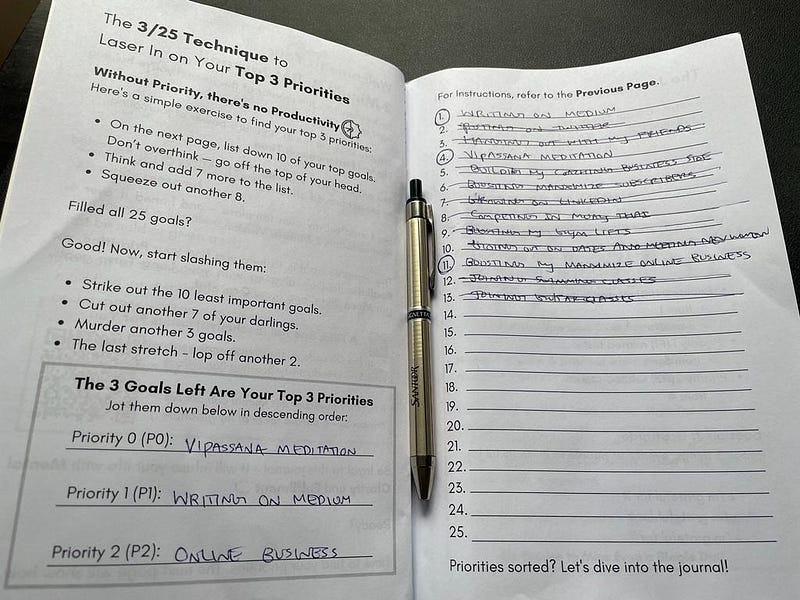
The 3/25 rule using the 2-Minute Bullet Journal (Photo by the author)

The 3 left are your true priorities. We’ll call them P0, P1, and P2 from now on. Mine are:

  • P0: Vipassana meditation
  • P1: Writing on this platform
  • P2: Online business

All our planning henceforth will stem from these 3 — in an “If it’s not a priority, it doesn’t exist” spirit.

Craft Specific Goals but Don’t Focus on Them(?)

2023 saw me make 2 polar-opposite goal mistakes:

  • In 2023’s 1st half, I hyper-obsessed over my goals. The stressful rigidity eroded my motivation and creativity.
  • The 2nd half? I abandoned them — thanks to “Time is a construct” and “Desires = suffering” thoughts after Vipassana.

While the former felt suffocatingly rigid, the latter was distractingly spontaneous.

Having burned and frostbit my fingers, I’ve come to a warm mid-ground.

Goals are necessary to create motivation, fight Parkinson’s law, and channel your focus in a specific direction.

But goals have no day-to-day utility — that’s the forte of daily actions.

Through daily repetition, they generate momentum and make goal achievement a side effect.

So, set 3 goals (G012) to 1:1 match with your 3 P012 priorities — and whittle them down to daily actions (A012). Take my case:

  • Writing (P1) → Publish 12 long-form articles (G1) → 1 hour of writing post-lunch (A1-Part-1) + 3 hours of editing pre-lunch (A1-Part-2)
  • Online Business (P2) → Revamp and relaunch 2 products (G2) → 1 business “unit” task, be it email/copy/design/admin (A2)

You can also compute your goal(s) by first defining the daily action(s):

  • Vipassana (P0) → 1 hour of Vipassana first thing every morning and 30 minutes before bed every night (A0) → 45 total hours of Vipassana(G0 )
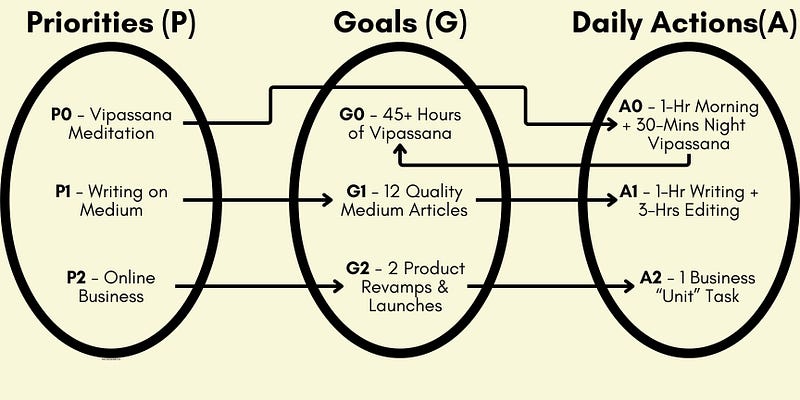
Made with Canva

Don’t overthink your goals. Ensure they are specific + realistic—no need for SMART or other fancy goal-setting methods.

Instead, focus on the crucial daily actions. Define them to be…

  1. Easy enough to stick to but hard enough to create progress. Editing for 4+ hours was draining. But 2 hours led to article spillovers. So, I finalized 3.
  2. As specific and unambiguous as possible — to avoid doubt and misinterpretation.
  3. Easy to “Plug-and-play” for your daily ToDos — so you minimize daily decision fatigue, avoid procrastination, and maximize momentum.

While point 1 is straightforward, points 2 and 3 have nuances I’ll flesh out with examples.

Point 2: “Specificity” has different levels — aim for Precise.

  • Vague — 90 minutes of daily Vipassana.
  • Better — 1 hour of Vipassana in the morning and 30 minutes at night.
  • Specific — 1 hour of Vipassana first thing after waking up and 30 minutes last thing before bed.
  • Precise — Vipassana meditation from 6:30–7:00 AM and 9:00–9:30 PM

P.S. Time-link your daily actions (or don’t) based on your schedule and preference. My mornings and nights are fixed — but noons and evenings are flexible. So, I’ve time-linked Vipassana, but not writing and editing.

Point 3: Like time-linking, duration-linking isn’t compulsory. Contrasting my P1 and P2 daily actions:

  • P2 — “1 unit business task" instead of “1 hour” as those tasks are homogenous. Choosing to write 1 email or rewrite 1 copy section is easier than puzzling over what to “fit into” 1 hour.
  • P1 — “1 hour of writing” instead of “1 article” as some articles are 3 minutes short and some 18 minutes long! Writing 1-hour daily irons out this difference over a week.

Wondering, “Why all this fuss over simple daily actions?”

Because it’s the daily rowing that’ll build your boat’s momentum! What use is a priority compass and goal destination if the boat doesn’t set sail?

Now that we’ve crafted our oars, the next step is to ensure seamless rowing.

Build Momentum on Autopilot with 3D Systems

Ever notice the ASMR-like synchrony of Olympic rowing teams?

If the angle or timing of even a single rower or oar is off, the momentum breaks— it’s the same with your daily actions.

That’s where systems come in — to lock in and streamline your daily actions for peak momentum.

P.S. In our context, systems are for SINGLE-action consistency — not to be confused with SERIAL systems that synergistically combine multiple actions/habits.

Tenor

Unlike most think, systems aren’t rigid concrete-glued bricks…

They’re more like well-oiled combustion engines — with tiny moving parts frictionlessly interacting. These cogs can be segregated into 3 dimensions:

  • Environment Design (ED)— to leverage tools, devices, blockers, and object placement in our favor.
  • Habit/Behavior/Self-optimization (HBS)— using habit-stacking, self-conditioning, planned leisure, bio-hacking, etc.
  • Accountability Maximization (AM) — via intentions, journaling, mentoring, tracking, and accountability partners.

No need to “connect” them with complex sequences — oil (aka optimize) each part and let it be. The system’s power stems from this disjoint dynamism.

“A system is never the sum of its parts; its the product of their interaction.”

— Russel Ackoff

Let me illustrate with the 3D cogs of my P0-Vipassana system:

  • ED — Phone on DND and out of sight. Physical alarm clock. Meditation cushion on the bed. Ambient night bulb. No devices after 8:00 PM and before 8:00 AM. Locked bedroom door.
  • HBS— light dinner for alertness and easy digestion. Pre-dinner shower to avoid bean-bag inertia. Minimal nightly water intake to prevent Nocturia. Ashwagandha for deeper sleep. No post-dinner family banter.
  • AM—rehash Vipassana’s priority via daily bullet journaling. Keep my Vipassana mentor updated. Rediscover Vipassana’s power with each session.

Beware of the over-optimization trap — excess “optimization” can make the system harder than the daily action itself! A simple rule to avoid this?

Prefer distraction-blocking apps/tools over “focus-enhancing” ones.

My P1-writing system illustrates this well:

  • ED— Distraction-free writing with ColdTurkeyWriter. Water bottle within hand’s reach. Block social media, Slack, and email while editing. Persisting alarms. Phone face-down on DND. Block ads at the source. Block social feeds. Clutter-free desk. Single looped song for trance-like focus.
  • HBS — finish 1st editing session before my family wakes up. Brief breaks with Blitz chess. Stick to a single-tab policy. Long break with a sunlit terrace walk. Write right after lunch.
  • AM — Promise article(s) beforehand to my email family. Check-in with my accountability partner, Akshad Singi.
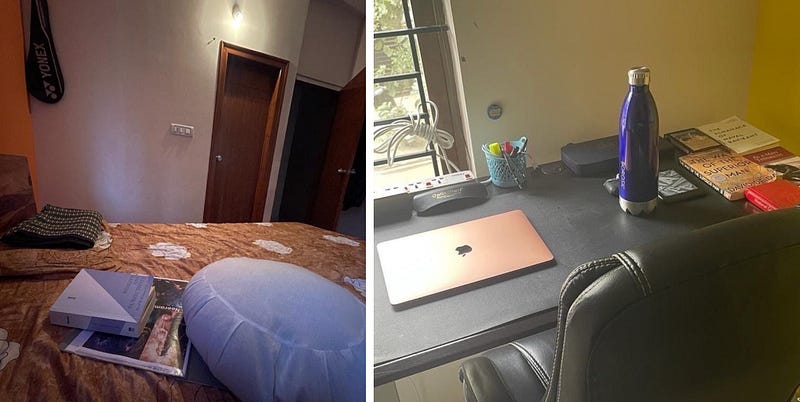
My bedroom and work desk (Photos by the author)

Robust systems guarantee smooth sailing — but what about storms, pirates, and leaky holes?

Let’s tackle them next.

Buttress Your Systems with Antifragility

If daily actions are shrubs, systems are oaks — but storms uproot both.

It’s the flexible palm trees that survive. Bending with the winds, they snap back into place.

The Christmas storm of gifts, guests, and trick-and-treat kids is approaching — only palm tree systems will thrive.

Tenor

That’s where non-negotiable minimums and lapse-recovery mechanisms come in — to turn oak systems into palms.

Keep Momentum Alive with Non-Negotiable Minimums

What’s the minimum daily action needed to sustain momentum? And how to make this minimal action impossible to miss?

  • 1 non-negotiable hour of Vipassana — Guaranteed by waking up early and meditating right after I wake up.
  • 1 non-negotiable article a week — Guaranteed by editing for an hour after my morning Vipassana and writing for 30 minutes post-lunch.
  • 1 non-negotiable product revamp — Guaranteed by ticking off 1 business unit task every other day.

Despite the most “non-negotiable” of planning, sh*t can hit the roof — that’s where lapse recovery comes in.

Snap Ruts as They Arise with Lapse-Recovery Mechanisms:

If and when lapses occur, how to snap back into peak momentum? How to snap ruts just as they threaten to begin?

  • Recover from Vipassana lapses through at-home Adhiṭṭhāna. For longer lapses, attend 1-day Vipassana courses.
  • Recover from writing lapses by expanding X/LinkedIn posts into long-form. For longer lapses, use daily buffer periods and Sundays.
  • Recover from product revamp lapses by batching “unit” tasks. For longer lapses, reduce the revamp scope and price hike.

Neither of these are excuses to slack or lapse deliberately…

Think of them as fire extinguishers and band-aids, not birth control pills.

Try your best to adhere to your daily actions — “fall-back” on lapse recovery and non-negotiable minimums only when you genuinely have to.

When you sustain momentum, you won’t even think of fallbacks. That’s what we’ll cover next.

The Easiest yet The Most Crucial Step

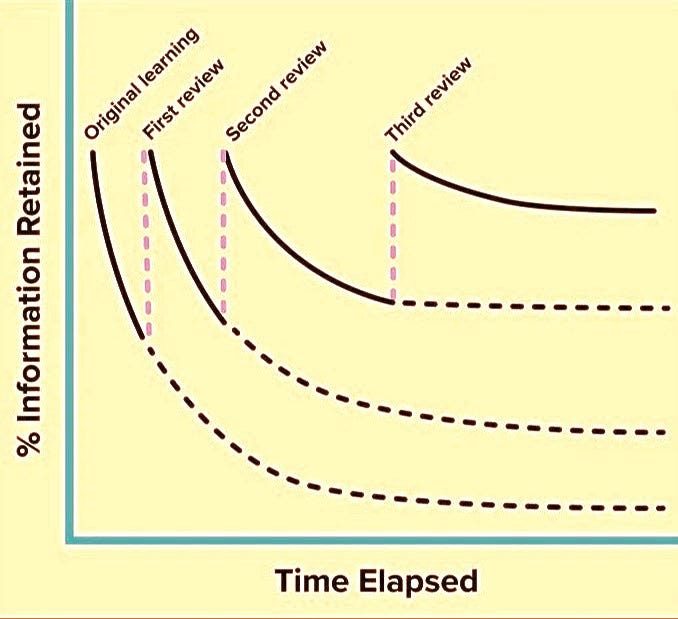
The Forgetting Curve states — we forget 90% of the information we pick up within 3 days!

So, to better remember stuff, we must regularly review and revise it. As Otago University’s psychology researchers put it,

“Repetitions spaced in time tend to produce stronger memories than repetitions massed closer together in time.”

This proven learning technique of spaced repetition is perfect for our use case, too!
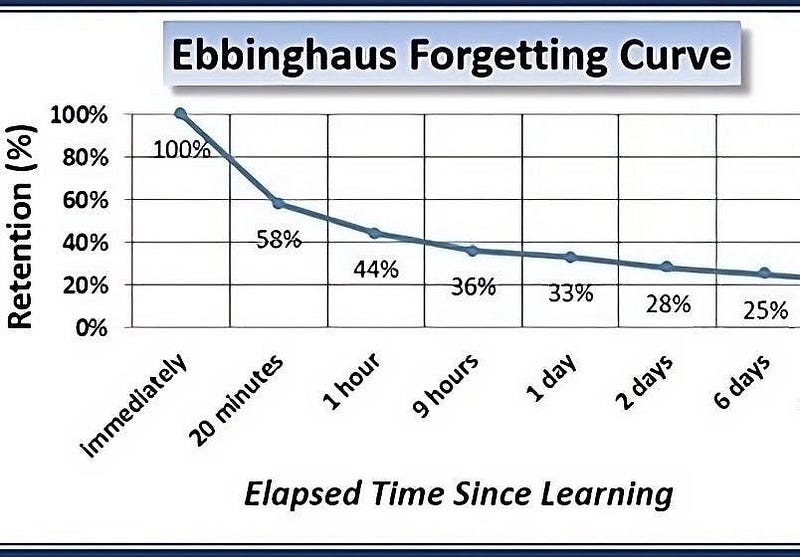
Spaced Repetition combats The Forgetting Curve (Sources: Flickr and Nova-live)

Spaced-rehashing our priorities, goals, and actions will dial them in. Here are 3 high- ROI ways I do so:

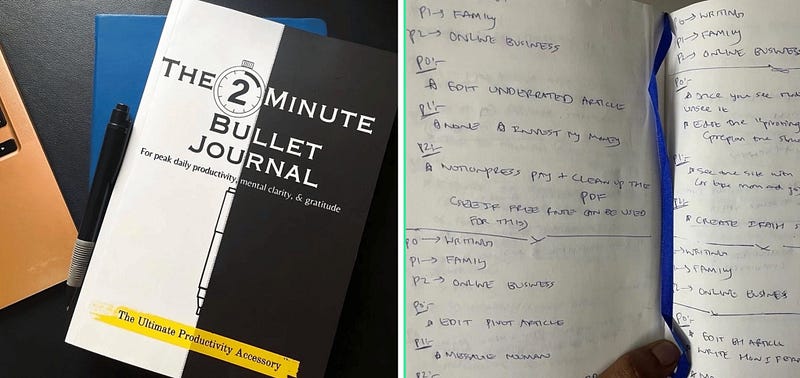
The 2-minute journal & normal notebook journaling (Photos by the author)
  • Ever-Visible Whiteboard (Fancier + More Effective + No Privacy) — with your weekly targets and daily ToDos glaring, it’s hard to procrastinate. The only con? It’s naked in its glory for guests and family.
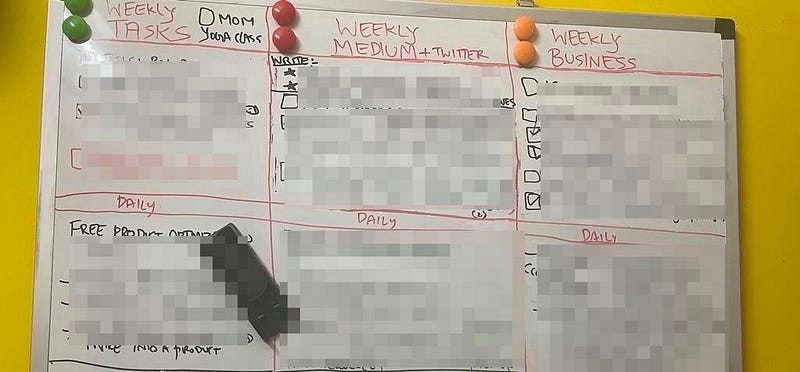
Photo by the author
  • Tej Dosa’s MindSet Folder (Fanciest + Hyper-Effective) — with high-consciousness visuals, self-image reprogramming, death awareness, etc. It’s game-changing but needs 30–45 minutes daily for 7 days to build. It also needs 100% privacy — away from the eyes of prying kids and spouses.
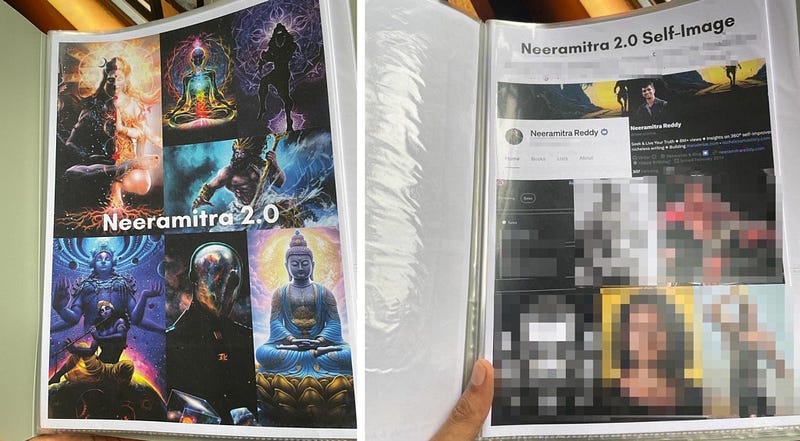
Blurred for the 100% privacy I mentioned (Photo by the author)

Is the whiteboard too public and the mindset folder too complex?

Stick to simple bullet journaling — again, if you don’t want to or can’t afford the 2-minute paperback journal, use a regular diary or the free Notion template.

An even faster way? Ditch the gratitude section — only rehash your P012 priorities and plan tasks daily.

Our goal is consistent spaced repetition — how you do it is up to you.

Of Course, It Goes Without Saying That…

No amount of planning, buttressing, and rehashing will help without intention.

“Attention energizes, and intention transforms.”

— Deepak Chopra, The 7 Spiritual Laws of Success

They can only channel our attention — only our intention can transform it into revitalizing momentum.

So, let’s summon and lock in a powerful intention. Repeat after me with conviction:

“On this day, I resolve to make the most out of 2023’s last few weeks. I will diligently stick to my daily actions and build massive momentum going into 2024. I deserve and am capable of achieving maximum happiness, well-being, and success.”

This isn’t woo-woo manifestation stuff — it’s proven positive psychology. Reword it if it isn’t to your taste — but speak with faith and courage. Let your brain hear and soak in the positive energy.

Then, close your eyes, inhale deeply, and visualize yourself doing your daily actions — and getting into an enjoyable rhythm of ticking off task after task.

Visualize swaying and staying rooted like a palm tree despite stormy setbacks.

Visualize cruising into 2024 at 180mph — while others dust their rusty bonnets.

Open your eyes — it’s time to turn it into reality.

“If you can see it in your head, you can hold it in your hand.”

— Bob Proctor

Godspeed and Happy New Year in advance to you!

Want to Start Each Day with Peak Energy, Motivation, and Focus? Grab Your Free Copy of God-Mode Mornings

Inspiration
Self Improvement
Productivity
Advice
Psychology
Recommended from ReadMedium