
New Year Resolutions
My Comprehensive Analysis of Over 1000 New Year’s Goals
Uncovering Societal Trends and Personal Aspirations Through a Deep Dive into Collective New Year Ambitions

The tradition of New Year’s resolutions, a practice rich in history and personal significance, serves as a mirror reflecting our collective aspirations and societal shifts. Historically, these resolutions symbolize a fresh start, offering individuals a chance to redefine their paths and goals (Rössner, 2011). In this article, I collected over a thousand diverse resolutions randomly and compared them with the findings published by Forbes to analyze the evolving landscape of personal and societal priorities. For me, this comparative analysis is not merely a curious exercise but a crucial tool for understanding how societal trends manifest in our personal choices.
My analysis, characterized by its qualitative depth and thematic diversity, contrasts with the quantitative approach of Forbes, revealing intriguing insights about our collective consciousness. The importance of such comparisons lies in their ability to unearth subtle societal shifts, particularly the growing emphasis on individualism over communal and familial values. As we navigate through this evolving landscape, I invite readers to ponder the profound implications these shifts have on our social fabric and personal well-being. While I revealed some of this analysis’s conclusions, I still want you to take a look at the analysis and its insights. So, let’s start.

Overview of My Analysis
In my quest to understand the evolving truth of our aspirations, I embarked on an analysis to collect over a thousand New Year’s resolutions written on blog posts, websites, and articles. The collection is made randomly through the most visited stories on the internet. The objective was to capture the pulse of our current societal values and individual priorities. Utilizing a qualitative methodology, I gathered data and categorized them manually into distinct categories.
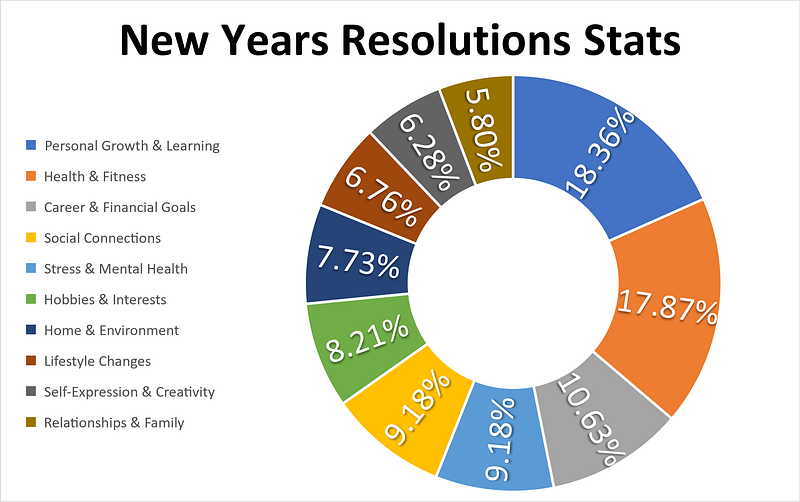
In the analysis presented in the table, you performed a categorical distribution of 1,035 New Year’s resolution ideas. Each resolution was assigned to one of ten distinct categories, such as “Personal Growth & Learning” and “Health & Fitness.” The count of resolutions in each category was then tallied. To determine the relative popularity, the number of ideas in each category was divided by the total count (1,035), yielding a percentage that reflects the proportion of resolutions within each category to the overall collection. This provided a clear view of the areas where people are focusing their aspirations for the New Year.
After doing the calculations, I found that they reflected a broad spectrum of human desires and concerns. The leading categories were Personal Growth & Learning (18.36%) and Health & Fitness (17.87%), underscoring a strong societal focus on self-improvement and physical well-being. Interestingly, Career and financial Goals (10.63%) and Social Connections (9.18%) followed, indicating a balanced emphasis on professional success and relational ties. However, it was revealed that Relationships and family garnered only 5.80% of the resolutions, hinting at a troubling shift towards individualism over communal values.
The significance of this study lies not just in its findings but in its methodology. The random and passive nature of data collection allowed for an unfiltered glimpse into personal priorities, offering a more nuanced understanding of societal trends. The results suggest a growing emphasis on self over community, a trend that could have profound implications for our social fabric. The table below shows the analysis results of New Year resolutions and their manual assigned categories:
+---------------------------------------+-------------+----------+
| Ideas Category                        | Ideas Count | Ideas %  |
+---------------------------------------+-------------+----------+
| Personal Growth & Learning            |         190 |  18.36%  |
| Health & Fitness                      |         185 |  17.87%  |
| Career & Financial Goals              |         110 |  10.63%  |
| Social Connections                    |          95 |   9.18%  |
| Stress Management & Mental Health     |          95 |   9.18%  |
| Hobbies & Interests                   |          85 |   8.21%  |
| Home & Environment                    |          80 |   7.73%  |
| Lifestyle Changes                     |          70 |   6.76%  |
| Self-Expression & Creativity          |          65 |   6.28%  |
| Relationships & Family                |          60 |   5.80%  |
+---------------------------------------+-------------+----------+
| Total                                 |        1035 | 100.00%  |
+---------------------------------------+-------------+----------+
Overview of Forbes’s Study
In my exploration of societal priorities, I analyzed Forbes’s comprehensive study, which offered a contrasting quantitative perspective on New Year’s resolutions. Conducted with a structured methodology, this survey of 1,000 U.S. adults revealed prevailing trends and demographic nuances. Remarkably, the 2024 survey marked a pivot from mental to physical health, with nearly half of the respondent's prioritizing fitness. This shift from the previous year’s mental health focus paints a picture of a society increasingly valuing physical over mental well-being.
Forbes’s methodology, employing predetermined categories, starkly differs from my thematic approach. This structured format possibly influenced the outcome, channeling responses into narrower lanes. Notably, the survey underscored the generational divide, with older adults (78 and above) maintaining a focus on mental health, highlighting varied priorities across age groups.
This observation leads to a profound realization: as we evolve, our collective consciousness gravitates towards tangible, measurable goals, like physical fitness, possibly at the expense of intangible aspects like mental well-being and familial connections. While Forbes’s study illuminates a society leaning towards physical health, it inadvertently mirrors a broader societal trend — a movement towards individualistic goals, overshadowing communal values and relationships.
Comparative Analysis
In comparing the findings from my study with Forbes’s, a fascinating convergence and divergence of societal trends emerge. Both studies underscore a strong emphasis on personal growth and health, reflecting a societal inclination towards self-improvement and wellness. This shared focus points to a broader cultural trend: an increasing prioritization of holistic wellness, encompassing both mental and physical health. However, the path to achieving this wellness differs markedly between the two studies.
Forbes’s survey, with its quantitative, category-driven approach, revealed a significant shift towards physical health, particularly fitness, as a primary resolution for 2024. This contrasts with the more balanced distribution of resolutions in my study, where categories like Personal Growth, Health & Fitness, and Social Connections were more evenly represented. This disparity suggests that the nature of the survey — closed-ended in Forbes’s case and passive collection in mine — might significantly influence the responses, possibly channeling them into more easily quantifiable goals like physical fitness over more abstract concepts like relationships and community.
These findings lead to a deeper reflection on the evolving nature of our resolutions. While we collectively acknowledge the importance of overall wellness, there is a notable drift towards individualistic goals at the expense of communal and familial values. This observation heightens my concern about the diminishing emphasis on relationships and family, which I believe are crucial for personal and societal health.
Personal Reflections and Concerns
My analysis’s revelations have deepened my concerns regarding an apparent shift towards individualism, a trend distinctly contrasted by the modest attention to ‘Relationships and family’ in the resolutions collected. This trend is disquieting, as it seems to signal a departure from the communal and familial values that have traditionally been the bedrock of societal health and well-being. The prioritization of ‘Health & Fitness’ over familial bonds in both my study and Forbes’s reflects a societal leaning towards personal achievement and self-care, arguably at the cost of nurturing deeper communal connections.
As I reflect on this, I can’t help but underscore the paramount importance of family and community in both personal fulfillment and societal health. Families and communities act not just as support systems but as crucial networks that shape our values, beliefs, and overall well-being. The low prioritization of family in these resolutions could have far-reaching implications, potentially leading to weakened community bonds and an erosion of collective values. This shift poses a challenge to the traditional fabric of society, where family and communal relationships once held a central place.
Conclusions and Implications
Synthesizing insights from both my analysis and the Forbes survey, it’s evident that our New Year’s resolutions increasingly reflect a societal trend towards individualism, with a notable emphasis on personal health and self-improvement. This shift, while positive in the context of personal growth and wellness, raises concerns about the diminishing importance of family and communal values in our lives. The comparative analysis highlights a critical societal evolution: as we increasingly focus on self-oriented goals, the traditional cornerstone of family and community may be getting overlooked.
This trend underscores the need for further research to understand the nuanced reasons behind such shifts in New Year’s resolutions. Are these changes indicative of broader societal transformations, or do they reflect transient cultural trends?
In conclusion, while it’s encouraging to see a strong focus on health and personal growth, it’s crucial to balance these with the values of family and community. As we set our resolutions each year, it’s important to reflect on how these choices align not only with our personal goals but also with the societal fabric that connects us. My personal resolution to spend more time with my family is a conscious effort to counterbalance the trend of individualism, reaffirming the enduring importance of communal bonds in our overall well-being. What about your resolutions? How do they reflect your personal values and the broader societal trends?
Author’s Note
Thank you for reading my story. Here is some information about my background. 🙏Consider sharing and participating in the conversation if this content speaks to you. For any queries, collaborations, or comments, reach out to me at [email protected]. Thank you for supporting my work!
References
Rössner SM, Hansen JV, Rössner S. New Year’s resolutions to lose weight — dreams and reality. Obes Facts. 2011;4(1):3–5. doi: 10.1159/000324861. Epub 2011 Feb 18. PMID: 21372604; PMCID: PMC6444530. [Link]
Forbes Health/OnePoll Survey (2024). “2024 New Year’s Resolutions: Fitness Takes the Lead.” Data collected October 2023. [Link]