
Week 24–30 October Writing Prompt
My Childhood Home in the Sky
The reality of living on three continents by the age of 14
My brother was born in South Korea, and my parents had hoped to stay there for a bit, but my father was assigned to a new post — Bogotá, Colombia.
But wait … his wife was ready to give birth any day!
They wanted to stay so that their kids could learn the language and culture. But my Dad’s job with the State Department had other plans. A second child? No problem…have the kid and go.
Instead, my father requested he be allowed to return to the US to have his second child (me) before going on to his next assignment. The joke later in life became that I was the only kid that would be eligible to become the President of the US. Yes, I was raised by feminist parents.
Request approved.
My mother, 8.5 months pregnant, boarded a plane with her husband and toddler, headed for the US. They hunkered down, waiting patiently as their second child was still contemplating when to exit the womb.
I was 2 weeks late. So, their plans got delayed. So, that little one in her belly didn’t quite want to come out. So … they waited. They waited in a town that was not accepting of multi-racial couples, and service to them at a restaurant was not given. It was pre-Loving Day (the law that was passed on June 12, 1967, granting the marriage of multiracial couples) in the United States. Thank you, Lovings. You make it possible for me to live without shame and fear in most areas of the US.

One month after I was born, our family boarded another plane headed for Colombia, where we spent 5 years.
Spanish was my first language. And, even though I was a newborn and toddler during those years, I remember some things.
Like the time I asserted my creative talents by using crayons to add to the beauty of the silk painting that hung in the dining room. Because…it needed my touch! C’mon! Or the time I cut down the shower curtain and attempted to make an outfit. That one made my Mom mad for days. Then there was the time I cut my brother’s hair—a skill I still hold today.
I was already showing my family that I was an outside-the-box thinker. And yet, they weren’t amused.
That house of dark wood and expansive backyard became a place for an international family to live while Dad worked. It was also a time when international children were stolen to be sold on the black market, so the enclosed backyard became our primary playground.
This was the house where I sat on my father’s lap, facing him, nose-to-nose, both of us giggling. Apparently, this was also the house where my father dropped me one night when he was rocking me to sleep, but also fell asleep. Oops.
This was also the house where I am shown (in a picture) sitting in front of the encyclopedias. Apparently, I pulled one of the books off the shelf and proudly held it above my head. This earned me the nickname “Toughie.”
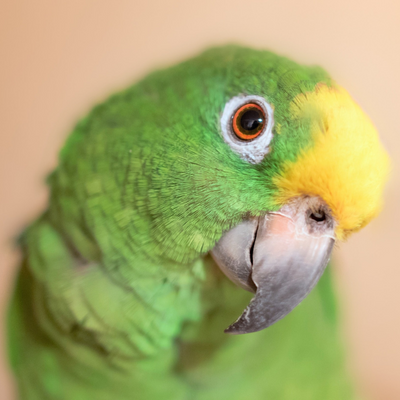
This is the house where we welcomed another family member — our beloved Roberto, the parrot.
Roberto was the prized domesticated animal until one of the maids poisoned him. Lo siento mucho, Roberto. Lo siento. (I’m very sorry, Roberto. I’m sorry.) We were all distraught. Roberto had become a member of the family with his beautiful green wings, his quirky mockings, and a slight nod of his head.
Often you would hear him crying out, “Nancita! Nancita!” as he mimicked one of the adults calling for me. That house was not the same after Roberto’s voice was no longer present.

And though all things alive will die, no one expects a child or animal to pass earlier than expected, especially at the hands of another human. But that was Roberto’s fate.
So, we planned a proper burial.
My father used a shoe box, gently placing Roberto in it. We all drove up to the mountains, and each took turns digging a small hole, placing the box with our precious bird in it. We bid our goodbyes to a member of our family.
Soon after, my father got another assignment, and off we went.
Our next temporary home was in Nigeria. I remember marble floors, three bedrooms, and a massive outdoor space. I also remember big parties and my brother accidentally getting drunk one New Year’s Eve when he asked the temporary bartender for a ginger ale and apparently got a gin and tonic instead. That ended with a young boy spinning around on the floor, giggling.
This was also the home where my brother and I would sneak out after dinner to go to the servant’s quarters to eat dinner with him. Interestingly, in Nigeria, the servants are all male. It is where I learned to appreciate fufu and goat stew—dipping your fingers in the small bowl of water, perfectly pinching some fufu and dipping it into the goat stew, moving it quickly to your mouth before the stew dripped on your clothes and chin.
This temporary home became the place where I learned how to play tetherball, speak Swahili, swim, climb banana trees, and play the piano. The early piano playing later earned me a spot in a Junior Orchestra.
This was also the home where I joined a Brownies troop, earning all the badges I could possibly achieve. I’m thinking Joyce Nielsen would be proud of me. I was showing my family that I was an overachiever.
Again, no one was amused.
My cheeky brother also taught me how to smoke at the tender age of 7, when we climbed our backyard wall (or was it the banana tree?), discovering a whole village behind us, where we sat, backs to the wall, giggling and hacking as we explored this thing called smoking.
More importantly, no one was doing anything about the serious issues brewing in the children.
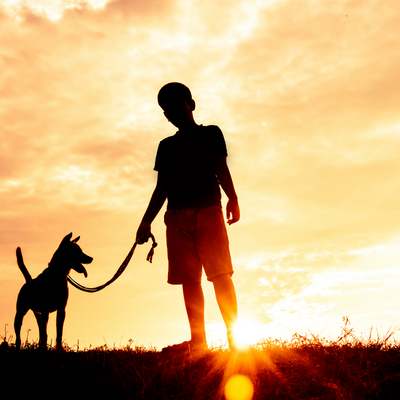
We also welcomed another family member into this home—our dog David. He and my brother were inseparable. The day before we had to leave, my father “attempted” to send David off to his new owner. The driver came back twice because David broke out of his “box.” Each time my father had to trick my brother into doing something so he could get the dog packaged up.
But at least David wasn’t poisoned. He was shipped off to a guy who had a farm that my Dad met in his agricultural adventures.
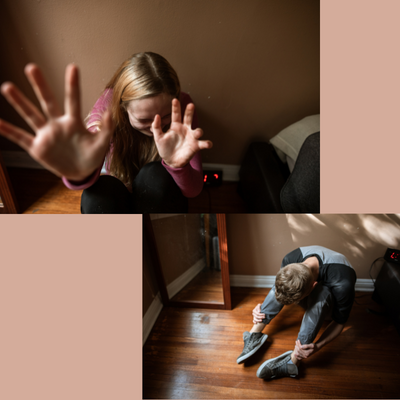
And, as much privilege as some of this holds, a lot of it ends with the words. Underneath the façade of glamorized travel and the nomad life, there was a deep trauma that brewed under the surface.
What could go wrong?
Let’s revisit the characters: a narcissist mother, a responsible but checked-out father, and two children soothing and attending to each other, hanging on to their sanity by holding each other up in the lurking darkness.
We learned that running outside was a way to self-soothe. My brother and I ran and ran and ran because I think we wanted to run away but didn’t know how.
We ran when we didn’t need to. We ran when we wanted to, and we ran because we had to. We would run and run and run, heaving with each emphatic breath, giggling, and then running some more.
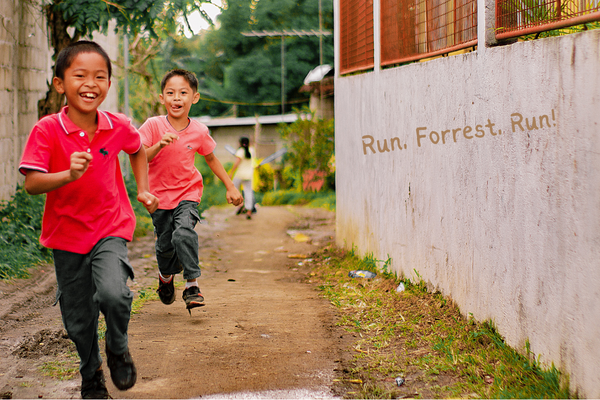
Even on our vacations, we ran. When the family was vacationing, we were running. My parents would be strolling in a beautiful park while on vacation. My brother and I … we were running. My mother was always a little happier on vacation as strangers gooed and wooed over the seemingly perfect family.
But that running. It was therapy.
Vacations happened every two years for an entire Summer. Just like temporary homes, servants, temporary pets, and learning new languages, we took long vacations.
Every two years, just before vacation, we had to pack for the just-in-case scenario where my father “might” be sent to another assignment. So, my personal belongings fit into two boxes. There were no books because I relied on libraries. This is why I am an avid supporter of libraries to this day. Reading is the gateway to imagination.
Before those long Summer vacations of travel, I watched my parents huddled at the dining room table, maps spread out, paper and pen next to them as they created an itinerary of adventure and exploration.
When I travel today, I stand at the great windows, watching the planes coming in and leaving, recalling the adventures of my past, taking in a deep sigh.

Everything about airplanes brings a sense of rest to my soul — the sight of the large wings, the smell of the piped-in air, the feel of the armrest, the touch of the plastic pull-down table, the taste of airplane food, the sound of the airplane ding when the doors are closing, and ever-too-small bathrooms to wash up.
The other part of the concept of home was temporary. Everything was temporary. The house was temporary, the school was temporary, and the friends were temporary.
This theme of temporary made me more resilient, a bit of a chameleon, and growing up as a Third Culture Kid (TCK).
With it comes curiosity (sometimes to the chagrin of others), an ease of talking to strangers, always keeping my passport up to date, and always having a proper suitcase. To this day, when I travel internationally, I travel only with a carry-on and my backpack. I have become that person — the expert at rolling clothes, tucking things into shoes, and being minimal.
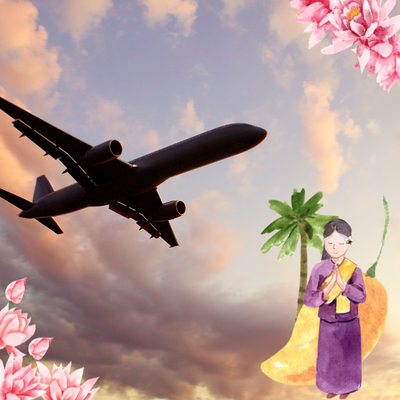
The next and last continent was Asia, but more specifically, Thailand. It was during the Vietnam War, and my father was assigned to Vietnam. Families were not allowed to accompany State Department employees, so my parents chose Thailand for the rest of the family.
Everything about being in Thailand makes me smile. From eating mangoes to Thai fried rice to seeing elephants to witnessing the delicate gentleness of Thai people.
It was my favorite temporary home. Maybe it was a coming-of-age thing, or maybe it was because I was asserting myself.
We lived on the third floor of a mid-size apartment complex for primarily ex-pat families. It was in that apartment building that I couldn’t wait to get on the school bus, a trait that still lives within me, as I am a lifelong learner to this day.
Thailand is where I experienced eating street food, riding tuk-tuks by myself, and where I had my first kiss with a boy. I learned how to play volleyball and flag football with the boys. I participated in Songkran, learned Thai, and continued with my piano lessons.
I loved being in middle school in Thailand. I loved the people and the friends I had during that time. All of it made for a wonderful temporary home.
I hated that my father wasn’t around. The absentee father thing was not great during those years as my mother became more unhinged. If it wasn’t her telling me that I was too fat every day or scolding me for my clothing choices, it was her running off to have plastic surgery, locking herself in her bedroom for weeks as she healed, too embarrassed to surface because what would people think?
But my brother and I still remained close, and we began to be each other’s protectors. With each utterance of crazy and narcissism from our mother, we clung to each other.
For that, I will always be thankful.

Thank you, Bear Kosik, for the nudge to write this part of my story. From one fellow travel lover to another, I see you.


