
My Chickens Had to Die for Me to Finally Understand the Connection Between Food and Inflammation
And even then, it has taken three years
Author’s note: Because the world is now flooded with people suffering from pericarditis related to COVID-19, I felt compelled to share my experiences. I am not a healthcare professional. I have no nutritional training. I am merely a patient working through a chronic health issue.
When you’re in the heart of an inflammation storm, it’s not possible to think clearly. All I could think of in the weeks after a raccoon tore apart the wire door of my hen house and slaughtered my four girls was that it was probably for the best because I had become so severely ill that caring for the chickens would not have been possible. Hubs had taken over horse chores and caring for the chickens would have been just one more burden I was thankful he didn’t have to bear.
Back story:
I was diagnosed with idiopathic pericarditis in 2010, just as I turned 50. I’d had mild flareups of it for years before the diagnosis. I say “mild,” but that’s in hindsight. There were at least three doctor’s office visits and two ER visits with symptoms during the decade that led up to my diagnosis — all with no results, treatment, or even much in the way of sympathy.
“Your heart’s fine,” they all said. “Have you been stressed lately? Are you sleeping enough? Maybe it’s a food allergy.”
It was shocking and a bit of a relief to have an actual name for the inflammation that had been randomly causing me severe chest pain and extreme fatigue for almost a decade. The surprising part was that my primary care doc was confident that two weeks on high-dose ibuprofen would knock it out and I’d be fine.
“Fine” didn’t happen for almost five years. As my symptoms progressed to intolerable shortness of breath and exhaustion so extreme that I thought death might be near, I sought help from a cardiologist who was at first helpful, but soon turned skeptical. There were also a rheumatologist, a gastroenterologist, an otolaryngologist, and an endocrinologist, none of whom did much of anything besides run tests that all came back negative because the problem was truly just inflammation in the lining of my heart.
Strong medications, including 800 mg of ibuprofen three times per day, a gout medication called colchicine, and occasional rounds of steroids helped me stay reasonably functional from 2010 to 2014.
The chickens and their eggs
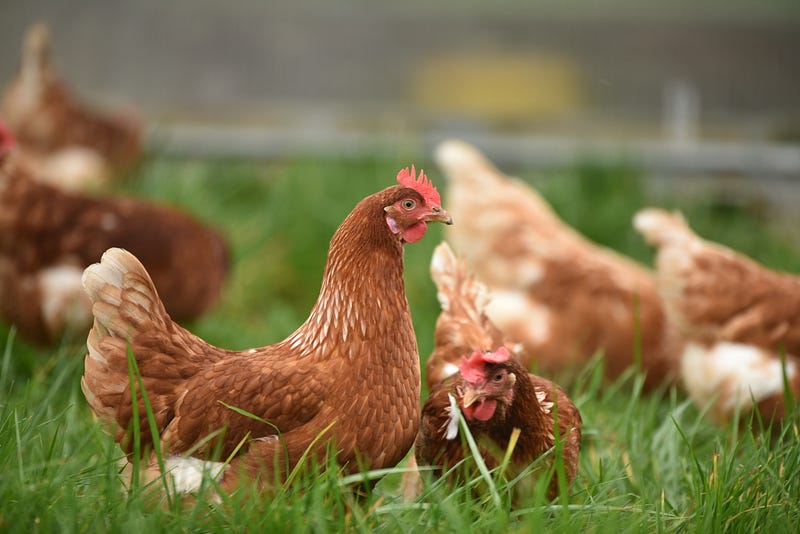
After enjoying the taste of fresh eggs from my daughter’s chickens, in early 2015, I decided I’d like some chicks of my own. They were a spoiled brood of hens. In addition to having free range to eat bugs and plants during the daylight hours, we fed them our fruit and vegetable scraps. Ever seen a flock of chickens diving into a watermelon? It’s as much a treat to watch as it is for them to eat.
At night they got a bit of commercial pellet food — the expensive kind with fish oil added to improve the Omega-3 content of the eggs.
They began laying eggs in earnest late that summer. By fall, we were enjoying the bounty of fresh eggs for breakfast, baking, and often for dinner. They were nothing like grocery store eggs. The yolks were a rich golden yellow and the whites were thinner.
My recovery
By November of 2015, I was feeling considerably better and had begun to taper off of the high doses of Advil. I assumed I’d never be able to stop taking the colchicine. The week before Thanksgiving, I contracted a bad food-borne illness that halted intake of everything except minimal sips of water for three days. By day four I was a bit better and considered taking my usual doses of medications. But guess what? When I got up and about, I realized there were no symptoms of pericarditis. That had not happened in years.
I made the decision to simply stop all the rest of the medications I was taking for the pericarditis. What I thought would be a trial situation to test the limits of going medication-free ended up being the beginning of full remission.
Because the pericardium surrounds the heart, when it is inflamed with pericarditis, every beat of the heart causes friction and bumping against the sore tissue. If you have an inflamed tendon in your knee, an orthopedist will tell you to rest your knee. It’s impossible to completely rest your pericardium, but the advice from the pericarditis experts at the Cleveland Clinic is to maintain a heart rate below 100 for optimum healing.
I had been in that “resting” state for years, so ramping my activity levels took some time. I started with slow strengthening exercises, then added walking. I proceeded very cautiously, not wanting to stir up the beast in my chest ever again. By mid-2016 I felt I was truly back to a normal life.
The freedom of remission
I spent the remainder of 2016 feeling like a productive human being again for the first time in years. I continued to add exercise back into my life and ramped up my work and travel load. As a travel writer, my ability to do my job well had been limited for years. But now I had newfound freedom. I could breathe. I had strength and stamina again.
In 2017, hubs and I visited seventeen countries and went on six cruises, giving me more material to write about than I’d had in a decade. In August of 2017, I did something I had not done since I was 18 years old — I began running. I started slowly, giving my body time to adapt. I paid attention to every signal my heart and lungs and muscles sent. It felt glorious. I started training for a 5K. My goal was to run one in early winter.
In January 2018, hubs and I went to Bonaire on a two-week scuba diving trip. Halfway through the first week, I began to feel the familiar tightness in my chest. By the time my sister-in-law joined us for the second week, I knew the pericarditis was coming back. I started on high doses of Advil, hoping to halt the progress. It seemed to work reasonably well and though I had some pain and a bit of fatigue, I did not have any shortness of breath or any of the severe symptoms I’d had in the past.
The monster returned, angrier than ever
Upon returning home from our dive trip, I reverted to my resting state, called my doc for a renewal of the colchicine script, and began life again as a pericarditis patient. I seemed to rebound pretty quickly and hoped I’d caught it early enough to keep it from getting any worse. I stopped all exercise, giving up my 5K dream.
As winter turned to spring, I began to consider starting a taper off of the Advil, but a lengthy European trip for a writing assignment in April forced me to put that on hold.
And then the chickens died.
Within a month of losing the chickens, the pericarditis went from annoying to excruciating to debilitating with lightning speed. By July fourth I was almost bedridden. My legs were rubbery and weak. My heart pounded in my chest, skipping beats randomly, and racing at top speed from something as simple as sitting up or eating breakfast.
I sought help from doctor after doctor. Medication routines were altered. Steroids changed the shape of my face. I had brain fog so severe I rarely knew what day of the week it was. My life ground to a halt. I went for months without even seeing my horses, much less caring for them.
By December of 2018, I finally found a cardiologist willing to explore all possible options to get me healthy again. As soon as he got the results from a cardiac MRI, he sent me to a cardiothoracic surgeon to schedule open heart surgery to strip the pericardium from my heart. It seemed to be the only way out of this mess.
The surgeon was a swing and a miss
Pericardiectomy is a very specialized surgery, and not every heart surgeon is comfortable doing it. The one hubs and I went to was only willing to remove the front of the pericardium, leaving the back. I knew that was unlikely to help, so back to the cardiologist we went. We begged for other options in an attempt to stave off the surgery as long as possible.
Door after door was closed, not by us or doctors, but by my insurance company. As each one closed, I became more convinced that I had gotten myself out of this before and could somehow do it again. I started with diet. I had already lowered my salt intake, but with the help of a cousin’s Facebook group, became familiar with the DASH diet, designed by the National Institutes of Health for people with hypertension. DASH stands for Dietary Approaches to Stop Hypertension. It’s less about what you can’t eat and more about adding healthy choices, primarily in the form of fruits and vegetables.
Baby steps and a miracle medication
As I flooded my body with healthy food, including yard eggs from a neighbor, and some from my daughter when she came to town, I began to see tiny improvements. The brain fog was the first noticeable symptom to clear. Throughout 2019, my improvements began to add up. I could walk a little again and was finally able to start feeding the horses on my own, but I still had to be extremely careful. Anything I did that stressed my body put me in bed for days.
Finally, in September of 2019, I got approved to begin an injectable biologic medication that was being used by the doctors at Cleveland Clinic. Kineret was a game-changer. Within weeks of starting it, I was feeling better than I had for more than 18 months. That fall, we went to Germany, Denmark, and Norway with Viking Ocean Cruises. But by the time we returned, I was sick again.
It was around that time that I first wondered about the egg connection. I was sick until I started eating yard eggs of my own. I got sick again when the chickens died and better when I started getting eggs from a neighbor. I felt worse again when we traveled. Was it possible that the eggs were really a factor in all of that?
I eventually stumbled on a blog post about the balance between Omega-6 and 3 and how free-range chickens are higher in Omega-3 as long as they aren’t fed a lot of grain supplements.
I’m not a food nut
I am the polar opposite of being a health-food nut. I like junk food. I eat sugar on occasion. I think fad diets are quackery and often dangerous. But I am always open to adding healthy foods (or supplements) to my routine. I don’t like taking things away. The first thing I had given up was salt. It helped with my blood pressure.
Next, I gave up beer and wine. Let me tell you, friends, that was a hard one. I adore a good craft beer or a perfectly paired wine with dinner. If there’s a good outcome from that, I haven’t seen it yet. Very slowly I read up on the whole Omega thing and became convinced that maybe I had been inadvertently been running an experiment on myself using “good” eggs and “bad” eggs.
The real test
By early 2020 I had switched from a mix of yard eggs from the neighbor and store-bought eggs to nothing but organic, high Omega-3 eggs from the local grocer. Bit by bit I was recovering, but every attempt to taper off meds or add activity caused a setback. When COVID hit, I felt torn between relief that I could stay home being still and terror that I would be more vulnerable if I was somehow exposed.
My next step was to add more Omega-3 foods (or at least better-balanced foods) to my diet: Tuna, walnuts, avocados, Smart Balance Omega-3 Spread, organic milk, grass-finished beef, and canola oil are among my top choices. (Sure, I know anchovies and sardines would be better, but I have my limits. The only sardines I’ve ever loved were fresh from the Adriatic, in a quaint restaurant in Slovenia.)
The most easily detectable change was from avocado. I honestly need a 1/4 to 1/2 of an avocado at least every other day. Skipping too many days leads to rapid decline. You do know Tom Brady eats avocados almost every day, right?
I am convinced
In February, here in Texas, you may have heard about our deep freeze event. Northerners can laugh all you want, but it was an extreme situation for the whole state of Texas. For me, besides the power outages and extreme cold which meant serious hard work to keep my horses alive (with help from hubs), it caused a month’s delay in my shipment of Kineret.
The extra activity and missing a month of injections literally put me back on the couch for the month of March. I was so disheartened. There are times when I feel the pressure of lost time almost as strongly as the pressure in my chest. I pulled through by adding even more Omega-3s’ to my diet: I started on krill oil supplements, and never missed a day without avocados.
The real proof though, came in May when I had retina surgery. The surgery required me to be off the Advil for 10 days prior to prevent bleeding problems. I was more afraid of that than of the surgery itself. I was certain it would be a problem.
Experience has shown me that very slow tapers of all meds is critical in preventing pericarditis flares, but I didn’t have the luxury of that. I had 20 days to get off of 12 Advil tablets per day.
I hit the 10-day target and did my best to consume all the organic eggs and avocados I could shovel in my face. The surgery went smoothly, as did my recovery, which involved laying face-down for nine days (def a story for another day). Pericarditis symptoms remained in check.
The surgeon had said I could re-start the Advil a few days after the surgery. By the time my one-week follow-up arrived, I had made the decision to hold off as long as I could. Guess what? It’s August and I’m still not taking Advil.
Omega-3 for the win
Those of you who have peri understand what a victory I am enjoying. Dropping any medication successfully is huge. I bet some of you cringed when I said I had to lay face down for nine days because when peri is at its worst, there’s no laying down at all — the pain is too great.
As I said, I generally lean away from massive dietary changes and have zero nutritional education, other than what I researched myself along the way. But there is nothing that can convince me that nutrition is not playing a huge role in my recovery. I still eat my pizza and tacos (because guac, right?) I still eat cookies, they are simply made with plant butter avocado oil sticks.
Next up, my attempt to spend 99 days reconditioning my body for a November scuba diving trip.
References:
Omega-3 Fatty Acids Fact Sheet for Consumers https://ods.od.nih.gov/factsheets/Omega3FattyAcids-Consumer/
Here’s What Tom Brady Eats Every Day and on Game Day https://www.menshealth.com/nutrition/a19535249/tom-brady-reveals-insane-diet-in-new-book/
Pastured vs Omega-3 vs Conventional Eggs — What’s the difference?https://www.healthline.com/nutrition/pastured-vs-omega-3-vs-conventional-eggs
Practical Tips for Balancing the Omega 6-to-3 Ratio https://www.psychologytoday.com/us/blog/evolutionary-psychiatry/201702/practical-tips-balancing-the-omega-6-3-ratio
DASH Eating Plan https://www.nhlbi.nih.gov/health-topics/dash-eating-plan