
My Career Transition: From factory to IT
5+ years later — What I would and wouldn’t do

Almost 6 years later of my professional restart, decided to re-share a little so that people can reflect on my path to make better decisions on theirs.
Checkout other medias I create content: ➡️ GitHub ➡️ My Data Courses (udemy) ➡️ Linkedin ➡️ Subscribe my Newsletter ➡️ Youtube
Yeah, time passes, and with it I like to always look a little back and review what happened, to have a reflection. And when I look at my professional past and compare it with my present, I would never imagine that I would be where I am, both professionally and geographically. Next April, I’m celebrating 6 years of this table-turning.
A lot of people who follow me know that I have no background in the IT area. I have completed a Technician Course in Mechanics (similar to an Ausbildung in Germany), a Bachelor’s in Product Design, and a Master’s in Materials Engineering. From 17 to 29 I worked in several areas of metallurgical industries: from aluminum casting assistant dropping melting aluminum in casting trays at around 700–900 degrees Celsius to CAD design, where I designed machines for the shoe industry.
For the time being, I had a nice experience, a cool salary for the average in Brazil, more than my Dad had ever made in his life (just for you to understand my standard at that time), but way below the IT professionals, which at that moment, was something out of my world.
For Portuguese Speakers, here is a link to two YouTube sites where I tell my story: -> Live with Stack people -> Live with mentor Joao Oliveira
Yes, I wanted to migrate to IT, but like many, lost and did not know where to start, studying random things on Udemy, with a queue of courses and none finished. Until a “sister” friend of mine, whom I will not mention (Evelise =D) was living in India, came to me with an invitation “There are vacancies for SQL developer here at TCS Kolkata, you need to know about Databases and speak English, it’s an internship by AIESEC”. Many doubts:
- What is TCS? AIESEC? - Internship at almost 30? - Database?
It was a lot of uncertainty for me who was “comfortable”. But, as I love a change of atmosphere, I answered (both to my friend and in the interview): “English I speak well, and the rest I know just a little, but I can learn!”.
To find out the rest, check my LinkedIn to know where I went and what I did. But in short, since 2018 I have been through TCS, iMaps Data Group (iMaps Intelligence and Datalakers), Whitecube, Flixbus, and now HSE in Germany (among other freelancers)
The most tense moment was certainly the internship at Tata Consultancy Services, in India, earning less than I earned in Brazil. There were many uncertainties, a 1-year contract, had to work out in that one year because, after all, I had the financing bills to pay. What if it didn’t work out? Didn’t you learn? Or didn’t you like it? It was a risk. In addition to learning technology, I had to learn a new culture, being an intern at 30 requires a little patience, because I was no longer used to being a dependent person, on the contrary, I was usually the one who helped people solve problems. A giant change of mindset. Well, I dedicated myself body and soul and for almost six months (of 1 year of contract) I took advantage of this internship and I fell on my head, I was the first to enter every day, I studied a lot, a lot, every weekend without fail until I felt confident to relax (lightly). Well, I left this 1 year in India with the conviction that it would work.
Then the story gets less tense. I returned to Brazil, and worked in companies with fantastic people: First, at iMaps I fell headlong into the world of BI, I evolved, I gained raises, I got certifications, and I made friends. Then I decided that I wanted to get to know new technologies (especially the so-called Power BI) and I ventured out into Whitecube (Microsoft’s gold partner) and it was where, almost by chance, I met Data Engineering and saw a lot of potential.
Another job change in which I focused on a lot, I took certifications that very few people had, created personal projects, worked for international projects… And, when you make friends and work seriously, the companies remember you, and then I went to Datalakers, which belongs to iMaps Data Group. At Datalakers, I went back to working with good people in data engineering, I had many opportunities within the company, I had too many GREAT colleagues, and I developed myself a lot. The Data Engineering professional I became at Datalakers was the professional who certainly caught the attention of the German company where I work today.
A little of past context, here are some key points that I would like to send to those who are in the process of career transition, or are thinking about doing:
Start
Don’t do like me and study random things. Use your time wisely, talk to people, hire professionals to help you walk the way. Spend some time researching which area you want to work on, to tune what you need to study. At first, give that gas, that focused on, turn off a little from others that are not important for your career migration.
I’m mentor in 2 platforms:
https://topmate.io/cassio_bolba
What to study
Don’t start with a graduation or post grad, the pace is very slow, it can be expensive, and the return is small. A graduation will make a difference, MAYBE, when you are competing for leadership or management positions. Learn the base of the area you have chosen, learn the IT base, as the fundamentals of software engineering, learn about algorithms, data structure, system architectures. Of course, it is necessary to balance the necessary depth of these topics according to your need/or your area. Remember not to get discouraged, you don’t need to know everything!
If you are looking to become a data engineer, I wrote this:
English
Aren’t you studying yet? You’re already wasting time and money. The IT market is almost geographic (maybe it invented that word), but I want to say that it has no borders. Working for companies from outside being in Brazil, or immigrating via IT, is the reality.
The step back
I consider this a decisive moment. Reducing your salary and also your work morale (sometimes) can be easier or more difficult depending on your current situation. For me, it was not so difficult, because there was no family to take care of, only dog, small mortgage and a car.
But if for you the situation is different, I want to say not to be discouraged, it will be worth it. He asks for support from the family, which will be better for everyone in the future. If your plan is moderately good, I assure you that.
Portfolio
Do you believe that I only went to create a repository in Git and a LinkedIn almost a year after my career migration? DON’T DO THIS, f”for the love of {my_divinity}!”. At the start, go out creating repos with your studies, create personal projects, publish on LinkedIn. This can be a watershed in your professional search.
I wrote about this topic here:
Same thing as about the portfolio, already have one and add influential people in your area, and also recruiters who can see you in the future. Interact in the posts, generate discussion. Generating connections in this network has become the new curriculum. This network can leverage you in your career and also help you stay on top of the news.
How to study
Don’t be a course saker. At first, I was like that! You forget everything you study if you don’t apply. So, study for a week, and the next week create something (that already goes to the portfolio) no matter how simple it is and so on. As the articles on study memory say, the other day, you forget between 60 and 80% of what you have learned, and if you don’t revise, you lose everything. Source: time news, roman. Just kidding, that was Alberto Dellisola, South American record holder of memorization, whom I met in the German course of Lua Fonseca, the club of the German sprache UND wissen. Credit given. So, don’t be a course saker who posts an Udemy diploma on LinkedIn every day and who doesn’t know how to apply 10% of what he has learned.
Some hacks to study:
Curriculum
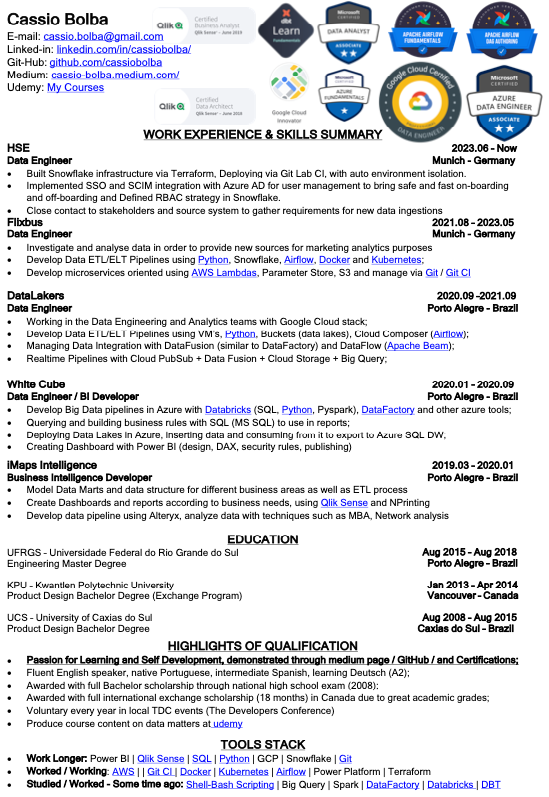
It is also good for the link, but if you come from another area, you will not have previous experience, so do the following: Try to relate how you can reuse your skills in the old profession, with the new profession. In my example, I was a designer and designer of machines migrating to BI / SQL developer, and one of my activities was to monitor and understand the performance of the machines. This in my new resume turned: - Manipulate database in Excel to generate performance indicators - Understand metrics with technical team for rule creation Did you so it? I’m not lying! Maybe for my old profession this is secondary, but for BI analyst it is important. Soft skills are worth it too! If you had a position of direct contact with customers or C level, if you led any team, this can all count.
Just for your information and inspiration, this is my current resume:
For the older people
Linking to the subject of giving value to your previous experience, make your professional maturity, experience in a business or corporate environment worth it. Your more mature behaviour worths A LOT. And that’s something that companies value. This is one of your advantages against younger candidates, use it to your advantage, show emotional stability, dedication, career focus, maturity… Not that younger people do not have these qualities, but it is more common to be present in more experienced people.
Wow! I can think of many other points, but these would be the ones I consider basic, to have a smoother transition.
Other things I write
You might be interest in this series where I’m introducing several important concepts that new Data Engineers should be aware of. The other topics I talked so far:
✅ Data Modelling ✅ CDC ✅ Idempotency ✅ ETL x ELT x EL ✅ Kappa x Lamda Data Architectures ✅ Slowly Changing Dimensions — SCD ✅ 10 Concepts all Data Engineers should know ✅ Modern Data Stack ✅ Snowflake as Data Platform ✅ Data Warehouse x Data Lake ✅ My favourite AWS resources for Data Engineering ✅ Normalization Model (3NF) x Dimensional Modelling ✅ Dimensional Modelling x One BIg Table (OBT) ✅ OLAP x OLTP
Here is a summary of all my Python articles about efficiency and software engineering with Python:


