
Daily neuroscience
My Brain Network shows if I am Lonely or Not
3 things about brain network and social network you should be aware (post-COVID edition)

Quarantine or self-isolation sucks, at least it did for myself. Many things have been hampered to curb the spreading of COVID19 this year, and some still are. What I haven’t thought about before corona time it is that loneliness — induced or voluntary- can be seen explicitly in the brain.
Last year I gave a provocative talk at TEDxMuenster, linking addiction to depression, and showing this on brain networks. The take-home message was that using online social networks can change our brain, and we should reduce online time and spend more time with our offline networks in person. At that time, I was not expecting something like self-isolation or quarantine or other COVID19 dramas. It turned out that this year we had to spend a lot of time alone or in isolation, social media were actually our best alley, and relationships between our brain and social networks got another weird twist.
In parallel to this weird state, a recent study came out. In an article of Andrea L. Courtney and Meghan L. Meyer, social media websites are not the only ones that keep track of your social network — your brain does, too. Loneliness can also change how the brain represents relationship [4]. So, let’s recapitulate 3 things about brain network in our quasi-post-lockdown regime:
- My brain is a network, as my friends
- Loneliness alters the brain networks
- Redesign the brain network is still possible
1. My brain is a network, as my friends
A structural connectome is a comprehensive map of neural connections in the brain. This representation reduces the complexity of the brains (spaghetti neurons) into a network. This is achieved combining tracing algorithms (called tractorgraphy) with anatomical subdivisions defined from previous studies. Tractography is generally obtained noninvasively by using magnetic resonance imaging (MRI) [1]. In the video below, there is my brain using the well-known anatomical AAL subdivision.
Other MRI techniques measures brain activity by detecting changes in time associated with blood flow, in this case we talk about functional MRI. Participants of those studies are generally asked to rest or perform a task (as squeezing a ball or thinking about something) [2]. In clinical study several of those networks for distinct groups are collected (e.g. people staying at home during COVID pandemic vs people non-isolating), and it is possible to find differences by using advances group statistics [3].
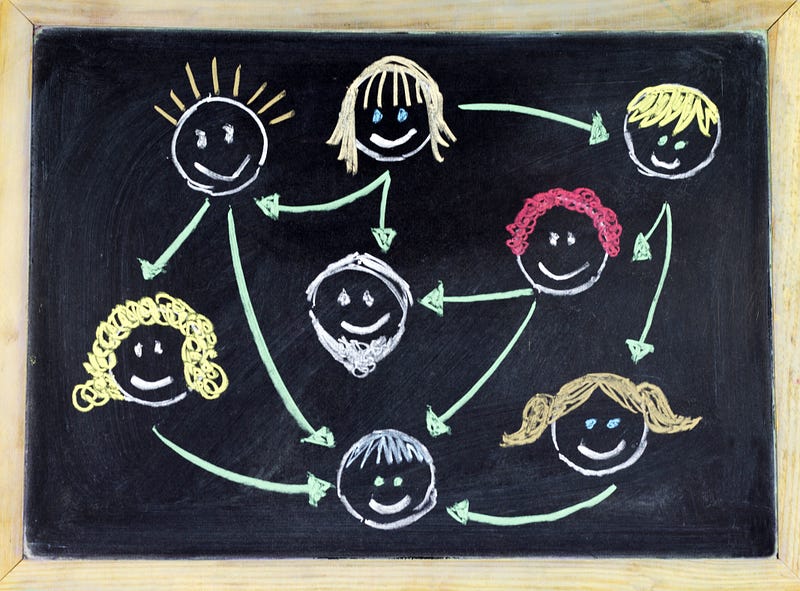
This is maybe too clinical. In real life, I -like everybody else- have another network: real-life relationships, both online and in real-life. It’s like I am one node and other people are the other nodes of this network:
2. Social connection is critical to well-being
Courtney and Meyer used statistical analysis on Functional MRI acquisitions, looking for differences — among groups — of brain activity at particular locations rather than differences in connectivity with people considering them self as isolating or not [4]. They assessed whether and how the brain organizes representations of others based on how connected they are to our own identity. They asked to participants to perform self- and other-reflection tasks. The study showed that the closer you are to people emotionally, the more similarly you represent them in your brain, namely the areas which are activated. Conversely, people who consider themselves as socially disconnected appear to have a lonelier self-representation in the brain.
The study involved 50 college students and community members (18/47-year-old). During the scan, participants were a asked to perform a self- and other-people reflection task: themselves, five close people, five acquaintances, and five celebrities, who are known people but not in the personal network. During the process, they reported their subjective closeness to each person and their trait loneliness.
The results showed how the brain seems to “allocate” internally people according to the three different clusters: oneself, one’s social network, and celebrities. Results showed that the neural activity reflects the self-representation and the representation of people whom are close to us are similar, and yet they will differ from the representation of lonely people. More specifically, the figure below highlights in blue the statistically significant areas, which are different among groups on left, and how similar they were within their same network of friendship (center and right). The highlighted area is called medial prefrontal cortex (MPFC), the region related to the idea of self. The other two graphs below represent how similarity were measured. In practice, the study has shown that loneliness seems to be associated with distortions in the neural mapping of social connections with others.
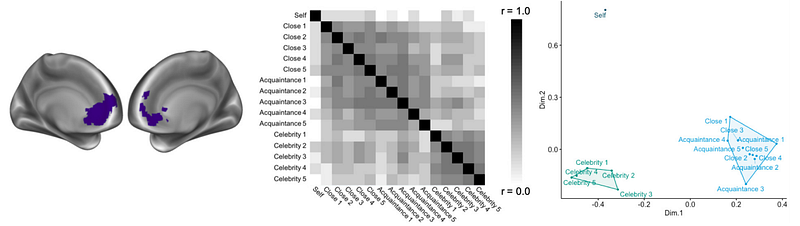
In simpler words, the closer participants felt to someone, the more similar their representations across their network were. Solitary people indicated less neural similarity in the MPFC among themselves as well as other people.
The study had a small sample size and does not capitalize to investigations on nature vs nurture, but it is inline with previous studies on the impact of loneliness to the brain [5,7]. It is generally known that people who are more integrated in social groups have shown regular biomarkers values for physiological function (e.g. endorphins) and lower blood pressure [6].
Social-affective processes require touch and visual interaction, as reading each other faces. It has been reported that social interaction based on visual contact -even if online- are considered of higher quality than purely verbal interactions (mail, letters, calls…) [8,9]. I do not have an fMRI sequence of me thinking of my friends, but during the self-isolation period I also had the impression of feeling more energized after a Zoom or Skype call rather than emails exchange.
3. Redesign the brain network is still possible
Some people are more inclined to loneliness than others or alternate periods of loneliness and high interactions (the dichotomy introverts vs extroverts). I am partially extrovert and introvert and self-isolation has been relatively painful. Moreover, representation of self and well-being are very abstract concepts. Therefore, if a “lonely” representation means a dreadful thing cannot be fully conclusive.
However, the quality and intimacy of social relationships are generally critical predictors of happiness and well-being [5]. Recent events might have forced people twisting their usual behavioural patterns in unusual ways and this might have had an impact. Even if someone considers him/herself an introvert, neurobiological studies showed that perceived social isolation (i.e., loneliness) may be the most potent threat to survival and longevity [6].
In specific epidemiological studies about death due to cardiovascular disease, the three factors deemed having the biggest effect were (1) the frequency of social support from other people, (2) how well integrated the person is into their social network, and (3) whether the patient were a smoker [7]. This highlights how our social network relevant is.
In summary, happiness might be in part related to the interpersonal maps is carried in our brains every day. Given the plasticity of the brain, it could be beneficial being aware of these processes, and still put some efforts taking care of mental health, nurturing social network (offline and online). As for the recent COVID19 pandemic, if forced to isolation, better use visual interactions (Skype, Zoom…) among the online alternatives of communication [8,9]. I still support this rather than cold emails.


REFERENCES
- Sporns, Olaf. Networks of the Brain. MIT press, 2010.
- Huettel, S. A.; Song, A. W.; McCarthy, G., Functional Magnetic Resonance Imaging Second Edition, Massachusetts: Sinauer, 2009
- Crimi, A., Giancardo, L., Sambataro, F., Gozzi, A., Murino, V., & Sona, D. MultiLink analysis: brain network comparison via sparse connectivity analysis. Scientific reports, 9(1), 1–13. 2019
- Courtney, A. L., & Meyer, M. L. Self-other representation in the social brain reflects social connection. Journal of Neuroscience. 2020
- Klinger, Eric. Meaning and void: Inner experience and the incentives in people’s lives. University of Minnesota Press, 1977.
- D Bzdok, RIM Dunbar The Neurobiology of Social Distance, Trends in Cognitive Sciences, 2020.
- Holt-Lunstad, Julianne, Timothy B. Smith, and J. Bradley Layton. “Social relationships and mortality risk: a meta-analytic review.” PLoS medicine 7.7 : e1000316. 2010
- Vlahovic T. A. et al. Effects of duration and laughter on subjective happines within different modes of communication: happiness and mode of communication. J. Comput.-Mediat. Commun. 2012; 17: 436–450
- Burholt V. et al. Technology-mediated communication in familial relationships: moderated-mediation models of isolation and loneliness. Gerontologist. 2020; (Published online May 5, 2020.