
Your Body Is A Temple
10 Insane Facts From Bill Bryson’s “The Body”
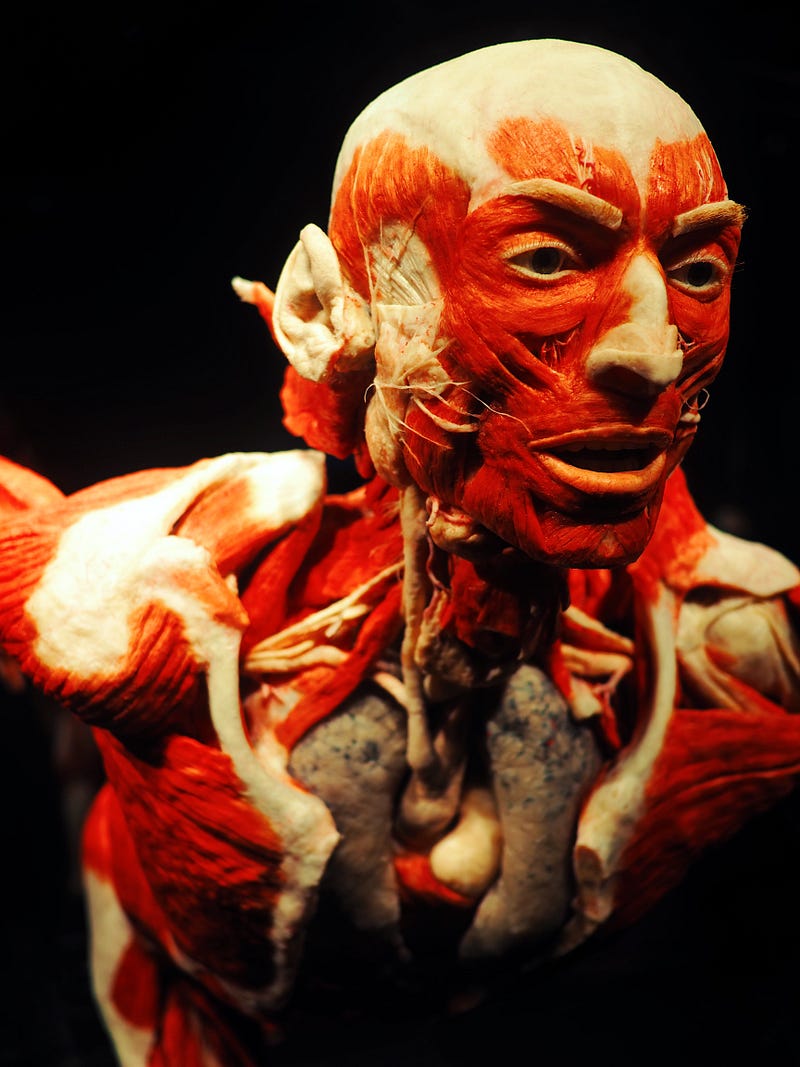
From harrowing descriptions of chainsaw mastectomies to advances in laser-gunning cancer, Bill Bryson’s sprawling, acerbic masterpiece is unputdownable. Bryson’s informative treatise takes us on a head-to-toe examination of every nook and cranny of the human body. Fact-filled, slapstick, poetic, heartbreaking.
Jampacked with information, this is a forensic study of the history, and present, of our uniquely human condition. It fired up my synapses, turned me into a medical acolyte and left me with a whirlwind of thoughts that I articulate below.
DNA
We have a metre of DNA packed into every cell. We have trillions of cells. Stretching out all the packed DNA into a single strand would take us beyond Pluto. We are literally cosmic. DNA only exists to create more DNA. A chicken is an egg’s evolutionary mechanism to make a better egg. DNA is indestructible, lying dormant for thousands of years, capable of constructing a whole organism when activated. Our genes are eternal. We carry some genes from when life first began 3 billion years ago. We are a living, evolving, genetic ledger that’s unbroken since then. All humans share 99.9% of DNA. A 2% variation separates us from chimps. A 40% variation separates us from a banana. We started off as a primitive fish; we now nap behind the wheel of a self-driving car.
Skin
The stratum corneum or the outermost layer of the skin is made up of dead cells. All that which makes us look good — our beauty — is literally dead. The global beauty industry estimated to be worth over $700 billion, is essentially for decorating deceased tissue. Our vanity, confidence, self-respect, ego, self-worth…is a sliver of dead skin.
Race is literally skin deep. Technically, it’s a few millimetres of the epidermis. It isn’t biologically significant or defined. Millimetres of dead skin and an intuition driven brain are the root causes of racism, socio-economic disparity, discrimination, bias, violence, eugenics, caste and slavery. Unforgivable.
Sweat
We have more sweat glands than most mammals. So, we sweat more. We have a larger surface area for heat dissipation and temperature regulation. So what? Evidence shows sweating is responsible for us having bigger brains. In computing, ultrafast, hyper-connected processors need radical cooling systems to keep them from melting. Faster chips produce more heat needing even more cooling. Evolution, with its billion+ years of R&D, has built the ultimate cooling solution for us. And we are so much better off because of it. Besides the obvious benefits of exercise, maybe breaking a sweat every day is good for the brain?
Microbiome
We are born 100% human; we die 98% alien — my favourite line from Ed Yong’s scintillating “I Contain Multitudes”. We don’t know how many microbes we host. Or what type. Or where. Of what little we have gleaned, we know our lungs alone is home to 174 different species of virus, 90% of them never seen before. We know of over 100,000 types of virus in existence. Of this, we know of only 586 that infect mammals and 263 that infect humans.
In 2014, French researchers discovered a hitherto unknown virus locked in permafrost for over 30,000 years in freezing Siberia. They injected this into amoeba and were amazed when it sprang to life, going about its biological functions without missing a beat. Imagine what apocalyptic strains of virus might be unleashed with the gradual melting of polar ice due to global warming? Climate change may bring about impacts beyond “just” flooding. And if a novel, flu-like virus has crippled humanity since late-2019, what might these unknown strains bring?
Brain
It’s unimaginable that a greyish blob of mostly water, protein, fat and some wiring is the most complicated object in the universe. Our brains are indescribably intricate. Figuring out how our brains work has occupied thousands of other brains. And we don’t yet understand it fully. Isn’t it weird that our brains study our brains? It’s like googling Google. But exponentially more complex.
Photons are colourless, sound waves are soundless, scent molecules are odourless. Yet we see, hear and smell. Why? Our brains. Data processing is 90% of the act of seeing, listening and smelling. The brain processes this, deciphers it, presents it, stores it, forgets it. Throughout our lives. All while consuming as many calories as in a muffin (400 kCal) daily. My laptop needs a charge every six hours.
Sidebar: What processes of elimination did our ancestors go through to figure out that the brain is in the head?
Bone
Bones produce hormones. They aren’t just for structure, support and scaffolding. They are organs. Osteocalcin — a hormone produced by bones — boosts male fertility, sharpens memory and manages glucose levels. Regular exercise builds stronger bones which produce more osteocalcin, thus staving off Alzheimer’s. The human body is fascinating. And yes, I should exercise more.
Diet
We’ve overcompensated. We used to die of starvation and malnutrition. We now die of overindulgence and lifestyle. Suicide by lifestyle is slow — our bodies will do absolutely everything to not die. Eat simple, exercise regularly and die anyway. Doing so could at least offset some of the enormous healthcare costs borne by us taxpayers. And give our overworked healthcare staff some deserved rest. If everybody in the world was the size of an average American, it would be equivalent to adding one billion people to the world’s population. An average woman in the US now weighs as much as an average man in the US in the 1960's. Yet, we talk of population control, blame immigrants for reproducing too much, castigate the poor for a sugary diet and promote the “DINK” lifestyle. Maybe go for a run instead. You’ll save the world.
Birth
Preliminary evidence shows that a nursing mother absorbs a little of her suckling baby’s saliva through the breast ducts. This is then analysed by the mother’s immune system which then adjusts the amount and type of antibodies she provides to the baby. How cool is that? A self-regulating, autonomous feedback loop between mother and child. The miracle of life, eh?
Yet, in 2018, the Trump administration opposed an international resolution led by Ecuador to encourage breastfeeding. They threatened Ecuador with trade sanctions if the resolution was passed. Did the $70Billion/year infant-formula industry have anything to do with this?
Death
Almost half of us will discover we have cancer at some point in our lives. It’s not because cancer has become more prevalent. It’s because we are living longer and not dying of what we used to die of before. Cancer is now more noticeable. We have seen how resilient the human body is. Cancer pits our bodies against us. It’s a civil war. It’s not motivated by malice though. From cancer’s perspective, it’s simply trying it’s hardest to survive. It’s the price we pay for cell-division and evolution.
Jeanne Louise Calment died at the tender age of 122. She outlived her husband by 50 years. She was the oldest person that ever lived. She smoked all her life and ate a kilogram of chocolate every week.
This isn’t an endorsement but an observation: not all smokers die prematurely. Many non-smokers get cancer. Not everyone who’s obese has an early death. Several fit and healthy people die young. A non-indulgent lifestyle improves your chances of not dying but doesn’t mean you won’t die. Everyone does. Everyone will. It’s what happens before that matters. Make it count. I will.
Lumped Together
Some other zingers from the book, lumped together as they are so deliciously random. These will either make great ice-breakers or ensure you remain single forever.
- The chin is unique to humans. We have no idea why it exists.
- We are the only creatures that shed tears due to sadness or elation.
- Nobody knows what tonsils do.
- Nobody knows why we hiccup.
- Babies yawn in the womb.
- The US has 4% of the world’s population and uses 80% of the world’s opioids.
Conclusion
“The Body: A Guide For Occupants” is a weighty but indispensable read — pick it up. There’s lots more in it that I haven’t mentioned — unsung heroes, daring pioneers, outrageous medical practises and serendipitous discoveries. It taught me to admire the pliability and indestructibility of our bodies, something I had taken for granted. Not anymore. Here’s a wholesome, bonus fact from the book as a parting gift — take from it what you will: recent evidence suggests having good and loving relationships physically alters your DNA. Not having any, doubles your risk of dying from any cause.