
“My Big Fat Greek Wedding”: What It’s Really Like to Marry into a Greek Family
“He don’t eat no meat?! What do you mean he don’t eat no meat?! (cue the abrupt silence) Ohhh… that’s ok, that’s ok, I make lamb, come, come.” That is the famous scene from the movie where Nia Vardalos’s character reveals to her Greek family that her American fiancé is a vegetarian.
As comical as that movie was, I’m not going to lie, there was a lot of accuracy in depicting the traditional Greek family. And of course, there was also a lot of exaggeration in some of it for entertainment purposes.
I married into a traditional Greek family living in America, so I can relate to how the American fiancé’s character felt. First, a little background….
My grandparents immigrated from South America to the United States, and I was born and raised in California. Growing up in such a liberal and “PC” (politically correct) state, has shaped me into being very “PC” myself, and sensitive to diverse ethnic and demographic groups. I am by nature, a filtered person, in that I think before I speak, and I aim to express myself in a way that is non-offensive to people. Even though I treasure my ethnic-cultural background, my life and my true culture are that of an American because my entire life has been made in the U.S.
My husband’s parents immigrated from Greece to the United States, and while my husband was born and raised in the U.S., his parents have done an exceptional job instilling in him at a very tender age, the idea that he must adhere to and preserve the Greek culture, customs, and traditions at all costs, over assimilating to American culture.
They in fact, look down on American culture as a “non-culture”, ironically even though the U.S. has given them their “American Dream”.
In this article, I want to share the most notable characteristics I discovered from marrying into a traditional Greek family.
The very first and probably the most well-known characteristic is inarguably, the level of importance Greeks put into family unity. This is actually one of the attributes I admired most about my husband when we first met.
He valued and loved his family and I knew he would value and be protective of me as well. Greeks make a proactive effort into maintaining that unity by arranging frequent get-togethers with the family. They have several celebratory occasions throughout the year and invite people over for dinner or have BBQs at the park. While this is a positive trait, it can sometimes interfere with a new marriage. As newlyweds, it was very important to me to set aside alone-time with my husband, to enjoy and learn each other as newly cohabitating spouses. I soon noticed that my calendar had already been pre-booked without my knowledge for family events by my in-laws and husband. That romantic spa getaway I had been planning for Labor Day, had now gotten bumped for a family BBQ. I went along with it, but immediately after, addressed it with my husband and set boundaries on our new planning protocol moving forward. I also attempted to delineate for him what would now be his new family hierarchy; as his wife, I was his new family and priority, and his family while still present, would now become his second priority. He gets that now.
The second characteristic that hit me like a ton of bricks was their blunt, sarcastic, and unfiltered way of expressing themselves. This is definitely part of their culture. To them, telling you upfront your pants look stupid means they care about you and feel close enough to tell you. As I mentioned before, being from California, I’m very open to different cultures and trying different ethnic foods. In fact, I love Indian food even though I’m not Indian. But mentioning that to his family provoked about verbal attacks. I was asked, “how can you eat that shit?!” I was floored but wanted to maintain the respect of my elders, so I sucked it up.
And then there’s the superiority complex (eye-roll). Granted their ancient ancestors can be credited for birthing democracy, western philosophy, literature, mathematics, and science etc., but to think in modern-day, they deserve any credit for it or that it makes them superior to the rest of the world is delusional and narcissistic. I come from a world where you get credit for what you’ve accomplished for yourself as an individual, not for what your ancient ancestors did. Marrying into this family, I did not expect to hear these self-idolizing comments as frequently as I have.
Now let’s talk about the third characteristic. Religion.
This is a major one, so brace yourself. The Greek Orthodox religion is ancient and considered the foundation of Christianity, or as they call it, “The One True Religion”. It is full of ancient rituals from kissing the icons in church and lighting the candles prior to entering the sanctuary, to doing the cross every time the priest mentions the Trinity or blesses the congregation by censing them with the censer apparatus made of bells and coal-burning incense. As a non-denominational Christian, I didn’t see a big difference in our core religious beliefs before getting married, and frankly, I still don’t. However, he does. So, here’s the gist of the Greek belief of any religion outside of Orthodoxy; they are all HERETICAL. They believe this even of other denominations within Christianity itself!
Before getting engaged, he brought up that he had no issue with my not being Orthodox, as long as our future children were brought up Orthodox. He also mentioned that if we got married, it would have to be in the Orthodox church. Since I didn’t see a big difference, I agreed to both.
Since I’m the open-minded person in our relationship, I don’t mind going to both, my church on Saturdays and his church on Sundays. I can appreciate the Orthodoxy ways of worship in maintaining ancient rituals that are still observed from ancient biblical times, while truly engaging on Saturdays with the kind of worship I’m most comfortable with.
The fourth and final characteristic is Greek tradition, which is derived from religion. I had no idea what a feast day or names day was until I married into a Greek family. A feast day is a day in which Orthodox Christians commemorate specific Saints on designated days throughout the year by attending liturgy on those dates.
Names days are interconnected with feast days, in that your family members with the same names of the Saints are also celebrated on their designated Saint’s feast day after liturgy by having a dinner for them. In Greek culture, a person’s names day has a much higher significance than the person’s birthday. I quickly learned that a wife is expected to call every person in the family on their designated names day to wish them a “Happy Names Day!”
Ever wonder why Greeks all have the same names? Another Greek tradition I discovered was that the first born of every sibling in an immediate family has to be named after his paternal grandfather if a boy, and after her paternal grandmother if a girl to keep the family lineage going. So, if we had a boy, and both my brothers-in-law did also, all 3 grandsons would have the same first name as my father-in-law. The names chosen for children born after the firstborns have to be names of Saints so they can have names days.
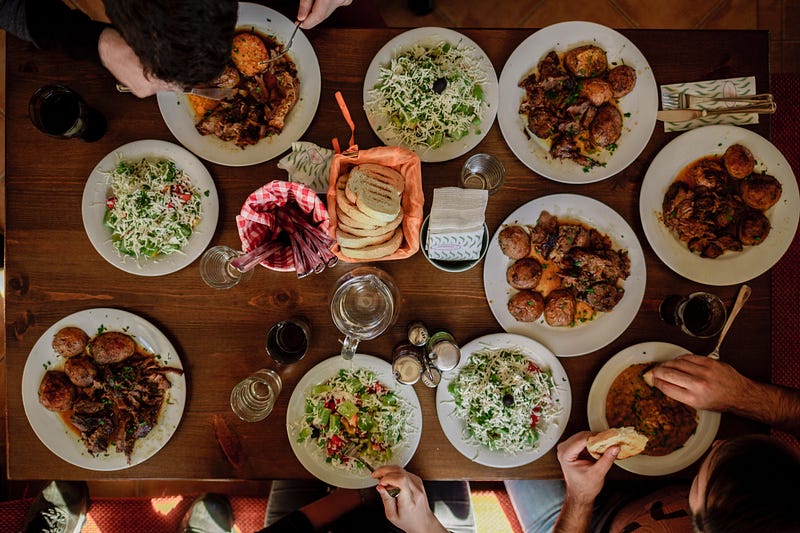
Referencing back the movie, I feel it was spot on in how fun, happy, warm, caring, and lively Greeks are. I’ve had so much fun going to Greek parties. The spread of delicious food seems never-ending, and I love to dance so I learned their traditional “Kalamatiano” dance and jump in the circle every chance I get! The Greeks are also very generous, caring, people. Marrying into this family, I never expected to be embraced as much as I have been. My in-laws have been very generous with me and have shown me their love in their way.
The movie was off in exaggerating the superstitions, and degree of invasion. Despite them tending to be nosey and meddle, they do respect the boundaries we have set for them. Greek parents are also very supportive of their grown children. They don’t hold them back from pursuing their career dreams. Family is first, and that includes those of us who marry into theirs.
Like the rest of us, there are flaws in their Greek ways, but I choose to overlook them because I treasure the core values they do have.
My intent in sharing my cultural findings was to bring about a more realistic view of the Greek culture in America from the perspective of a non-Greek. Whether these are positive or negative attributes, I’ll let you be the judge of that.