
My Best Valentine’s Day Ever
My wife and I met our son on Valentine’s Day
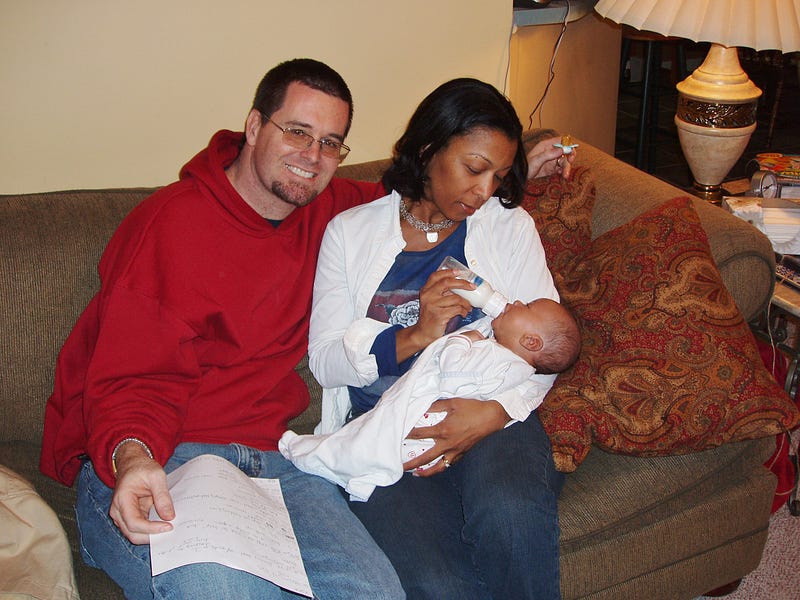
Fourteen years ago, my wife and I traveled from our home in a quiet suburb of Los Angeles to Memphis, Tennessee, to meet our adopted son.
The adoption would be legalized in court, but the day we remember the most is meeting our son for the first time at his foster family’s home.
It happened on Valentine’s Day in 2008. He was one month old and wearing a onesie. It said the words, “Be Mine,” across his chest.
My wife and I took turns holding him in our arms, and I remember bathing him on the counter in a plastic container beside the kitchen sink.
He was so tiny and fragile in my arms, and I could feel love growing in my heart as I held him. We met his biological mom at the adoption agency, and the next day, we came back to his foster family’s home to pick up our son.
My wife and I brought him back to our hotel room and laid our sleeping baby on the sofa, and she asked me, “Do we even know what we’re doing?”
“We’ll figure it out.”
Autism diagnosis
My response turned out to be prophetic because our son was diagnosed with autism when he was three, and my wife and I had to learn on the fly about autism and how to meet the unique needs of a child on the autism spectrum.
As a stay-at-home mom, my wife noticed his autistic symptoms first: walking on his tippy toes, watching a ceiling fan spin around, and spinning in circles. These didn’t seem all that unusual to me, and my response was not to worry.
A lot of kids like to spin in circles, right?
When parents of a child on the spectrum receive an autism diagnosis, it is common for them to process their emotions individually rather than together as a couple and to react in different ways to the diagnosis from each other.
This is due to the urgency of focusing on the child’s needs.
Everything we read on the internet said there is a window of time between three and five years old when the plasticity of a child’s brain (the ability of the brain to modify its connections or rewire itself) is best for brain development.
Moms typically react by going into overdrive and researching to find therapies for their child, while the dads are often in denial regarding the diagnosis — or at least it may take dads longer to process and to accept their child’s diagnosis.
My wife and I fit these archetypes, and this is why we processed our emotion for our son’s diagnosis mostly on our own. My wife was also angry at me pre-diagnosis because I didn’t read the books she bought on autism immediately.
They were technical books with mostly clinical descriptions of symptoms, and I didn’t want to view my three-year-old son as a cluster of autistic symptoms.
I read most of one book, and it motivated me to build a close relationship with my son because the so-called autism expert kept emphasizing things autistic kids have a difficult time doing or may never be able to do like typical kids.
Marriage in crisis
Due to receiving an autism diagnosis, it is common for many parents to hyper-focus on their child’s therapy needs in the months and first few years after the diagnosis, and they often tend to neglect to nurture their own relationship.
This described my relationship with my wife, and neither of us was aware of it. It’s like we were a frog in a pot of boiling water. We were not even aware of how our relationship was slowly deteriorating — until it became more obvious.
The turning point in a marriage, according to a marriage book I’m reading, is when one or both partners begin to associate the presence of the other with pain or stress rather than with joy or pleasure, and I shared this with my wife.
It was recently after our two to three-year rough patch in our marriage. “I didn’t want to be around you at one point,” my wife told me.
I felt the same way about my wife because of the stress of parenting. The stress wasn’t so much because of our son — our autism — but us having two totally opposite parenting styles and not being united in co-parenting our son.
A therapist assessed our problem in thirty minutes: I was the Fun Dad who needed to “step up” my parenting, and my wife was the Commander-in-Chief who needed to give fewer demands and spend time connecting with our son.
“It’s like our son has a Drill Sergeant for a mother and a Muppet for a dad,” my wife said as our son cupped his ears on the drive home.
So easy to assess. So difficult to change.

My co-parenting breakthrough
The breakthrough moment came for me on a trip to Knott’s Berry Farm. Our son was seven at the time, and my wife created a rule that he stay one-arm distance away from us at all times. It made me feel like I was a traffic cop.
I knew if my wife and I were to have a chance to achieve unity on that day, her goal had to be mine too. I was just less enthusiastic about the one-arm rule.
Tim, a friend from my recovery group, once said this AA maxim during a meeting: “The good news about recovery is, you discover your feelings. The bad news about recovery is, you discover your feelings.”
I didn’t understand what he meant until our trip to Knott’s. I wanted to be free and, maybe, run from ride to ride like my son and I run from house to house on Halloween Night. But this was not an option with my wife’s one-arm distance rule, and so I discovered the “bad news” of recovery: My feelings.
I felt like we were visiting a library or museum rather than an amusement park. I wanted to fly like an abandoned kite and to unravel the strings of my impulses, but I felt like someone had taped my legs tightly together with duct tape, and I was being forced to not walk any faster than a metronome pace.
I felt kind of like a tether ball chained to a pole. I became snippy with my wife’s reminders every few minutes to enforce her one-arm rule. I felt like a lobotomy had been done on my brain. I felt like a hippie forced to work in a office cubicle, and I learned what Tim meant to “discover my feelings.”
But, after a half hour of suffering internally in silence, I realized I had only one option: to do Knott’s Berry Farm my wife’s way and to enforce her one-arm distance rule, and I accepted that calibrated behavior would rule on this day, even if this meant giving up how I wanted to experience the afternoon.
I realized this day wasn’t about me; it was about my son, wife and me enjoying the day together as a family, and if this meant sacrificing my freedom, I would do so for unity’s sake and the more I yielded my wife’s one-arm rule, it became easier to experience harmony and unity with my wife in co-parenting our son.
Valentine’s Day
February 14th is a special day in our family because we mark this day as our son’s “Gotcha Day.” Gotcha Day is a term coined by many adoptive families to celebrate the day their son or daughter joined their family.
Usually, it is the day when the adoption was finalized, but we celebrate our son’s “Gotcha Day” on Valentine’s Day because of the association with love, and it is the anniversary of the day when we first me our son in 2008.
We celebrate his “Gotcha Day” by spending time together as a family, watching a movie and ordering take-out food from our son’s favorite restaurant (KFC) while my wife and I get food from another restaurant.
A last thought to couples
If I could share one thought with couples, it would be this advice from John Gottman who has researched marriage for four decades: Try to maintain a five-to-one ratio of positive to negative interaction with your spouse. This way your relationship won’t ever become like the frog in the pot of boiling water.
The Tag Blanket
I’m sending out Gaurav Jain’s Tag Blanket to share my story:
Amanda Payne, Kate Hathaway, Adelina Vasile, Alexandra Christensen, Angie Smartt, Ann van der Giessen, Scott Younkin, Adrienne Parkhurst, Kenny Campbell, Erik Carlstone, Leonard S. Collier, Bernie Pullen, Erica Marie, Deborah Camp, George Blue Kelly, Janet Meisel, KL Simmons, Sam Ochstein, Sally Prag, Madison Sasser, Lu Skerdoo, Pam Winter, Jane Kelley, Megan Llorente, Andrey Pilipets, Julie Derby, Micah Ward, Sarah Ouellet, J.R. Spiers, Joyce Mwangi, Jessica White, Graham Cooke, Sandy Maximus, Lynne Collier, Caitlin Chisling, Harold Zeitung, Victoria Valentine, Richard Armstrong, Lisa's Desk Chat, KiKi Walter, Mary McGrath, Linda Rivenbark, Daniel Gil, Marilyn Glover, Denise Estey Lindquist, Crazy Wonderful, Elvira Yuzbay, Deb Fiore, Susan Wheelock, Breezy, Muchina T.K, Meghan B., Andy Spears, T Mann, Melissa Marietta, Abena Talks, Patrick OConnell, Serenity Jean, V Ernst, Mary Louisa Cappelli, Sujona Chatterjee, Lilith Helstrom, Hana Gabrielle Bidon, srstowers, Michelle Scorziello, Patricia Timmermans, Donna Blevins
Thank you for reading my story.
You might also like:
Or check out my YouTube video on finishing what you start.


