
Parenting, Mental Health
The Remarkable Way My Autistic Son Calms Down
He uses pillows and blankets from home for DIY deep pressure therapy
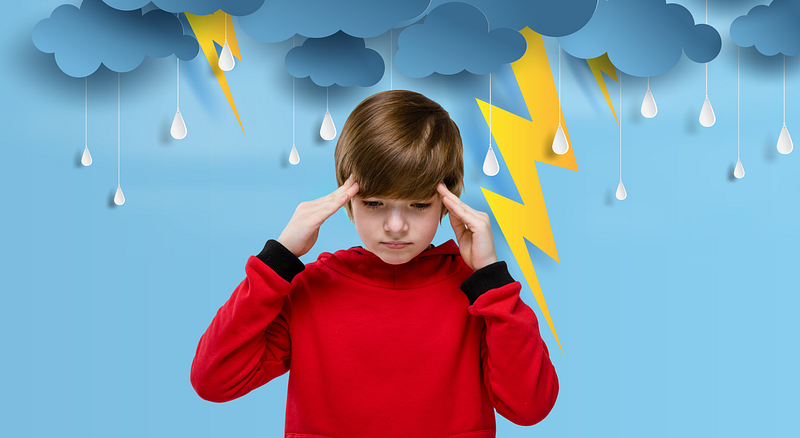
Deep Pressure Stimulation (DPS) is firm but gentle squeezing, hugs, or holding that relaxes the nervous system. This pressure can be applied with the hands, special massage tools, or products that your child can wear or wrap around themselves to provide pressure. Done properly, this therapy triggers a chain reaction in the body that releases an overall sense of calm and peace.¹
Stormy Weather
I heard my son screaming before detecting the unpleasant wail of our small town’s tornado siren. Sky — who’d been quietly building with Legos only moments before — was in full panic mode. He ran through the house, yelling, with his hands over his ears.
“We are under attack! We are under attack! Take cover!”
I did a quick Google search for weather in my area. The news wasn’t good.
I remained quiet but stood in front of Sky to lead him gently to the playroom. I didn’t touch him but used my body to block his way so that he naturally moved in the direction I needed him to go.
I’d set up a sensory area for Sky several months before, and this wasn’t my first time helping him find his it. Once he was in the playroom, Sky immediately ran to his giant beanbag and flung himself onto it.

A Comfy Nest
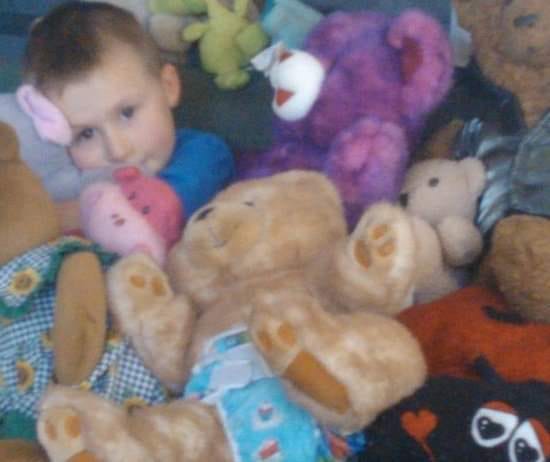
I turned down the lights then began piling pillows, cushions, blankets, and stuffed animals around him. Sky became engrossed in creating a nest from his fluffy hoard. His screams quieted to a loud hum.
While Sky was busy humming and building a comfy place for himself, I did a quick Google search for weather in my area. The news wasn’t good. We had severe thunderstorm warnings until 6:30 pm, and it was only 1 pm.
It was going to be a long day.
Every motherly instinct in me wanted to pick up Sky and cradle him to me. Instead, I moved closer to him and reached for his little hand.
I sat on the floor, close to Sky. I didn’t speak but helped him add the final touches to his pillow fort. Once Sky cradled himself with fluff on all sides, I placed a heavy blanket and large couch cushion on top of him.
Sky hummed happily under the weight.
The Eye of the Storm
The siren outside faded away. Sky’s humming became gentle, chuffing, and he peeked at me from under the cushion.
“Is there going to be a tornado, Mum?”
He knew I always strived to be honest — even with bad news.
“It doesn’t look like there will be a tornado this time, but there is a severe thunderstorm warning until six o’clock.”
Sky disappeared back under the cushion. After a moment, he snuck his hand through and reached for my arm. His action was my invitation to touch him.
Every motherly instinct in me wanted to pick up Sky and cradle him to me. Instead, I moved closer to him and reached for his little hand.
Sky had a tendency to be fascinated by anything that terrified him.
Sky was very sensitive to touch. He didn’t like to be touched suddenly or softly. He reached his hand to mine, and I grasped it firmly — the same pressure I used to shake hands with adults. Then I tapped our code for “I love you” into Sky’s palm.
Tap (I) Tap-tap-tap-tap (love) tap-tap-tap (you)
Sky tapped the code back to me. I asked if he needed a hug.
“Not yet, Mum.”
I loosened my fingers from his hand to readjust. He grabbed my hand back and hugged my fingers to his cheek.
Reassurance
“It’s okay, Buddy. We live in a strong, brick house. We are in the safest and strongest room in the house…”
Sky interrupted me.
“You are incorrect, Mum. The strongest room in our house is the bathroom.”
I resisted the impulse to Google this information. Experience taught me that Sky knew his stuff.
Blankets, pillows, cushions, and Teddy bears flew all over the room.
“Oh! I didn’t know that. Where did you learn that?”
Sky began explaining the videos he’d watched and articles he’d read on the subject. He’d been preparing for a moment like this for years. He got so into his story that he sat up and loosened my hand.
All is Well
I took that opportunity to adjust to a more comfortable position. I opened Google music and played Sky’s playlist at a low volume.
Sky tended to be fascinated by anything that terrified him. He told me all the information he’d gleaned about tornados — including statistics for our town.
I made sure to give Sky some physical and verbal clues that I was listening to him. I asked him questions, and he responded enthusiastically.
I wrapped him tightly in a blanket then pulled him close.
After a while, Sky asked me to sit in my comfortable chair. I stood up with much unattractive grunting and creaking of knees and made my way to my comfy chair.
As soon as Sky heard the click and squeak that meant my feet were up, he exploded from his pile of comfy things. Blankets, pillows, cushions, and Teddy bears flew all over the room.
Sky ran to me. I wrapped him tightly in a blanket then pulled him close.
Sky was ready for a hug.
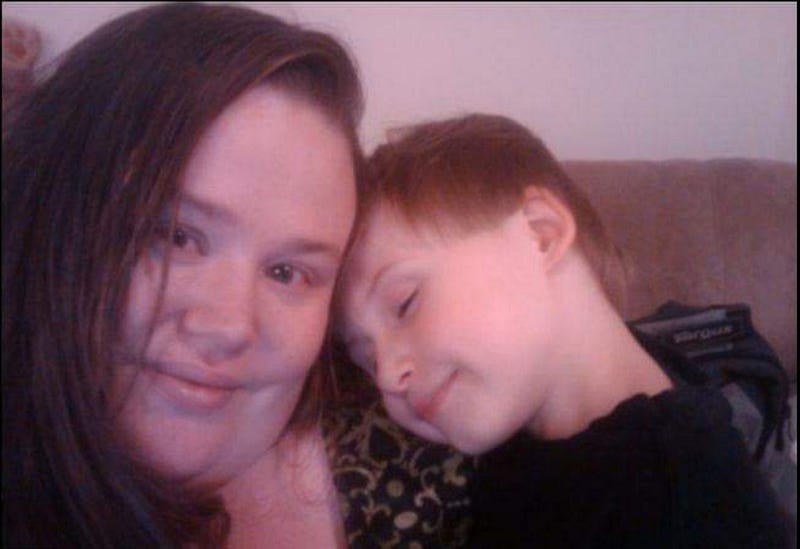
Potential positive effects of deep pressure therapy include:
- A general sense of calm that can last up to a few hours after therapy
- Decreased overall anxiety when practiced regularly
- Increased happiness
- Improved social interactions
- Increased communicativeness
- Better sleep
- Improved focus
- Lowered incidence of seizures
- Lowered hypersensitivity to touch
- Improved ability to tolerate the school environment
- Decrease in self-injury
Note from the Author
I have permission from Sky to share stories about him. He and I are both committed to sharing our stories to help people understand and embrace neurodivergent minds like his!
I used the term Autistic to describe Sky because that is what he prefers. Autism is very much part of his identity.
I showed him this article and got two thumbs up without a single eye roll. I call that a success! He’s even decided to start writing here also!
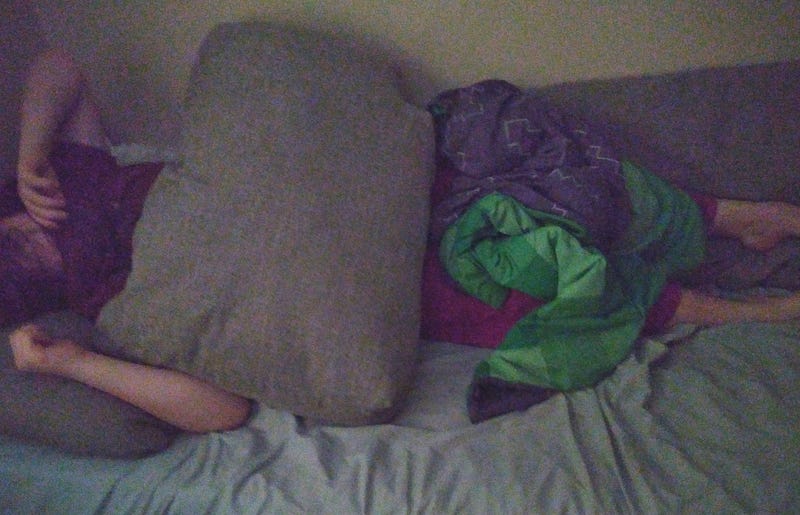
Ten years later, Sky still enjoys deep pressure touches and uses couch cushions to calm himself. I took the photo above at 5 am this morning!
Sky first began doing that when he was 6-years-old and undiagnosed. He’d crawl right under the cushions on our couch!
I took note that the cushions were essential to him, and I started saving them whenever we replaced our couches. Sky uses them most nights and sometimes during the day.
I’ve included some links below that might help you understand more about Autism and touch sensitivity.
Thanks for reading!
Glossary
- Autism Spectrum Disorder (ASD); a neurological and developmental disorder that begins early in childhood and lasts throughout a person’s life. It affects how a person acts and interacts with others, communicates, and learns. It includes what used to be known as Asperger syndrome and pervasive developmental disorders — MedlinePlus
- Neurotypical (NT) means having a style of neurocognitive functioning that falls within the dominant societal standards of “normal.” Neurotypical can be used as either an adjective (“He’s neurotypical”) or a noun (“He’s a neurotypical”).- Neurocosmopolitanism
- Neurodivergent. (ND): having a brain that functions in ways that diverge significantly from the dominant societal standards of “normal.” -Neurocosmopolitanism
Resources
¹ https://www.appliedbehavioranalysisedu.org/what-is-deep-pressure-stimulation/
² https://www.ncbi.nlm.nih.gov/pmc/articles/PMC5612681/
³ https://www.spectrumnews.org/features/deep-dive/social-touch-shapes-autism-traits/


