
My Ancestry Test Was Full of Surprises
I’m just a regular Chinese guy after all
As a Chinese-American, I’ve always felt like I was different from other Chinese people.
Perhaps I went out of my way to prove it, but whether it was my being more athletic as a runner, being more intense and competitive than my relatives, my different value system, and my much greater willingness to associate with people of different races and cultures, I’ve always been very different from people who look like me and come from the same heritage as me.
And, like many people, I always wondered whether me being different is a result of nature or nurture.
But I always felt in my gut that there had to be a hereditary reason. Of course, the first reason most people think is that they were adopted, and their parents never told them they were. It would be painful to know I was adopted all this time, but there were way too many baby pictures of me in the hospital with my parents for that to be a strong chance.
I also joked with my friends that I was probably related to Genghis Khan. A 2003 study in the American Journal of Human Genetics found that almost 8% of Asian men from the Pacific Ocean to the Caspian Sea were related to Genghis Khan, and my willingness to go all out in everything I do and be super intense about sports has led to many of my friends nodding along when I invoke this possibility.
There was also the very slight possibility I could be a part Japanese. Given my affinity for Japanese people, culture (namely anime), and the fact that a lot of people used to confuse me for Japanese, I always wondered.
But the historical implication would not have been great — in World War II, about 14 million to 20 million Chinese people were killed by the Japanese, although estimates vary greatly depending on who you ask. Countless Chinese women were raped.
But since my family has a history of farmers in the mountains, and because the “comfort women” phenomenon of women forced into prostitution by the Japanese was much more pronounced in Korea than in China, the chances of me being Japanese were incredibly low.
I also wondered whether I could have been a member of one of the minority groups in my family’s province of Hunan. The Hmong people are a notable Asian minority across multiple Southeast Asian countries and the most popular minority in Hunan. In the particular county both my parents are from, the Yao people also account for about 15.27% of the population.
So yes, a large part of me did wonder and low-key long for the possibility that I was more than just a regular Han Chinese man, just like 9% of the global population. A large part of me has always felt different, so I wanted some hereditary validation to prove it.
So, my best friend asked me what he should get me as a wedding gift. I thought about it for a couple of hours, then I said I would really enjoy an Ancestry test. I wanted to know more about whether 1) I was adopted, 2) whether I’m related to Genghis Khan, and 3) whether I’m at all Japanese, Hmong, or Yao.
My friend paid for the ancestry test, but Ancestry.com actually has several different features. I first used the “World Explorer,” which includes U.S. and international records to learn things about your family.
I entered what I knew about my family’s information and scrolled for about 10 minutes. As an Asian person with most of my family in China, this was an absolutely useless waste of time. I found no records relating to my family in the U.S. or China. I later learned that Ancestry.com isn’t actually the ancestry site or program for Asian people (which means it just requires a lot more Asian people to submit their DNA tests) and my wife recommended 23andMe as an ancestry site that has a better database for Asian people.
Regardless, I just canceled the World Explorer membership and instead got the DNA test. I did the test (where you just spit a lot into a vial, very similar to a COVID test), mailed it off, and then got updates that processing my DNA could take up to six to eight weeks. I moved on with my life and forgot about it.
This morning, I finally got an email about my DNA test results. I eagerly signed in to Ancestry.com to find the truth about my ethnicity and heritage after all. I opened my DNA Summary, only to be very disappointed to find out that I’m just a regular Chinese guy after all.
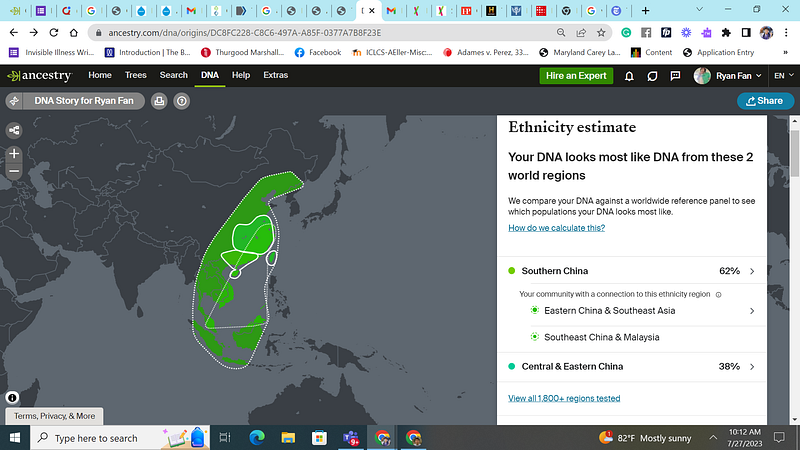
I didn’t take much stock in the difference between my 62% Southern Chinese ancestry versus the 38% Central & Eastern Chinese heritage — these both covered virtually the same region and I’ve had relatives who have lived in surrounding provinces to Hunan, so it really wasn’t a surprise.
I learned later I can still upload my raw DNA data to another site that has a better database and functionality for Asian people, like 23andMe, so I plan on doing that too. I learned that I’m certainly not Hmong or Japanese or Yao. I also learned I’m probably not related to Genghis Khan, although another analysis of my DNA can probably confirm that.
I was surprised by the fact that Ancestry.com could link me to a lot of distant relatives. No, I didn’t discover I had any hidden brothers, sisters, or first cousins. The closest links were two fourth cousins and some fifth to eighth cousins. I messaged the fourth cousins and will see if they respond (they probably won’t), but I was able to look at the ethnicity profiles of all these distant cousins. Most were also mostly Chinese. Some had very small Vietnamese, Filipino, or Dai (another Southeast Asian minority) heritage as well.
There’s nothing too exciting there. What was exciting was the fact that the DNA test could tell a lot about my behavior and personality. It was able to tell I was more extroverted, a night person, I’m able to remember dreams, and I take a lot of naps. These are pretty accurate, but Ancestry also said these were probably more impacted by my environment than my genetics.
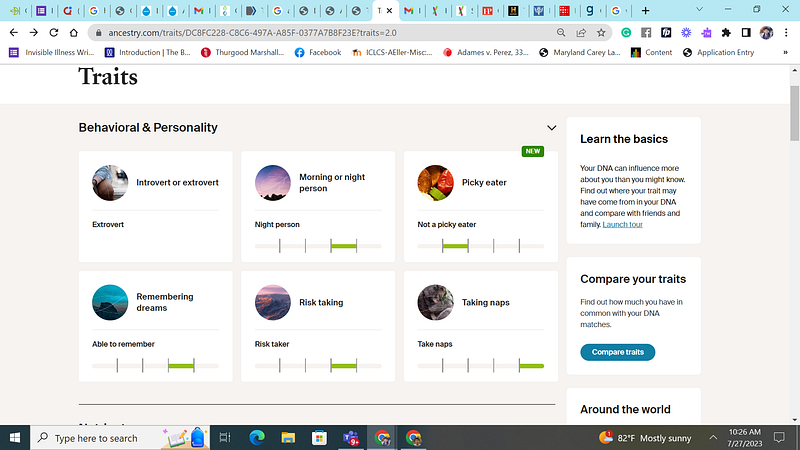
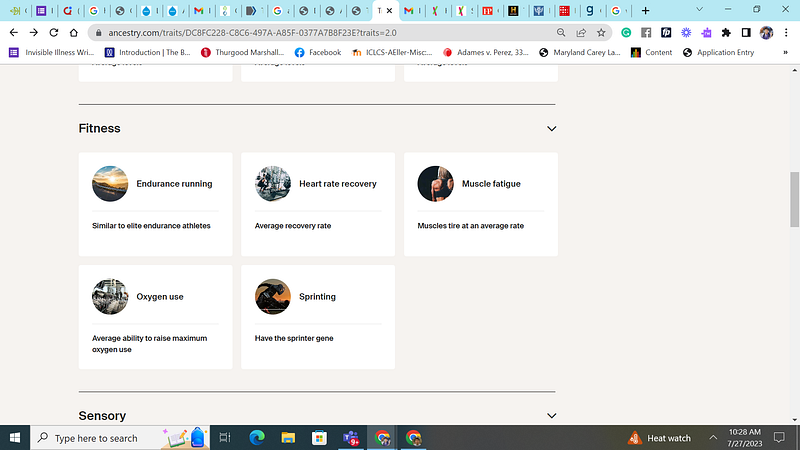
It gave details about my nutrients, which said I had average levels of everything except Vitamin B12. Something I found very interesting was that my DNA test gave me plenty of information about my fitness and athletic ability. I was flattered to see that my endurance running ability is “similar to elite endurance athletes” based on DNA and that I have the “sprinter gene.”
I did a deeper analysis and Ancestry said this was more the result of my DNA than nurture, and cited specific genes like ACTN3, which gears muscle function for speed. Well, that explains a lot. I can be Chinese and still have the DNA of an endurance athlete and/or sprinter, contrary to stereotypes I guess.
On a sensory level, the test said I sneeze when exposed to bright light (sun sneezing), that I dislike cilantro, that I’m less sensitive to sweets, and I’m less likely to tolerate dairy. It also said my face is likely to flush when consuming alcohol, and all these seemed accurate. I didn’t know about the sun-sneezing or aversion to cilantro before, because I don’t pay attention to either of those things, but they were good to know.
All the appearance-related measures were accurate too. I was happy to know that genetically, I’m less likely to lose my hair than others as I get older.
Takeaways
I’m sure everyone has the nagging “was I adopted all this time?” question that can only be put aside by raw, hard data. To be clear, this doesn’t completely rule out my being adopted — I could be a Chinese kid adopted by a Chinese family.
Plus, I’ll see what another genealogy/ancestry service actually says about my relation to other Asians and Genghis Khan. They could just tell me the same thing as Ancestry.com and make me pay to find that out.
Regardless, I think if you’ve ever had curiosity about your ethnicity, any distant relatives, whether you were adopted or not, or anything genealogy related, the DNA test cost my friend $80 (it was a wedding gift). I think some people will always be more curious than others. You might find out some unexpected, or you might validate everything you’ve ever been told about your lineage, and I know these tests have a special salience for anyone who doesn’t know their parents or actually is adopted.
They also have some significant privacy concerns, and well, not everyone is ready to have their whole life story up-ended by one test.
For me, learning I had the sprinter gene and learning that I was just another Chinese guy, after all, were the big surprises. I have long identified as a distance runner and run marathons — have I been making a huge mistake by not focusing more on the 100 or 200 meters this whole time? And why am I surprised at the lack of surprises about my heritage?
At the end of the day, I’ve come to the conclusion that it’s a lot about our environment and who we choose to be through our own determination and will rather than our genetics. I don’t mean to sound too personal-responsibility-esque, given my knowledge of the impacts huge systemic factors like poverty and racism can play on people’s lives.
I find it rather liberating that you can be the same race, ethnicity, and lineage as someone and be nothing like them, which is the case between me and my own parents and a lot of Chinese people I know. Perhaps it was because my own resistance and environment were so different from my parents, per se, that I ended up so different in a lot of respects (while still being similar in others).
One example is that I’ve always loved sports when I was younger. I loved playing soccer and basketball with my friends. And I didn’t want to just be another stereotypical Asian who studied all the time and got good grades — I was restless to be active, to compete in whatever I did outside the classroom, as well. Beyond that, I wanted to be a story of someone who didn’t let generational curses and trauma define him, nor did I want to be someone who adhered to the set roles and expectations anyone had for me, whether it was an outside society that didn’t understand people that looked like me, or whether it was my parents, who only saw one path to success as a doctor.
That being said, it was surprising to know that my genetics played so much of a factor in my athletic ability rather than so little. I thought, as a Chinese guy, I became a 2:39 marathon runner and 15-minute 5k runner out of sheer hard work, consistency, and grit, but it seems like my genetic predisposition helped me out a lot there, without me ever realizing it.
Getting a DNA test just to learn that our environments are more important sounds like it defeats the purpose. Both matter, but sometimes we need to see and experience a lackluster genetic test to realize our genetics don’t define us.