
My AI-generated Article Hit the 1st Page on Google In 1 Week
Here’s how I did it.
If you’ve been following me for a while, you might know that I launched my website in July 2021 to run my SEO experiments.
As a content writer and an SEO expert, I sincerely believe that every digital marketer should continuously experiment to understand what works on the market. Otherwise, how can you grow a website and consult clients?
Since I regularly work on client projects, I must know what SEO strategies yield the best results in the shortest period.
Based on my experience, SEO writing is one of the strategies that can help you grow a website.
When I say SEO writing, I refer to the continuous creation and publication of optimized content on the web.
No matter what others say, SEO is all about content.
If you don’t create content that’s easy to understand for users and Google, your website won’t rank.
However, focusing too much on content quantity rather than quality won’t help you achieve great results in organic search either.
I’ve seen so many posts on X (former Twitter) from content creators bragging they’ve published hundreds of AI-generated content to grow their websites.
They proudly share screenshots of how their websites’ impressions and traffic grow.
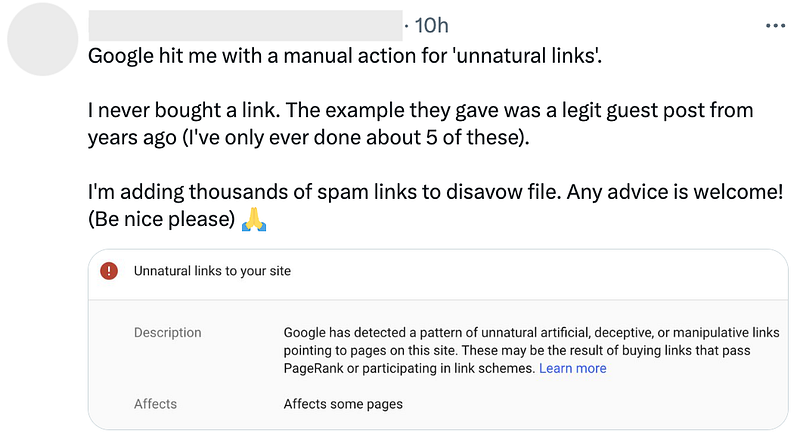
However, the same creators later asked for help from the community since Google applied manual actions against their websites and pushed their websites down in organic search results.
That’s why I always favor natural and organic website growth, even though it’s much slower.
However, I can be 100% confident that all my efforts aren’t wasted.
You might be surprised, but I also use AI tools to grow my website.
I believe AI tools for SEO content writing can be helpful if you know how to use them correctly.
In fact, my latest product review article generated with Koala Writer reached Google’s first page in one week!
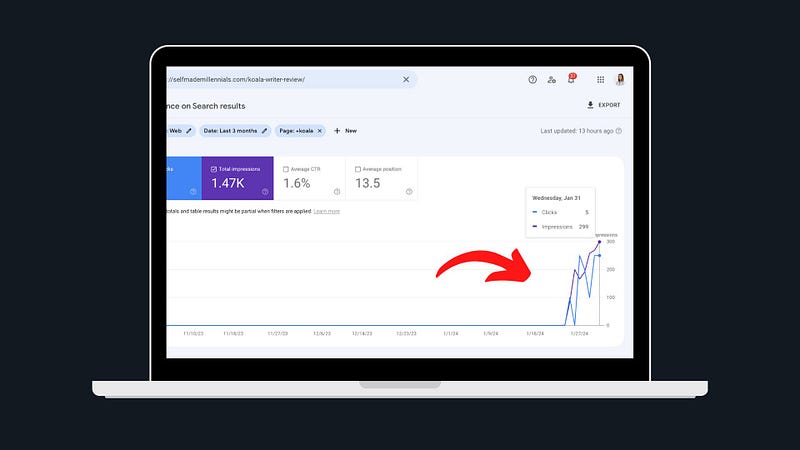
Here’s how impressions and clicks have grown since I published the article on my website on January 24th, 2024.
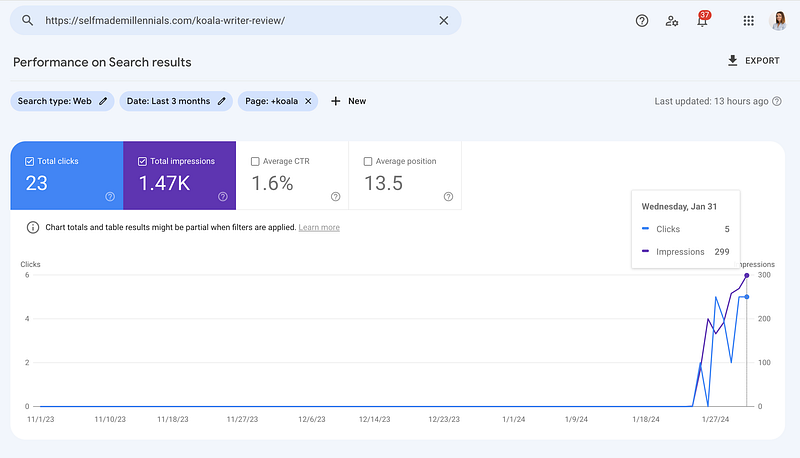
I might sound too confident now, but I knew this page would perform this way.
I’ve written over 70 optimized articles on my websites and up to 100 articles for B2B and SaaS companies.
I can predict how the content will perform based on some criteria.
I’m sure you are curious how I do it. So, here are just a few criteria I take into account when planning content on my website and for my clients:
- Website’s domain authority
- Keyword difficulty
- Keyword global volume
- Users’ search intent
- The competitiveness of the first search engine result page (SERP)
You can learn more about my SEO writing process in my ebook, “How to Create Content that Hits the Google Front Page.”
However, I’m not a creator who gives fake promises. Instead, I always show the entire journey with all challenges and setbacks.
Even though I’ve experimented with AI-generated content for months and had outstanding results, I don’t believe website owners should rely entirely on AI-generated content.
After all, Google explicitly said that it’s a violation of their policies:
Using automation — including AI — to generate content with the primary purpose of manipulating ranking in search results is a violation of our spam policies.
How to use AI-generated content without harming your website
After publishing hundreds of optimized content pieces, I realized that strict keyword placement and link-building were no longer working.
Neither keywords nor links define your success in SEO.
Instead, Google wants to know how users perceive your content and whether they find it helpful.
If you align your content with Google’s E-E-A-T (expertise, experience, authority, and trust) requirements, there is a high chance it will rank in search results.
Moreover, even AI-generated content ranks on Google if you align it with E-E-A-T. That’s why I always edit every blog post I create for my website or clients.
You can learn more about how to implement E-E-A-T in my SEO ebook.
In my example, it took me 2–3 hours, instead of 8–10 hours, to create an optimized blog post using Koala Writer.
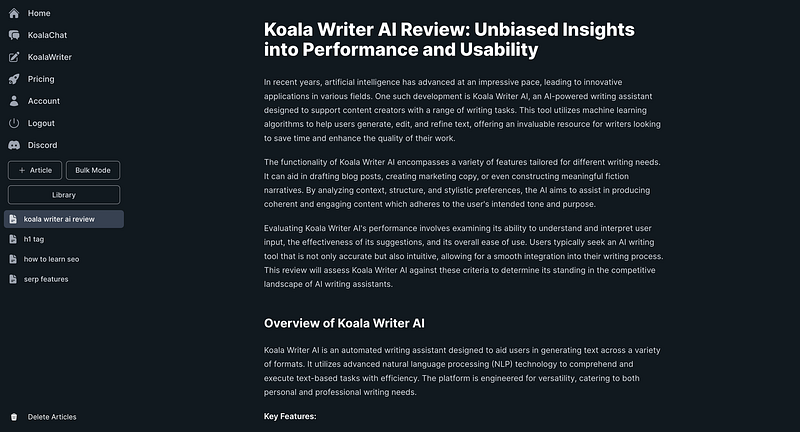
I customized the outline and specified the keywords I wanted to include in the article.
I’ve got a complete article a few minutes later.
However, that was just the beginning of the SEO writing process.
Here’s what I did next:
- I changed the tone of voice so the content aligned with my writing style.
- I added a few manually written paragraphs to share my first-hand experience with the tool.
- I added a few FAQ questions at the end of the article to answer users’ most popular questions.
That’s it!
Google will continue ranking my article on top if users find it helpful.
I did insert a few keywords into my article. However, I spent way more time aligning my content with Google’s content quality requirements and making it better than any other post on the web.
In conclusion
I know what you think about it.
My experiment is not perfect.
Data from the performance of one article is not a reliable source of information.
I agree with you. However, that’s how AI content performs on a healthy website.
If you are a solid business with an established brand, publishing AI content is a quick way to lose the trust of your audience. That is because AI content has literally zero value for people. It does not add anything new to the table. Instead, it curates available information, creating something “original” on a given topic.
Why should I waste my time reading your article if you did not even dare to write it?
I don’t think AI tools will replace content creators soon. These tools are incapable of creating content worth reading!
So, rest assured. Your job won’t disappear yet.
However, we don’t know how long “yet” will last.
📈 Want to grow and monetize your website?
Grab my free case study on “How I Turned My Website into a Profitable Side Hustle in 3 Years.”


