
My Advice for Coming Out — Be Assertive
A Memoir-Esque Piece for Pride Month
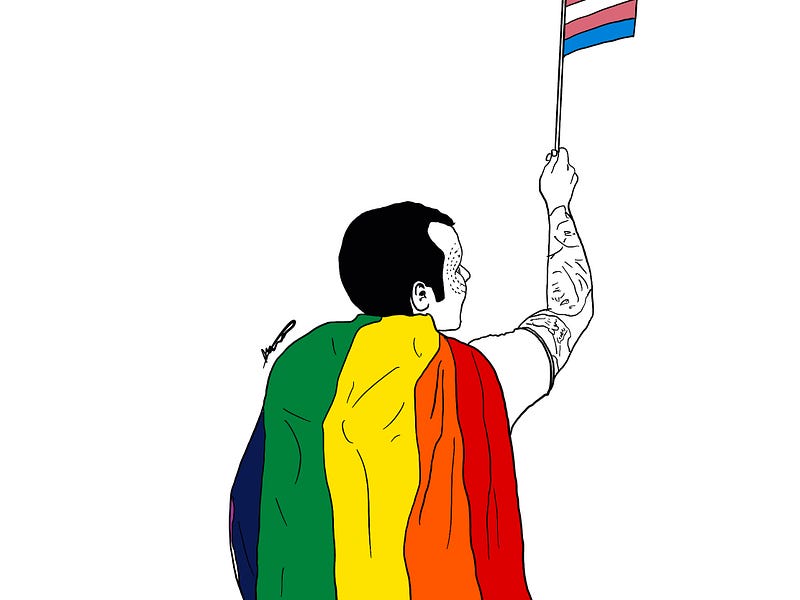
Recently, I wrote a piece titled “How to Be More Assertive in 5 Steps”, which I drew up from some personal experiences. Since then, fellow writer Noah Levy approached me. He asked if I could write a “Memoir-Esque piece” about a time when I became assertive when I wasn’t previously.
So this one’s for you Noah.
Assertiveness is one of those things that comes and goes for me, particularly since I feel I’m naturally submissive. In the article, I talked about a time overcoming a high school bully. Another example would be relatively recent in my Master’s degree over my choice of unconventional methodology, which got me my Distinction (first-class) in the end.
Though I think perhaps the most crucial example of gaining assertiveness, where it didn’t exist before, would have been when I came out as transgender to my immediate family. Each had their personal reactions since I told them individually — not all at once. So I’ll talk a little about each of their responses below.
My Mother
“I love you, no matter what creed, sexuality or gender you are. We’ll get through this.”
I kept it inside for months. I even wrote my mother a letter, but I never gave it to her (until recently). In an embarrassing moment, I officially came out to her by breaking down crying on a bus ride back to her place and sending her a text, while she sat next to me.
It was both terrifying as well as a relief to get it out of my head. Bless her, while my mother is as liberal as the flower power movement, she didn’t have a clue on how to handle the situation. But her first words were “I love you, no matter what creed, sexuality or gender you are. We’ll get through this.”
After a little while, she asked me a bunch of questions like “what brought you to this decision? Is this why you’ve been depressed? Is there anything I can do to help?”
Beyond knowing what being transgender meant and what it entailed, she gave a model response. She gave me the confidence to continue, and together we went to the doctors and began my journey of officially transitioning.
This was arguably the hardest part, the first time making it official within my family. Before, I struggled a little with my identity (as do most teens at that age). But by realising the depth of my situation and finding out more about who I was, I was able to become assertive with the strength of my identity and then my mother’s support.
My Father
My father didn’t follow the model response my mother did. Perhaps because I waited until after I’d started seeing a mental health therapist to tell him, and because the manner wasn’t voluntary either.
“No one is going to want to be with you.”
He received a letter from the hospital detailing my next appointment. Before you ask, they addressed it to “parent or guardian of — “as I was still under 18. He came to question me why I had an appointment.
His first instinct was not an expression of love, but blame. He felt that I didn’t have enough ‘female role models’ in my life because of living with him (despite being very close to my sister). After that, I remember him saying “you’ll need to move to a more metropolitan area when you’re older, people here are not going to be nice about it.” And then, “no one is going to want to be with you.”
He also asked me some more invasive questions like “are you going to have a sex-change operation? Would you be able to have children?” In the end, I sent him away and stayed in my room until the next day.
He would likely deny this ever happened, as he doesn’t share these kinds of views anymore. I spent a long time educating my father on the realities of my situation, and we have a much better relationship now.
As I said before that coming out to my mother was arguably the hardest, because it was the first time, I’m thankful I gave myself the experience. The reason being, my assertion would have crumbled under my father if this had been my first experience of coming out. It would be necessary to continue on of course, but I wouldn’t be anywhere near as confident about it and I would have less likely been assertive about it too.
My Brother and Sister
It is interesting how my brother and sister mirror my parents in terms of personality and in their initial reactions to my coming out. My sister, with a humorous and smug expression, said: “I knew it, that explains so much.” After that our conversation veered towards childhood memories and how much of a ‘tomboy’ I was growing up.
We had a lot of laughs that day. I was, and still am, very close to my sister. It’s funny I didn’t decide to approach her about it first instead of my mother, thinking out it. Though as it was, assertiveness wasn’t necessarily required as much as it was with my parents.
In a calm and confident tone, I responded by saying “this is a life or death situation for me if I don’t transition I would rather die.”
My brother, on the other hand, having studied psychology, became much more interested in how my mind processed the information that led me to my conclusion. Like my father, he was also concerned about how others were going to treat me. I remember him asking if I was sure about it all.
My brother was pretty much last to know (sorry dude), and because of all the experiences I’d had so far as well as time to reflect, my resolve grew stronger still.
In a calm and confident tone, I responded by saying “this is a life or death situation for me if I don’t transition I would rather die.” That brought it home for him, and for me too.
It was true what I said to my brother. Of course, telling your passionate truth helps in becoming more assertive because you believe in yourself when you do. Though the secret I think, to real assertiveness, is that belief in what you’re trying to convey but being open to seeing different perspectives. In that way, you’re less likely to be aggressive as opposed to assertive.
Having these experiences of coming out to my family, and receiving their support, no doubt forged my confidence to face those who would deny the legitimacy of my identity. That’s why my best advice for those who are struggling with coming out is to be assertive — trust yourself and the words will flow.
Nowadays, I find I’m in an incredibly privileged position; from a stranger’s gaze, I pass as an average (albeit very short) white man. That couldn’t be farther from the truth — being mixed-race, bisexual and transgender pretty much ticks all the diversity boxes besides being able-bodied. And I find that sometimes I feel guilty for not being as vocal about my identity as other’s are. Still, I remember that I support my community and identity in other (quieter) ways.
Now that pride month is upon us though, I’ll likely write a little more about my rather diverse identity since it seems to help people — knowing they aren’t alone. If you’re reading this and you identify with some of the things I’ve said, it’s true, you’re not alone in this vast, full world; and I love you, even if it seems like no one does.