
My 530 Square Feet Home is Not Enough for Me to Work From Home
Is this a first-world problem or are offices still needed in today’s world?
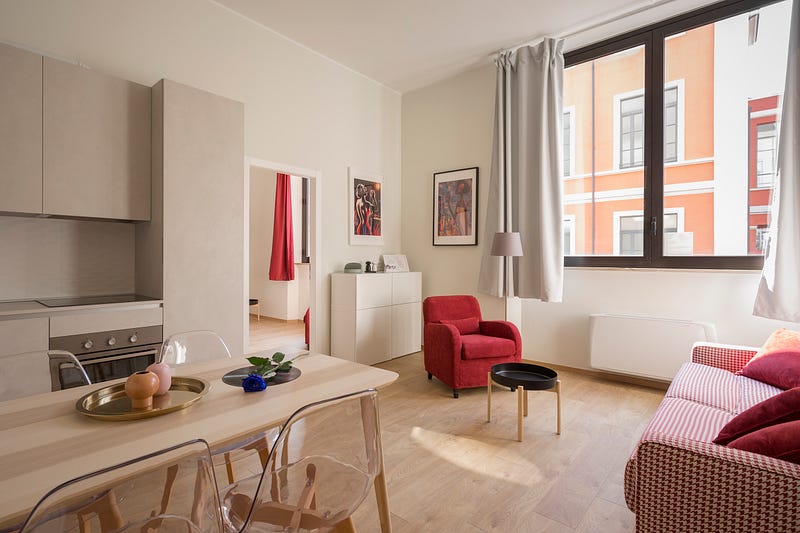
I live alone in those typical shoebox new-built apartment blocks in London that’s character-less but functional. I have an open kitchen-living room, a well fitted out bathroom, and a massive bedroom.
I can fit a workspace anywhere, it’s not a problem.
My problem, which is shared with many people who have stressful jobs and live alone, is how our homes are now associated with two things and two things only — loneliness and stress.
We lost our boundaries between life and work, and the private side of our lives have become lifeless due to the lack of social interactions.
So when I arrive at this co-working space, with people I don’t know talking on the phone in the background and the sound of the coffee machine, I feel so alive. This is why I believe as technology improves, offices shouldn’t go away but change to meet people’s needs.
Here are some lessons I have learned — it’s very first world, I’m sorry (not sorry).
I need a study
If my bedroom is for resting, and my living room is for relaxing, my one-bedroom flat practically gives me no segregation to a work station.
It’s fine to be clever about space planning so you create different zones. I come from Hong Kong, where real estate is premium, and a 500 sq. ft home can easily fit a family of 4. I know a thing or two about it.
But when we are living alone, our relationship with our space is different from when we live with our family and friends. Everywhere we walk inside our home, it’s empty. Whereas in a family home, your bedroom (if you are lucky enough to have your own), is your oasis; and everything outside the room is common good.
The lack of social and common good elements when living alone means that we own every part of it. The segregation in space becomes how we organize our relationship with our head, our mental state.
If I could buy a new flat again, I would buy a two-bedroom, even if this means that each room becomes smaller. I will convert one to a study. I might even paint the door a different color so it signifies work time for my head.
But an office is better
One of the most claustrophobic spaces in London is the junction at Monument.
It’s on the north end of London bridge, between Fenchurch Street and Bank. People walk in all directions here to get to all the offices nearby at all times. They are always in navy or black coats, everyone is trying to outwalk another, most look exhausted, annoyed, and burnt out. We also hate tourists.
But now London’s central business district is dead. The Monument and surrounding areas house all white-collar workers from bankers to lawyers, so as soon as Covid hit, we packed our monitors and ergonomic chairs and Uber-ed back home.
This makes us wonder if offices are no longer needed. Some big corporations actually terminated their leases indefinitely given Zoom seems to be fine.
No guys, it’s not fine.
The staggering amount of people suffering from mental health problems is because Covid has locked us in. If we look into why is confinement making us ill, we mustn’t ignore the fact that our boundary to different aspects of life is blurred. We might be checking emails in bed, and answering calls in the bath. There is no segregation.
Not only that, whilst some people are multitasking as a parent/teacher/carer/worker/spouse, on the flip side, people who live alone feel helpless because they can’t do anything. I haven’t seen my family since October 2019 when Covid first began in Asia, people can’t date, many spent Christmas alone. The “home” if we can call it that, becomes a prison with nice things.
The feeling of helplessness has been acute.
So no, an office has not lost its value. It creates a mentality shift for many from home mode to work mode. It also gives a clean physical break to really switch off our minds as we switch off our laptops.
Actually, a co-working space is the best
Many corporations struggle with paying prime rent in London, and it does seem a bit pointless as it doesn’t seem like we will be going back to work anytime soon.
Perhaps some people will get used to the new normal, especially when children go back to school, parents will feel better to be at home early enough to see their children.
But most of us are likely to want to go back to work in an office with good coffees, lunch with colleagues and pints after work.
Co-working space has been sprouting in cities since around 10 years ago to meet the growing demand of freelancers, contractors, and start-ups. In 2019, the industry worth $9.27 billion worldwide, and is predicted to worth $11bn plus from 2023, after a small dip resulting from Covid-19.
I visited one for the first time today, and man, this is fantastic.
A perfect balance of an office and a coffee shop. Without the crazy volume of chatter and tiny desk space in a coffee shop; and without the need to constantly behave as not everyone around you are your colleagues (unless your whole team is there).
I was able to get things done properly and not get tempted by Netflix, baking and everything else like I would at home. There is a chance to meet people from different backgrounds, but not coerced to chitchat if you don’t want to.
When Covid-19 finishes
The price of co-working space can be steep for some. But for my mental health’s sake, I feel that it’s a small price to pay. Some spaces even do a day-rate so you can choose to pop in only when you need to.
Looking into the future, imagine corporates and employers stop leasing a standard office space and employees are allowed to expense their co-working space cost. It caters to both people who wish to come back and those who wish to work from home going forward. It’s a win-win situation.
It’s likely to be cheaper for the employer and more flexible for everyone. People can choose where to go as well, perhaps somewhere within walkable distance from home. It eases the transport pressure in major cities and stations, the dread to commute, and allows local areas to flourish.
I can’t see a better way forward in opening co-working space in more towns and suburbs. In fact, it’s my dream to open one.
What I’ve learned
We need a boundary between living and working. The notion of work-life balance has extended beyond a concept to physical segregation that has previously taken for granted.
As we have more experience, data, and information about the aftermath of mental health issues as a result of the pandemic, we must rethink how we link with our space, time, and responsibilities going forward.
This is the golden opportunity to address issues with transport, town planning, the economic disparity between big cities and small towns, mental health issues that already exist before Covid-19 too.
The disruption of the pandemic can’t be all bad. It’s a wake-up call that maybe our ways of living has reached a tipping point and need to be further improved.
Think further, think bigger, make something good happen out of this crisis.


