
My 5 Favorite Writing Warmups
Stretching your brain and making the words flow.
Writing is fun. You probably agree if you’re reading this. But when writing is our job, it’s easy to lose sight of the fun we once had. We get bogged down by forcing the words from our fingers, and our creativity up and leaves. It’s disheartening, but it’s not the rule for our existence as writers. We can make writing fun again.
I don’t play writing games or do warmups every time I sit down to write. But when I’m struggling, they can be a fun way to facilitate the creativity and motivation I need to push through a project. Here are the briefs with more description below:
- Word purge with a timer
- Word purge with a timer and a topic
- Personification
- Two dudes in a room
- Picture perfect scene
Word purge with a timer
Word purging is simple: sit down with a piece of paper and a pencil or pen and let your conscious run wild. There is a right way and a wrong way to do it, however. The wrong way is thinking. Thinking ruins everything. The right way is setting a time limit — eight minutes works best for me, but I’d never do less than five minutes or more than ten. Begin writing. Whatever comes to your mind, and I mean whatever come to your mind. The sentences don’t have to be complete; the words don’t need proper spelling.
The point of writing traditionally instead of typing is to slow the rate at which you can process the words. The goal is to have more thoughts than you can write. It comes out absurd, frantic, and it is pure ecstasy. Catharsis of the mind. When you read the finished product at the sound of the timer it should make no sense. In the chaos you may find a shard of gold; if not, I bet it still felt great and loosened you up.
Word purge with a timer and a topic
Sometimes it’s good to have a topic to orient your word vomit around. If you’re up against a deadline for a research paper or a story, take the theme of the piece and purge every word possible on the subject. It should come out just as incomprehensible as the themeless method, but the golden flakes you may find will at least pertain to what you need. And if nothing good comes from it, you’ve eliminated all the muck from your mind.
Personification
I don’t know that “personification” is the best thing to call this, because you don’t necessarily need to personify something in the traditional sense.
This method requires you to describe the first thing you see. Whether it’s a water bottle, your printer, or a dog, just start writing about it. Consider the five ‘w’s: who, what, where, when, why? But don’t restrict yourself too much. Try to branch away from the standard structure and write something unique.
Two dudes in a room
Back in my theatre days this was a common improv and it’s just as fun to write. The concept may be the easiest, just picture two people in one room and imagine the conversation or the story that can evolve. They don’t have to be men — I use “dude” as a gender-neutral term. Heck, they don’t even have to be people (for my friendly fans of the absurd)! Just two people in one room.
Of course, you can always have two rooms and six people, or any other derivative, but it isn’t the same. The beauty of two characters and one setting is the limitation it imposes, forcing a new level of creativity. For instance, if the scene is unfolding in the kitchen, my first thought is “What can they see through the window?” It’s one setting, but it’s really two. And the two people could never speak, creating an insurmountable level of tension. There seems to be limitations, but there’s nothing that can bar your brain from thinking outside the figurative box.
Picture perfect scene
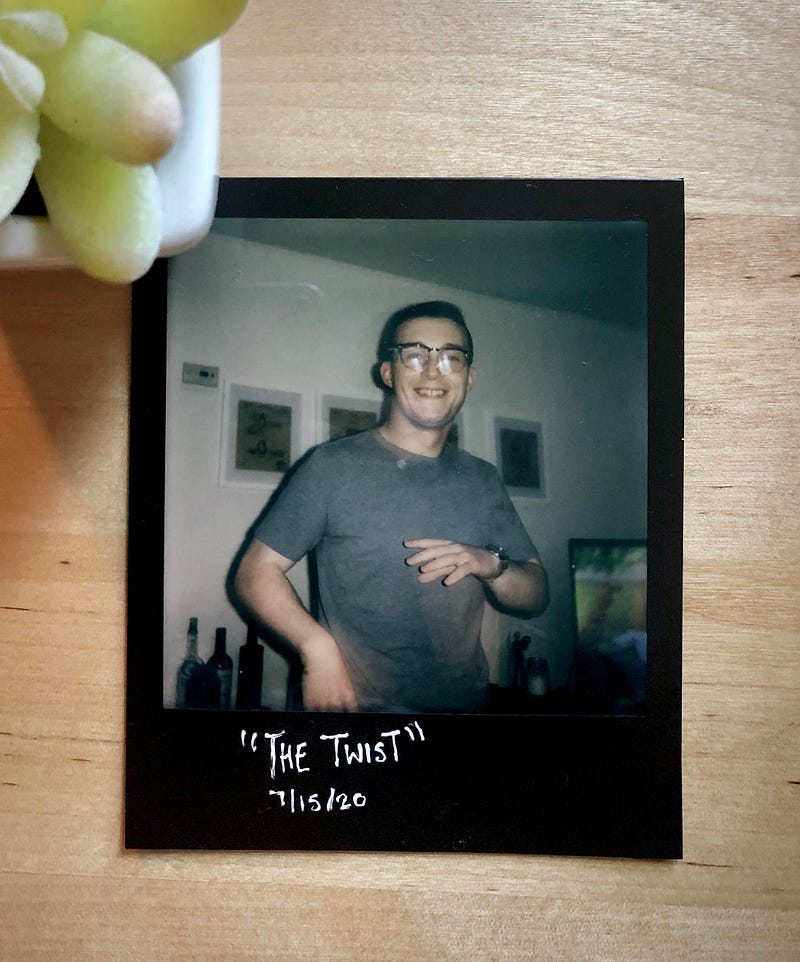
Polaroids are making a comeback these days, and I’ve always loved the eeriness of polaroid pictures. Two rules apply to polaroids: first, it’s impossible to look bad in a picture — they’re all flattering; second, they all look creepy. They remind me of the days of slasher flicks and campy horror. Nothing good is ever happening.
But seeing these pictures made me try out a new warmup I loved. Many people recommend looking at a picture and describing it in detail. But instead of mere descriptions, try writing a background story for a picture, unrelated to its context.
Take this picture of me teaching my fiancé how to Twist. Classy — I know. I’m a real heartthrob. But instead of a fun picture we’ll keep for ages, what if this was the last picture taken of me before someone shot me through the window? What secrets are uncovered about my double life? Who shot me? Why did they shoot me?
For the romantics, what happens when a young someone sees this picture in the paper advertising dance classes? They go there in hopes of meeting the guy from the ad. Is there a love story there?
The options are never-ending. Any picture will do if you let your imagination run wild.
You have no excuse not to write! Writer’s Block can get in the way sometimes, but there are countless ways to overcome it and produce work you love — you merely have to want it. You must work for it!
Inspire yourself and get those fingers warmed up — you never know what you’ll create.