
Startup
Mustering up the Temerity to Start a Startup in These Uncertain Times

Virtually all of the industries — aviation, tourism, hospitality, etc. — have been affected by the COVID-19 pandemic. We have also witnessed the desperate attempts of some of the leading tech unicorns to reduce their expenditure. The shrinking workforce and the introduction of pay cuts are the manifestations of those attempts. The general public might consider this period as the worst time to run or start a startup.
This is the story of a fledgeling tech-entrepreneur who attempts to go against the tide. I hope that this would encourage more young people to find more innovative ways to weather these uncertain times.
The risk-averse side of me
I was a quiet and timid guy who wouldn’t initiate any conversations with anyone in my primary school. I would only speak to my teachers when I need to answer a pressing call of nature.
I would only talk to two of my friends when either one of them shouted: “WINNNN”. I think we are congenitally lazy. I don’t have the faintest idea why we love to abbreviate names which have merely 2 syllables.
There was an instance in which I went to the supermarket with my parents. Since the price of the fruit, which I couldn’t recall, wasn’t written on the price tag, my mum asked me to inquire the staff near the weighing machine.
With my palpitating heart and quivering hands, I carried the fruit to the staff knowing that I won’t be able to start the conversation. I exchanged a few seconds of eye-contact with the staff before I sprinted back to my parents. I shrugged my shoulders and said “I don’t know” feebly when my mum asked me about the price of the fruit.
I was afraid of stepping out of my comfort zone and trying something new. I was terrified when life threw me with something foreign.

Finding my alter ego
In order to push my envelope, I tried partaking in story-telling, dramatic monologue, and oration competitions. To my astonishment, I won most of the contests.
Signing up for my first competition was indeed a knee-jerk decision, albeit registering for the subsequent ones were more like a joie de vivre. Being able to bring happiness to the people in my vicinity through my performance was the thing that sparks joy!
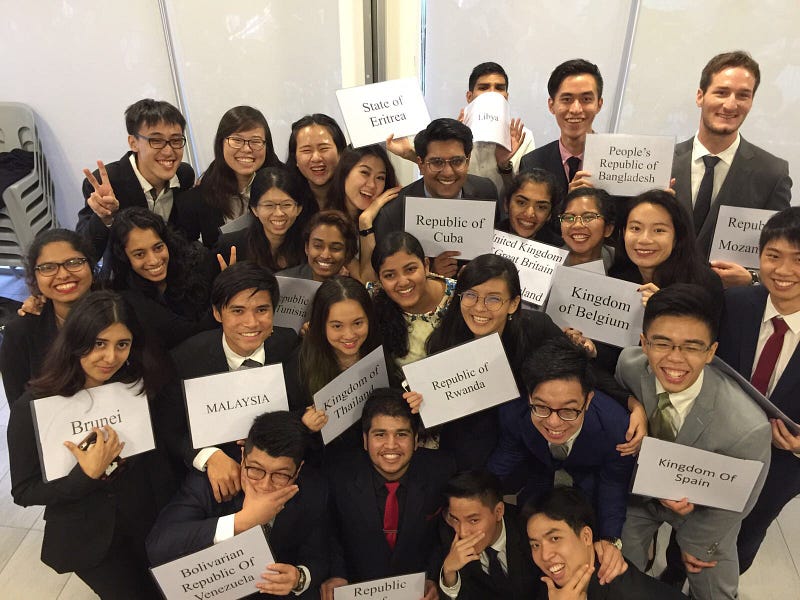
During my college’s Sophomore year, I registered for the HNMUN (Harvard National Model United Nation) training programme in my school. I was one of the 20+ lucky people who managed to get into this programme; I was one step closer in representing my school in a conference in Harvard, Boston.
Coming from a non-International Relations (IR) background, topics such as history, human rights, and diplomacy were not my forte. I had to juggle my time to study Computer Science (CS), which is a far cry from IR, and the intricacies of the geopolitical conditions of the countries I represented. Since I have never heard of most of the countries (e.g. Burkina Faso, Côte d’Ivoire, etc.) that we were representing, I had to spend a lot of time on my research.
The thought of dropping out of this programme started to “haunt” me when my assignments, quizzes and exams started to pile up. I still can remember that I had to prepare for my HNMUN training before I sat for my CS final exam the next day.
Upon discussing my intention to drop out with my trainers and fellow delegates, I decided to persevere till the end. I am glad that I have persisted. Otherwise, I wouldn’t have been able to foster strong friendships with these erudite people.
A perpetual passion for tech
After my short exposure in IR and diplomacy, I started to realise that I need to start working on my tech profile. I began to participate in tech hackathons and meetup events. My first hackathon was a three-day-long SG100 Nation Hackathon.
We do know that it is a dream of every participant partaking in a competition to receive an accolade and thunderous ovation during the award ceremony. Although we didn’t make it to the podium, we did gain umpteen experience in that short period of time.
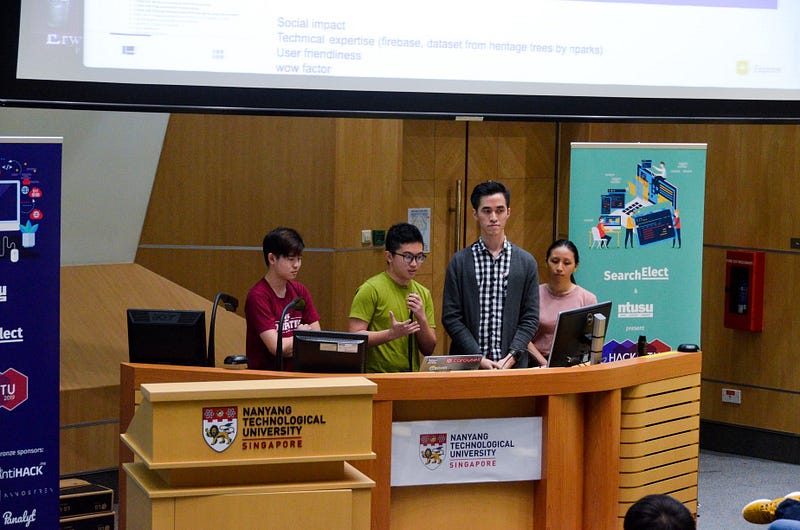
Fast forward a few hackathons, my team finally managed to come out as one of the eight finalists during HackNTU 2019. We built a platform to encourage people to get out of their homes and pay more attention to the greenery around them. In the end, we did manage to come out as one of the 8 finalists. Click here if you want to read more about what we did!
My intention to join hackathons remained consistent, which is to meet and work with passionate problem solvers and programmers. Although, I have to admit we also came for possible job opportunities, foods, and freebies.
My maiden job hunt
I guess our very first job search was one of the most nerve-racking experiences that we have experienced in our life. It heralded the advent of adulthood; it is a sign that we would have to start to, what my parent called, 做牛做馬 (work like a horse).
However, I have to admit that none of my parents nor families nor teachers nor friends has ever taught me “how to work like a horse”, let alone “ how to be a good horse”. We used to naively believe that our schools and universities would fully equip us for this stage of life.
The moment that we realised that we would have to start building our network, writing our CV and cover letters — be it during our school time or beyond that — we learned that there is not much hand-holding left. There are indeed a plethora of career resources we could find online.
However, none of the tips and tricks could work out of the box; it entailed numerous trials and errors and fine-tuning. I went to look for some advice for my resume from my school career service staff and my friends. With that done, I set off on a quest to look for my first full-time job.
Upon applying for 60 different roles in 50 different companies, 10 of which were internal staff referrals, I went for 25 interviews in 12 different companies. However, only 2 of the companies were willing to hire me. I accepted the offer from one of the companies with a grateful heart — knowing that my job-hunt was finally done and dusted.
My first career hiccup
As I was not a local citizen of the country in which the company operates, I had to obtain a valid work visa before I could start working. After a tedious month-long wait, I finally received an email from my company HR department.
The HR staff informed me that my application was — to my chagrin — not successful, and the authority was not able to provide the reason behind the rejection. The subsequent month-long appeal process was also to no avail. Fortuitously, I had a freelance web-development project to keep me occupied.
Dejected and distressed, I wondered why would I have to go through this and wondered how much efforts I would need to resume my job search. I subsequently poured most of my time on my freelance project as the January 2020 deadline was slowly catching up.
Seizing the opportunity
“Opportunity is missed by most people because it is dressed in overalls and looks like work.” — Thomas Edison
We often fall prey for our laissez-faire attitudes towards life. We would eschew from taking up an opportunity, as it would translate to an increase in responsibility. I told myself that at this juncture, I had to take whatever opportunity that came my way.
I happened to meet one of my old friends who works for one of the top-tier legal companies in Jakarta in early January. We talked about the rapid evolution of the legal and IT landscape and how technology, with its boons and banes, has aided legal practitioners in many ways.
He subsequently started sharing about the issue of trust between lawyers and their clients. He also highlighted the lack of a dedicated online legal marketplace that could alleviate that very issue of trust. Knowing that we are trying to solve a real problem, I firmly told him: “I am in”.
Working for ourselves
Working for a big tech company (a.ka. FAANG¹ companies) has always been my dream since I was in Secondary School. Hence, the notion of working for my own, frankly, never came across my mind before.
I remembered how my mum used to persuade me to be an entrepreneur when I was still a student. She often pontificated all of the benefits of entrepreneurship. Paradoxically, she was also the one who poured cold water on this opportunity.
Bewildered by my mum ambivalent advice, I started to expound our vision and mission. Upon listening to my explanations, she acquiesced and gave me her blessings.
The ride against the tide
逆水行舟,不進則退 — It is like rowing a boat upstream. If you stop moving forward, you’ll fall back

Starting a startup is indeed a very challenging task because you would have to create a product under extreme uncertainty. Honestly, I do feel despondent at times. The vacillation between getting a stable paying job and focusing solely on our startup, which currently doesn’t pay me anything, didn’t make things easier.
However, I recalled that it was that passion for programming and solving real-world problems that brought me here. Against my better judgement, I put my job search aside and started to code our web application’s prototype.
It took us more than 6 months to launch Pengacaramu² Minimum Viable Product (MVP)³. We spent the first 5 months coding, another month to settle the legal matters and payment gateway, and another few weeks to get potential lawyers to join our marketplace.
What’s next?
The challenge didn’t end there as there are still a lot of uncertainties ahead. We would have to constantly ask ourselves questions like: “How can we improve our marketing strategies to get our first client / more clients?”, “How do we retain the current users?”, and “How do we convince potential VCs⁴ to invest in our product?”.
Lastly, my advice for those people who wish to embark on any entrepreneurial endeavour is: follow your dreams and hunches. You can’t come up with a great idea or product overnight. Moreover, do remember to establish a feedback loop to get constant feedback from your users. This is done to minimize the risk of building something that doesn’t truly solve any problem.
To be continued…
[1] FAANG stands for Facebook, Apple, Amazon, Netflix, and Google (now known as Alphabet)
[2] Pengacaramu means “Your Lawyer” in Bahasa Indonesia / Bahasa Malaysia.
[3] The Lean Startup — Eric Ries http://theleanstartup.com/principles
[4] A venture capitalist (VC) is a private equity investor that provides capital to companies exhibiting high growth potential in exchange for an equity stake. https://www.investopedia.com/terms/v/venturecapitalist.asp#:~:text=A%20venture%20capitalist%20(VC)%20is,have%20access%20to%20equities%20markets


