
Musing on (Hu)Man(ity)’s Best Friend
Santosh Pandipati, MD
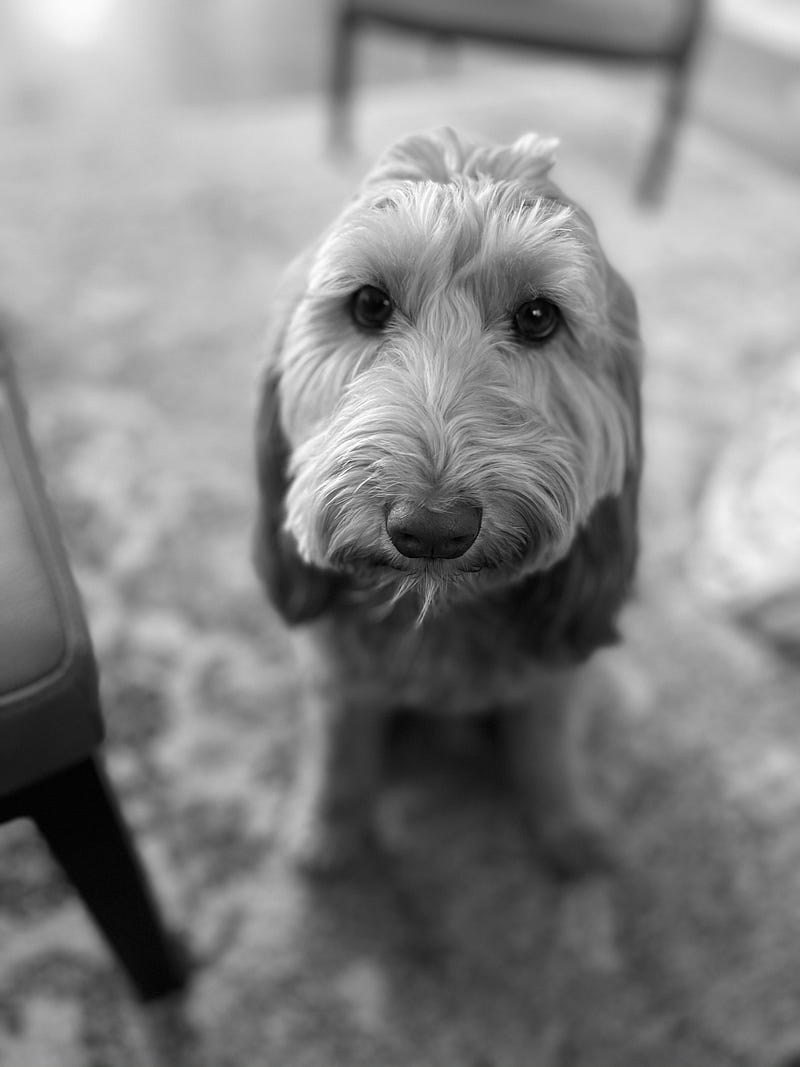
Staring back at me is an animate lump of fur, a localized fuzzy patch of the universe that is somehow keen on my newly returned presence from a busy day at work. As with all things that surround us, this animal is a mental construct of a truly mysterious reality posing before me. After lathering the beast with numerous kisses, rubs, and pats I pause to stare back at the creature, my eyes to her eyes. What is this life before me thinking? And feeling?
I, on the other hand, am grieving. Lost in the recent turmoil of the Russian invasion of Ukraine is the latest alarming news from the IPCC that we are in a runaway train with human-caused climate change, that we will be facing unprecedented climate alterations never before confronted in the history of our species, placing billions at risk. But with oil prices skyrocketing and even supposedly sane politicians like President Biden and Senator Kelly (D-AZ) wanting to provide more oil to the American public to stabilize prices we continue to plummet headlong into the abyss, IPCC warnings and the warnings of thousands of scientists such as Peter Kalmus be damned.
Falling victim to false propaganda, claiming all the while that everyone else who criticizes them are themselves victims of a contralateral false propaganda, many Russians believe theirs is a righteous conflict — even as the rest of the world, condemning the atrocities, clearly sees the war for what it truly is, a heinous and irrational land grab rooted in deep-seated insecurities. But it’s an asymmetrical reality as dead citizens are not strewn about Moscow as they are in Bucha. The cycle is no different from the radical elements of the American right, with revulsion towards climate activism, and against opening our eyes to racism, discrimination, and oppression. The American left, vicious in its own ways, cannibalizes those who are trying to find a stable center ground, a means to build bridges, willing to sacrifice those trying to liberate themselves from the shackles of societal mental conditioning, but who have not embraced change fast enough or radically enough. Social media became a veritable Russia-Ukraine conflict in its own way, long before the physical war, balkanizing human societies just as Jonathan Haidt so eloquently and expertly elucidated recently in The Atlantic. And so we fall victim to our own minds’ delusions, in a war for our own survival.
Perhaps fundamentally we are afraid. Perhaps we are too afraid of what we have done and we are too afraid of what we must do. And so we continue to walk in lockstep towards our collective grave without ever truly facing reality. Deep within ourselves, do we know this to be our ultimate fate? Is this why we cling to our pets — especially our dogs — as we would to our families? As I think about the abject devastation modern Homo sapiens has wrought upon the biosphere that birthed it a mere few hundred thousand years ago, I wonder if perhaps, at the end of all the carnage, the only creature left for us to ponder — and who might ponder us in return — may be the domestic canine. I am struck by melancholy at this notion.
This sentiment is echoed in the Mahabharata, humanity’s longest epic poem, written some 2500 years ago. The epic story hauntingly foretells a fate that we seemingly now face globally. It is a tale of human passion, hubris, avarice, malice, and delusion — at its center is a horrific and senseless war between cousins and extended family, not too dissimilar from the Slavic war currently raging. Much life is lost, human and animal, resulting in tens of millions dead in the name of duty and loyalty. It is a tribal story, a parable of humanity the world over. The protaganists, King Yudhishthira, his brothers, and their wife, are never clearly in the right, never clearly in the wrong. At the very end, in very old age, beyond the reproach of time, Yudhishthira, accompanied by his brothers and his wife, conclude that their worldly existence had run its due course. Desirous of finality, they relinquish their possessions, depart their kingdom, and eventually set off for the Himalayas seeking the entrance to heaven on Mount Meru. Early in their journey they are accompanied by a dog, previously unbenowknst to them. One by one they succumb to mortal calamity. But Yudhisthira perseveres. He climbs and traverses and climbs some more, the stray dog ever faithful at his side. As he ascends Mount Meru, he is approached by Indra in a celestial chariot. Indra offers to Yudhishthira a fast pass to heaven, but requests that he forego his canine companion, for there is no place in a celestial chariot, much less in a celestial kingdom, for such a lowly animal. Yudhishthira, despite exhaustion from a tumultuous and long life, now bereft of human companionhip, on the cusp of penultimate relief, adamantly refuses, stating he cannot abandon such a helpless creature even if doing so sacrifices his attainment of heaven:
I never give up a person that is terrified,
Nor one that is devoted to me,
Nor one that seeks my protection,
Nor one who is afflicted or destitute,
Nor one that is weak in protecting oneself,
I shall never give up such a one till my own life is at an end.*
In an ironic twist, seeing this loyalty in a human, the dog then transforms into Dharma incarnate. As the manifestation of the order of all things, Dharma, the divine being, praises Yudhishthira for his virtuous devotion and so he attains heavenly liberation.
Over the past 30,000 years we humans have bred dogs to have soulful eyes that gaze back at us, that link to minds that clearly ponder us as we do them. These eyes connect us to a universal reality that we innately know to be much greater, much grander, and much more mysterious than our everyday mental superficialities would have us believe. Is it not remarkable that one part of existence can shape another part of existence? In its ephemeral nature, perhaps it is no different than the wind shaping the dunes of sand on the seashore. One day, perhaps not too far off, if we continue in our recklessness, there will be little independent animal life to provide companionship to human beings. As those around us perish, much as they did around Yudhishthira, our faithful canine pals will remain steadfastly here at our side, oblivious to the wrath beset upon all living things by humanity.
___________________________________________________________________
*Yudhishthira, in Mahaprasthanika Parva, Mahabharata Book xvii.3, translated by Nath Dutt (1905)