
Musicals Had a Strange Effect on My Offbeat Family
Our parents bought every record produced from musicals in the 50s and 60s. They became an odd form of family therapy.

The phone rang at 11 p.m, setting off a familiar chain reaction as mother lunged for it and cautioned us simultaneously. “Turn the music down! You all know who this is.”
Sure enough, it was Bob, one of three elderly neighbors sharing a home across the street. We could hear his usual sigh of resignation with an undertone of complaint. I didn’t blame him. We were an uncivilized lot.
“We’re trying to get some sleep over here, folks. Could you turn it down a notch?”
We’d been so absorbed in the new “Oklahoma!” soundtrack, we lost track of time. I was four years old in 1955, the year “Oklahoma!” became a big hit on the screen and inside our home, busting its seams with nine children and two adults onboard. Let’s not forget the two more to come.
We had just finished cleaning up after our typically late dinner the night Bob called. I had been rocking out to a line in the theme song, ‘Oh Oklahoma where the wind comes sweepin’ down the plain.’
I changed it to ‘Oh Richland, where snakes slither and ants crawl up into your pants.’ My oldest sister was pleased. “That’s better than the original!”
I enjoyed singing along with the canaries and often stood in front of their four-foot-high cage in the living room while exercising my lungs. Opera and musicals were their favorites. I could even hear their exuberant responses to “South Pacific” when playing outdoors. Maybe they missed their tropical home.
They reproduced almost as often as mother and father. There were four new chicks in the nest. Their tiny cheeps and chirps tortured our two cats, who stood alongside me.
Their tails switched furiously in the air, heads swiveling side to side, tracking the birds in flight. Drooling and growling their frustration. So close and yet so far.
This scenario was considered normal in our daily routine.
Our parents were music fans with eclectic tastes. Records from cultures and artists across the world packed the shelves.
But it was always the musicals that drew us into spontaneous therapy sessions. When life overwhelmed us, a daily occurrence, we turned to them to release pent-up feelings and embody a story. We used our voices to express in song what we couldn’t put into words. The records became a form of family sound healing.
“The King and I,” [1956] “South Pacific,” [1958] and “Oklahoma,” [1955] were my top three votes for listening in that decade. It was never counted by the older crew who enjoyed squabbling about each others picks. Their brouhaha was resolved the instant the needle hit the record, and we automatically began singing whatever came forth.
The song ‘I’m gonna wash that man right out of my hair’ during a scene in “South Pacific” might ripple out of my teen sister. She was besotted by a cad who wasn’t worth her attention, and we steadily encouraged her to dump him.
The homestead became creepily cathartic and potentially exhilarating when we acted out the movie roles while singing. A clear case of musical possession, replacing the reality of 13 people living in a cramped, four-bedroom ranch house.
Both of our parents had good voices and sometimes sang duets while making dinner. They grew up in New York City and had six children on the East Coast before relocating to California, where my father enrolled in Engineering College.
He graduated at the top of his class and was immediately solicited by the government to relocate to our nuclear hideout in the desert of eastern Washington.
He had no idea our town was one of three created to serve The Manhattan Project in the manufacturing of atomic bombs.
Family legend describes mother holding my four month old self in her arms and crying when they first drove into town. I cried, too. “This is a cultural and environmental wasteland,” she sobbed. “What have we done to our children?”
A few of those children were in their early teens, shifting around in the back of the black hearse father bought in order to cram us all in.
They were eagerly complaining right along with her. “What a dump! Why are we here? Can we go back to California? It’s hot!”
In a desperate attempt to expose us to the world at large, our parents stuffed bookcases with sets of encyclopedias and classics.
Father bought a stereo kit and put together a high-class sound system right off the bat. He was well aware he needed to appease his mother’s fraught sensibilities and to soothe his own disappointments as well.
Music worked like a charm on our mother. We knew we’d be having a tasty dinner when she sang along to the opera “Madama Butterfly” or any musical of our choice while preparing food.
A stray kid was usually crashed out to the tune of barking dog, meowing cats, singing canaries and various siblings presenting their drama of the day. People yelling when the white rat escaped from it’s cage and the ant farm was overturned by a ricocheting ball.
This cacophany disappeared from mother’s senses as soon as a musical started playing. I admired her knack for transiting into the great beyond as I drifted off to the canary cage and imagined myself in a scene from “The King and I,” [1956]. Bidding the canaries' attention with a rendition of ‘Getting to Know You.’
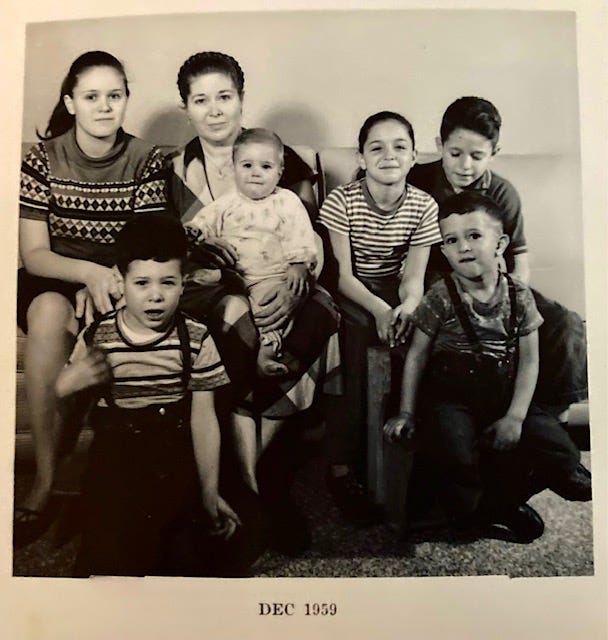
There eventually arrived a welcome transition in family population control. The first cluster of five siblings began drifting away to colleges, marriages, etc. After sister number 3 left for beauty school, I had the privilege of having my own bedroom at age 15. Unheard of in our family history.
My brother 15 months older and I became the elders at the dinner table when we were in high school. We used pecking order status of first choice on musicals only when dealing with our younger brother’s temporary obsessions.
“Camelot,” [1960], was his steady pick and longest phase since he fancied himself a young Lancelot in the making. He wanted to give his all to King Arthur as long as Guinevere waited patiently in the garden.
His next earworm was ‘Trouble in River City’ in the smash hit “The Music Man” [1962]. We heard ‘76 Trombones’ so often I started grinding my teeth and noticed a tiny patch of eczema blooming on my arm.
Shortly after my protest rant about his fixations, I too succumbed to being overly enthralled with “West Side Story,” [1961]. I morphed into Maria, pining for badass Tony from the wrong gang.
The dance scenes in the movie between the Jets and the Sharks turned me into a living room, teen rebel songster. ‘Got a rocket in your pocket, keep cooly cool boy!’
This warning was aimed at my four brothers. Delivered with the eagle eye technique I perfected after years of observing mother.
I’ll also confess to being completely swept away by “Zorba The Greek” [1964]. I couldn’t hear the theme song without jumping up and trance dancing myself straight into a sunlit plaza surrounded by white washed, turquoise trimmed homes and sparkling, deep blue water.
I announced to anyone who would listen I would one day journey to this country filled with people suffering from my same angst over the meaning and purpose of life.
I described to my eye-rolling brothers how I would dance with Zorba under the Mediterranean sun and snack on olives and figs.
How I would have a short, intense love affair with Zorba’s confused but handsome young student on the shores of the Aegean Sea. Then heartlessly dump him as I fled back home to my nuclear hometown.
My brothers were distinctly put off by my hormonally induced ramblings and steered me toward “My Fair Lady” [1964] in a wide swing across the pendulum.
It turned out to be a good distraction by activating my inner feminist, flower-child persona. An odd but intriguing combo of character traits. I longed to give Henry Higgins a gentle little slap on his entitled butt.
The musical that really took me over the edge was “The Sound of Music” [1965]. Maria, the free-spirited young nun who arrived as a governess for seven unruly children, was unrealistically sweet and patient.
I explored my shadow, fantasizing how I would trip her with a snare as she strode through the hills, so alive with their sound of music. I shared these dark thoughts with the bros. They were amused. That was disturbing.
The lyrics from the song ‘Sixteen Going on Seventeen’ gave me a severe case of brain strain. Boy sings to a girl one year younger, ‘You need someone older and wiser. Telling you what to do. I am 17 and going on 18. I’ll take care of you.’ It made me want to spit in the gutter. The last thing I needed was another boy telling me what to do.
My bro closest in age and I were simpatico. He never told me what to do.
We were gifted an extraordinary opportunity when our parents departed for a month-long visit with relatives on the east coast, leaving us behind.
They took our three younger brothers out of school and boarded the train to New York City. We were in our junior and senior years, and they didn’t want us to miss that much school. Thank you, God.

We promised to uphold our integrity, attend school every day, and not have wild parties. I eagerly agreed to every request until my mother began regarding me suspiciously. Prompting me to throw a minor hissy fit into the brew now and then.
School weeks passed smoothly during the parental absence. Weekends were tantalizingly spicy and filled with my rambunctious girlfriends. No guys are allowed or invited.
The final weekend arrived too soon. My buddies showed up with beers in tow on a full moon Saturday night. I couldn’t stand alcohol, but I managed to down three cans in a row, then wove my way to the turntable.
“West Side Story” jumped out of the stack and electrified our auras into a united swoon. We realized it was Tony we were looking for. Not the woebegone creatures littering our radiated town.
Three beers, no food and a solid hour of never before seen dance moves was a sure fire recipe for producing a very drunk young woman.
Bro walked in with two of his friends, took one look at our altered states, and calmly turned off the blaring soundtrack. I cheerily waved from my prone position on the floor and continued singing, ‘I Feel Pretty.’
His face loomed over me, zooming into my spinning, tilt-a-whirl world. “You don’t look pretty right now sis. If you puke on the floor, you’ll be cleaning it up tomorrow morning.”
My guts began protesting. Why did he have to say that? He took one look at my green face, lifted me off the floor like a toothpick, and dragged me to the bathroom with perfect timing for the purge that followed.
He cracked open my bedroom door the next morning and asked me why I did the things I did. I gave him a limp smile. “Because I’m 16, going on 17. The question is, why aren’t you doing the things I’m doing?”
I got straight A’s in school that quarter. My parents were impressed with my academic efforts, and my brother never squealed.
Life was good. Maybe “The Sound of Music” wasn’t so bad after all.


