
Multiphase Flow Modeling Approaches in CFD

Overview
In this week’s CFD Dose, we will delve into the fascinating world of Multiphase Flow Modeling in CFD. We will explore the main approaches to model multiphase flow in your CFD code. So let’s dive right in!
Introduction
Multiphase flow refers to the simultaneous flow of two or more immiscible fluids (such as gas, liquid, or solid particles) within a system. In multiphase flow, these fluids coexist and interact, exhibiting complex behaviors and characteristics that differ from single-phase flows.
In a multiphase flow, each phase may have its own distinct properties, such as density, viscosity, and velocity. The phases can exist in various configurations, including bubbly (or dispersed), separated, or intermingled states (transitional flow), depending on the specific application and flow conditions.
Examples of multiphase flows in real-life
- Gas-Liquid Flow: This occurs in various industrial processes, such as oil and gas production, chemical reactors, and pipelines. It involves the simultaneous flow of gas and liquid, with phenomena like bubble formation, droplet entrainment, and liquid film coating.
- Liquid-Liquid Flow: It is encountered in applications like emulsion formation, mixing processes, and wastewater treatment, where two immiscible liquids flow together. Examples include oil-water flows and associated extraction processes.
- Gas-Solid Flow: This type of flow is observed in pneumatic conveying systems, fluidized beds, and particle transport in pipelines. It involves the movement of solid particles suspended or entrained within a gas medium, leading to complex phenomena like particle agglomeration, erosion, and deposition.
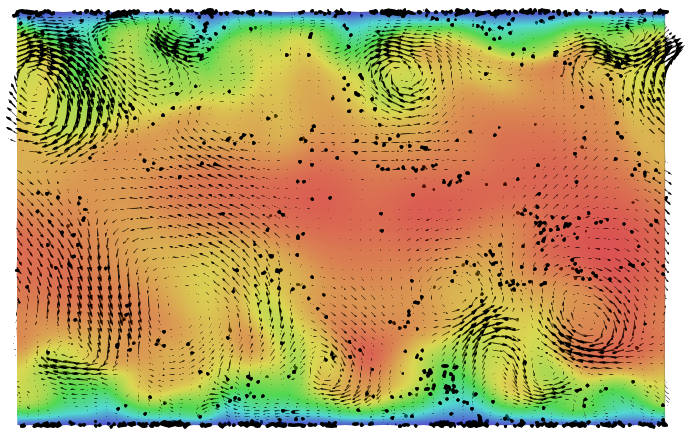
It should be obvious that understanding and accurately modeling such flows is crucial for a wide range of industries. These applications enable engineers and researchers to optimize processes, design efficient equipment, predict and mitigate potential issues (such as corrosion, erosion, or blockages. …etc), and improve overall system performance.
In the following, I’ll show you briefly the main techniques used to model these flows. No deep dive, just a first layer for now 😊
Multiphase Flow Modeling Approaches
Lagrangian Particle Tracking (LPT)
- Also known as the Euler-Lagrange approach (discrete particles are solved on a Lagrangian frame while the carrier fluid sees the Eulerian frame of reference).
- Usually considered an “accurate” approach. However, its CPU cost can be very high in some cases as the transport equations are solved for each particle at each time step (in a concurrent simulation obviously).
- Perfectly suited for dispersed flows, while not practical for transitional flows due to the immense particle count needed to represent the interface.
Eulerian-Eulerian Approach
- Also known as multi-fluid or two-fluid or interpenetrating-continua
- We solve as many transport equations as there of phases + a phase indicator function (alpha).
- In the resulting solution, every cell will give the average volume fraction, but NO topological details will be obtained for the interface between the phases.
- Suited for separated, bubbly, and transitional flows.
Lagrangian Interface Tracking (LIT)
- Much more suited for separated flows (in comparison to the two-fluid approach)
- Only one set of transport equations is solved for all phases with an interface tracking method (to track the interface and its topology)
- Some of the most common IT methods are: Volume Of Fluid (VOF), Front Tracking (FT), Level Set (LS), Color Function (CF), and Constrained Interpolation Profile (CIP).
Bed Time Reads (BTRs)
- Multiphase Flow Patterns — by Anand Nagoo
- A Review of the Methods of Modeling Multi-Phase Flows within Different Microchannels Shapes and Their Applications
- CFD Approaches for Modeling Gas-Solids Multiphase Flows — A Review
I hope this quick overview has sparked your interest and given you something new to learn about today. Stay tuned for future editions as we continue to explore the latest trends, advancements, and applications in CFD together 📖
Wishing you a productive and insightful day ahead!
The boring stuff — but they matter
- If you want to support this blog, feel free to give a round of 👏 (50x+ makes my story get featured) and share the blog with your ⭕️. Also, feel free to follow me on Medium so you get all the updates from this blog.
- If you feel lost and wondering where to start your CFD journey, let’s have a 1:1 free session and discover each other's stories — maybe I could be of a little help.


