
MULTI-FACTOR AUTHENTICATION
What is Multi-Factor Authentication (MFA)?
Multi-factor Authentication (MFA) is an authentication method that requires the user to provide two or more verification factors to gain access to a resource such as an application, online account, or a VPN. MFA is a core component of a strong identity and access management (IAM) policy. Rather than just asking for a username and password, MFA requires one or more additional verification factors, which decreases the likelihood of a successful cyber attack.
What Is IAM Security?
Identity and Access Management (IAM) security is an essential part of overall IT security that manages digital identities and user access to data, systems, and resources within an organization. IAM security includes the policies, programs, and technologies that reduce identity-related access risks within a business. IAM programs enable organizations to mitigate risks, improve compliance, and increase efficiencies across the enterprise.
How Does MFA work?
MFA (Multi-Factor Authentication) functions by requiring additional verification elements, or factors. One of the most common MFA factors is the use of one-time passwords (OTPs), which are typically 4–8 digit codes sent to users via email, SMS, or a mobile app. These OTPs generate a new code periodically or with each authentication attempt. The code is created based on a seed value assigned to the user during registration and another factor, which could be a counter that increments or a time value.
Three Main Types of MFA Authentication Methods
Most MFA authentication methodology is based on one of three types of additional information:
- Things you know (knowledge), such as a password or PIN
- Things you have (possession), such as a badge or smartphone
- Things you are (inherence), such as a biometric like fingerprints or voice recognition
MFA Examples
Examples of Multi-Factor Authentication include using a combination of these elements to authenticate:
Knowledge
- Answers to personal security questions
- Password
- OTPs (Can be both Knowledge and Possession — You know the OTP and you have to have something in your Possession to get it like your phone)
Possession
- OTPs generated by smartphone apps
- OTPs sent via text or email
- Access badges, USB devices, Smart Cards or fobs or security keys
- Software tokens and certificates
Inherence
- Fingerprints, facial recognition, voice, retina or iris scanning or other Biometrics
- Behavioral analysis
Other Varieties of Multi-Factor Authentication
As MFA incorporates machine learning and AI, authentication methods become more advanced, including:
Location-Based Authentication
Location-based MFA examines a user’s IP address and, when possible, their geographical location. This information can be utilized to block access if the location doesn’t match the approved whitelist. It may also serve as an additional authentication layer alongside other factors like passwords or OTPs to verify the user’s identity.
Adaptive Authentication or Risk-Based Authentication
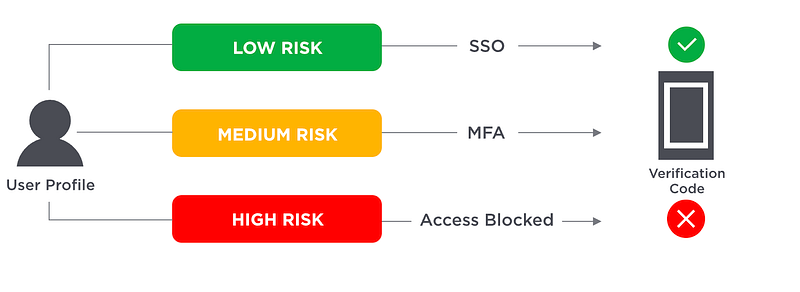
Another subset of MFA is Adaptive Authentication, also known as Risk-Based Authentication. Adaptive Authentication assesses additional factors by considering context and behavior during the authentication process. It utilizes these factors to evaluate the risk level associated with the login attempt. For example:
- Where is the user attempting to access information from? - Is the login occurring during the user’s typical hours or outside of normal patterns? - What type of device is being used? Is it consistent with previous usage? - Is the connection via a private or public network?
The risk level is calculated based on these factors and determines whether the user will be prompted for an additional authentication factor or allowed to log in without further verification. This approach is often referred to as risk-based authentication.
With Adaptive Authentication in place, a user trying to log in from an unfamiliar cafe late at night may be required to provide a code sent to their phone, in addition to their username and password. However, if they log in from their regular office location at their usual time, they may only need to enter their username and password.
To combat cybercriminals’ continuous attempts to steal information, implementing an effective and enforced MFA strategy is crucial. An efficient data security plan can save your organization time and money in the long run.
What’s the Difference between MFA and Two-Factor Authentication (2FA)?
MFA is often used interchangeably with two-factor authentication (2FA). 2FA is basically a subset of MFA since 2FA restricts the number of factors that are required to only two factors, while MFA can be two or more.
What is MFA in Cloud Computing
In the realm of Cloud Computing, Multi-Factor Authentication (MFA) has become increasingly indispensable. As businesses transition their systems to the cloud, they can no longer solely depend on a user’s physical presence within the same network for security. It becomes imperative to implement additional security measures to verify the authenticity of users accessing the systems, safeguarding them against malicious actors. As users have the flexibility to access these systems from any location and at any time, MFA plays a vital role in ensuring their true identity by requiring additional authentication factors that are challenging for hackers to mimic or crack using brute force methods.
How MFA helps prevent common cyberattacks
In 2020, global cybercrime costs exceeded $1 trillion, impacting 37% of organizations with ransomware attacks and 61% with malware attacks. These alarming statistics highlight the pressing need for organizations to confront a multitude of severe cyber threats. To safeguard their networks, systems, and data, robust cybersecurity controls and measures like Multi-Factor Authentication (MFA) are essential.
MFA offers protection against various types of cyberattacks, including:
1. Phishing 2. Targeted spear-phishing attacks 3. Keyloggers 4. Credential stuffing 5. Brute force and reverse brute force attacks 6. Man-in-the-middle (MITM) attacks
By implementing MFA, organizations can significantly bolster their security defenses and mitigate the risk posed by these sophisticated cyber threats.
Conclusion
MFA cannot guarantee foolproof security or stop all cyberattacks. However, it can help protect high-value systems and accounts, secure email access, and limit the usefulness of stolen credentials. Most importantly, MFA adds additional layers of authentication to protect systems and combat many types of cyberattacks. MFA is also critical to achieving Zero Trust, the most reliable cybersecurity approach in the modern cyberthreat landscape.