
Mountains, Melancholy, and Memories
Entering a long-ago book, slipping through pages back in time.
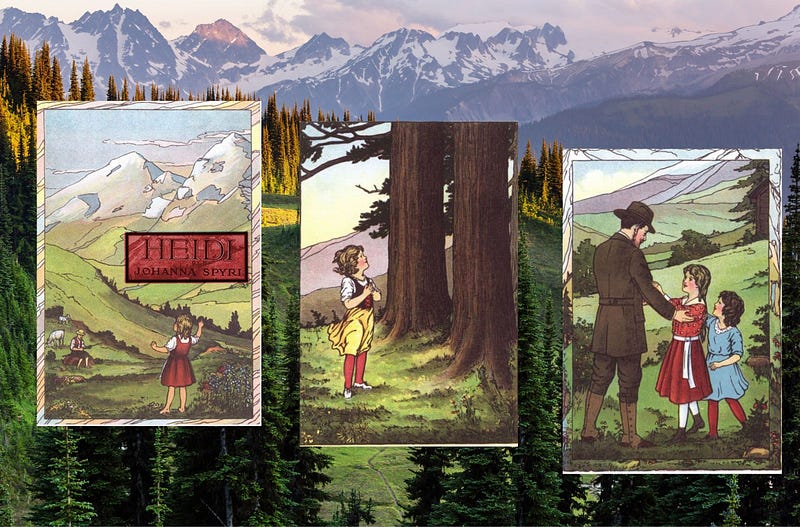
Oak trees are dancing and bowing outside my window, and the sound of wind through the trees takes me back in time, the melody of a song I yearn for. My thoughts wander back to the old spruce at the family homestead in Alaska.
My mother named it Heidi’s Tree—she must have read the book, Heidi by Johanna Spyri as a child and memorized it, I suspect. But, oddly, I think the only version I ever read was an abridged, illustrated copy, despite my mother’s frequent references. So I recently reread it.
Winter snows or my mother’s depression often forced us to move from the mountains to town. Mom would say she yearned for the mountain like Heidi, and if she didn’t return, she would surely die. It seemed possible to me as a child. I felt the same way; in fact, sometimes I still do.
The weight of trouble on the little heart grew heavier and heavier; she could no longer eat her food, and every day she grew a little paler. She lay awake for long hours at night.—Heidi.
Taken to live in the city of Frankfurt, Heidi continued to waste away.
The child has not a strong constitution, but if you send her back at once she may recover in the mountain air, if not — you would rather she went back ill than not at all?—Heidi.
The Heidi Tree was a sanctuary from the storm, within and without.
A forest fire burned through the valley twenty years before we arrived on the mountain in 1958. Only a few of the earlier trees survived, a cluster of poplars, we called the cottonwoods—and the Heidi Tree.
In the Bavarian peaks where Heidi lived, my mother said there were trees like ours, with branches bent to the ground forming a sheltering space under her boughs. So even in a downpour, one could sit dry and warm on the layer of needles accumulated there.
This spruce tree looms large in my memory, but it was probably only twenty feet tall back then. It was always a motherly creature in my mind. She is white spruce, one of the prominent evergreen species in Southcentral Alaska.
And so the time passed happily on till evening. Then the wind began to roar louder than ever through the old fir trees; Heidi listened with delight to the sound, and it filled her heart so full of gladness that she skipped and danced round the old trees, as if some unheard of joy had come to her. — Heidi.
The soil on the slopes of a mountain in Eagle River valley was left when the glaciers receded, leaving broad valleys behind.
Timberline, the highest altitude at which trees grow, is right below the tundra-like meadows on the upper slopes. Vegetation changes, descending into vast groves of nearly impassable Sitka alders, a pioneer species fond of glacial moraines. Gradually, isolated birch and poplars and spruce forests cover the mountains.
I stuck to the moose trail that ran through the tall grass covering the lower field. Otherwise, my pants would have been soaked in a minute. My dog bounded ahead, careless in the rain. I was only ten, and sometimes I still wished I was a dog.
It was spooky and damp, fog adding to the persistent drizzle soaking through my too-small sweatshirt.
Slowly, I circled Heidi’s tree, looking for the opening that faced Pinnacle Peak.
Ducking beneath the branches of the ancient spruce tree, I collapsed on the welcoming layer of needles. Tears leaked, then I gave into sorrow, sobbing until I hiccuped into silence, snot running down my face. The dog nuzzled my hand, and we laid there together while the shadows lengthened across the fields.
I don’t recall why I cried, only that I was often sad back then, living with my mother’s unpredictability.
Fear and loneliness creep into my belly as I write.
We did not have a topographical map telling us the names of the mountain peaks back then. So my mother again returned to all she knew about the wilderness, only what she’d learned from Heidi.
Why haven’t the mountains any names? Heidi went on.
They have names, and if you can describe one of them to me then I will tell you what it is called, answered her grandfather.—Heidi.
Mother named the nearest mountain—faint snow still gleaming in June, dotted with the distant specks of Dall sheep and mountain goats in July. She said it’s Pinnacle Peak, so that is what we called it.
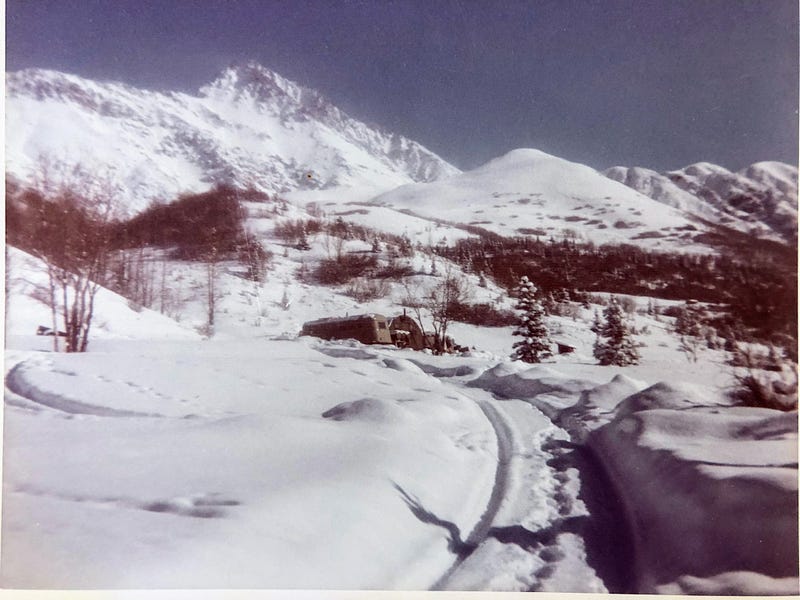
Raven Glacier at the east end of the valley still feeds silty meltwater into the south fork of the Eagle River, making its way to the northern section of the Cook Inlet. From our perch, high up on the mountain, we could see both the gray south fork and the clear north fork, carrying melting snow from high up in the Chugach mountains.
I never got tired of that view. It’s a frequent visitor in my dreams.
On Heidi’s journey home:
…Heidi looked around her and began to tremble with excitement, for she knew every tree along the way, and there overhead were the high jagged peaks of the mountain looking down on her like old friends.—Heidi.
Like Heidi, wide-open spaces still call to me.
Every day, I leave my apartment to walk in a natural space nearby. But traffic roars by only 50 yards away, and the sound of construction in a nearby subdivision destroys the silence.
Still, I sit to calm my heart and listen to the trees. I will return to the wilder places that I love.
But Heidi did not stir; she had no need now to wander about, for the great burning longing of her heart was satisfied; she was at home again on the mountain.—Heidi.
The man who bought the land from my mother posts videos of the homestead, especially the grizzly bears who have multiplied in the valley.
The footage is gorgeous, and how the trees have grown during the fifty years I’ve been gone. It’s even more beautiful than it was back in the days of Heidi’s Tree.
Note: Heidi by Johanna Spyri is now in the public domain
Cindy is writing a memoir of her adventures growing up on a homestead in Alaska, farming in the southwest, owning bookstores, and more. Access exclusive family photos here.