
What the Heck Are We Supposed to Eat These Days?
It should be getting easier, not harder.
Most of us grew up with very little information on the nutrients our body needs. I vaguely remember a chapter in health education in the sixties, but that’s about it. The term a well-balanced diet seemed to sum it up.
My mother was obsessed with diet, or more accurately, dieting. She was never happy with her shape even when she weighed 125 pounds at five feet, six inches, definitely not too heavy. However, that didn’t stop her from trying the latest trends in her women’s magazines as she cycled through the hardboiled egg and grapefruit diet, Ayds diet candy, and her home-based dieting club.
I consider Women’s Day, Family Circle, Ladies’ Home Journal, and similar magazines the equivalent of social media today. What those magazines touted, women followed.
By age seven, my mother had me on a diet.
Since I was considered chubbier than my two sisters, not even overweight, I was urged to join her. By age seven, I was self-conscious of my size.
With six children to feed on a limited budget, we never had quite enough food, my siblings and I were frequently hungry. Over-eating was definitely not a problem.
Eating out, in Alaska, in the fifties and sixties was only for special occasions, and A & W Root Beer Drive-in was the only fast food in town.
Mom fed us sugar-laced Kool-Aid, white bread, and Miracle Whip. Fresh fruits and vegetables were a rare treat, shipped by slow boat to Alaska, and without refrigeration on our homestead, we drank dreadful, watery powdered milk.
Thinking back, the meat from my father’s annual moose harvest was probably the healthiest thing we ate.
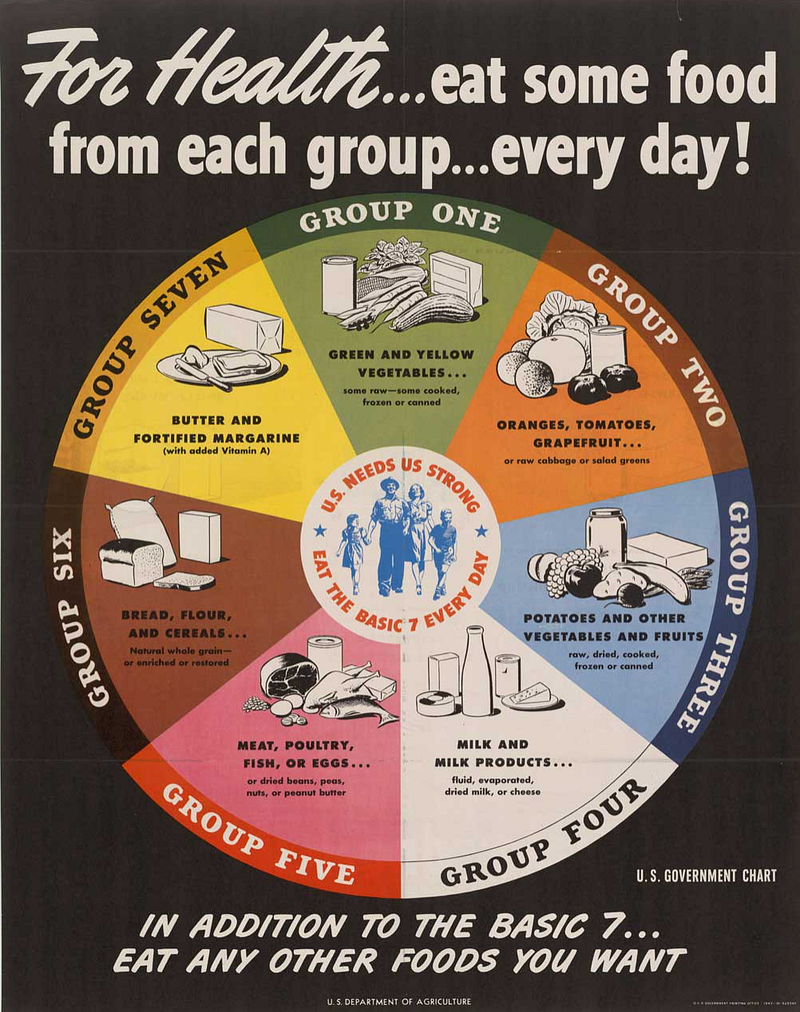

Looking at this United States Department of Agriculture (USDA) chart, used from 1946 until 1956, I see it’s not bad advice.
Notice Group Two showed a recognition of the importance of Vitamin C in preventing scurvy.
Vegetables and fruits have three whole slices of the pie, in groups one, two, and three.
Unfortunately, we see fortified margarine in Group Seven. We’d have been better off sticking to the butter.
My mother called it oleo, and along with Crisco, it ruled the kitchen.
Hardened beef fat and solid cottonseed byproducts are sold as food.
In 1814, French chemist Michel Eugène Chevreul discovered margaric acid, one of three components of beef fat, also known as tallow. When Napoleon III offered a cash reward for anyone inventing a butter substitute to be used by the poor and the military, the creation of oleomargarine was complete.
Margarine contained various ingredients, from whale oil to paraffin, and at times, provided up to 700 calories of the European diet.
Fast-forward through the Depression, World War I, and up to the rationing of WWII. Dairy products were nearly impossible to get, and margarine became the daily spread.
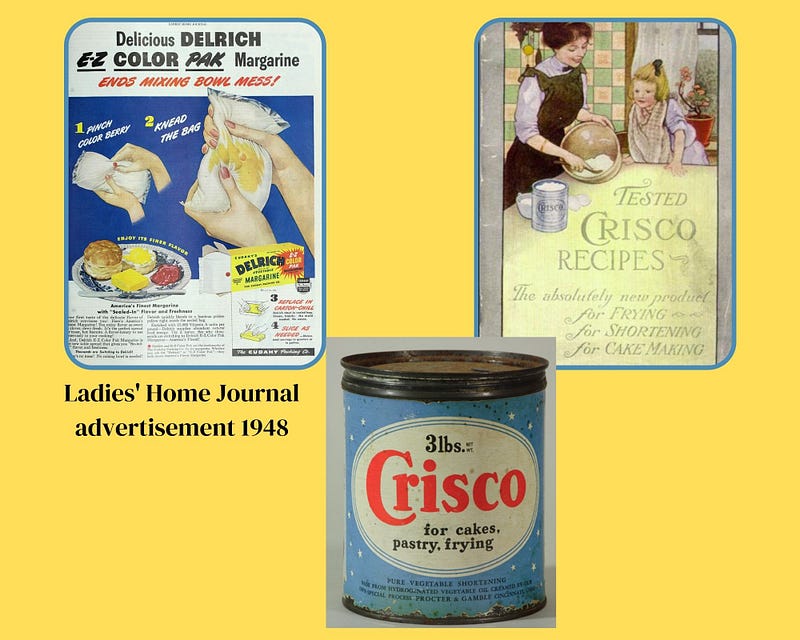
Crisco served to replace lard and butter.
In 1911, chemists at Proctor & Gamble created the first shortening made entirely of vegetable oils, cottonseed. After rejecting the names Krispo and Cryst, they settled on Crisco from Crystalized Cottonseed Oil. Crisco used a brand new process called hydrogenation to turn liquid cottonseed oil into a solid product.
Today, Crisco uses palm, soy, and canola oil, but it’s still hydrogenated and still bad for us. Interesting fact, there is no canola plant. Instead, it’s the product of rapeseed, primarily grown in Canada and politely re-named for Can-oil. Who’d of guessed?!
Enter the Basic Four food groups.
You probably remember this one. From 1956 until 1992, the United States Department of Agriculture recommended its “Basic Four” food groups.
These food groups were:
- milk
- meat
- fruit and vegetables
- bread and cereals
Mysterious ‘other foods’ could be incorporated, as needed. This category included fats and sweets.
So how the heck are we supposed to guess what to eat?
We can take the path of least resistance, skip the details and focus instead on the big picture: eating a balanced diet and hoping for the best.
Now we have the new USDA My Plate guidelines.
For most of us, this would be good enough—if we stuck to it. And tried to get a good variety of foods. But do you eat two cups of fruit and two and a half cups of veggies a day? Do you realize that five and a half ounces of meat are barely larger than a pack of playing cards?
And is corn grain or a vegetable? Could I eat 2 1/2 cups of potatoes every day and be well-nourished?
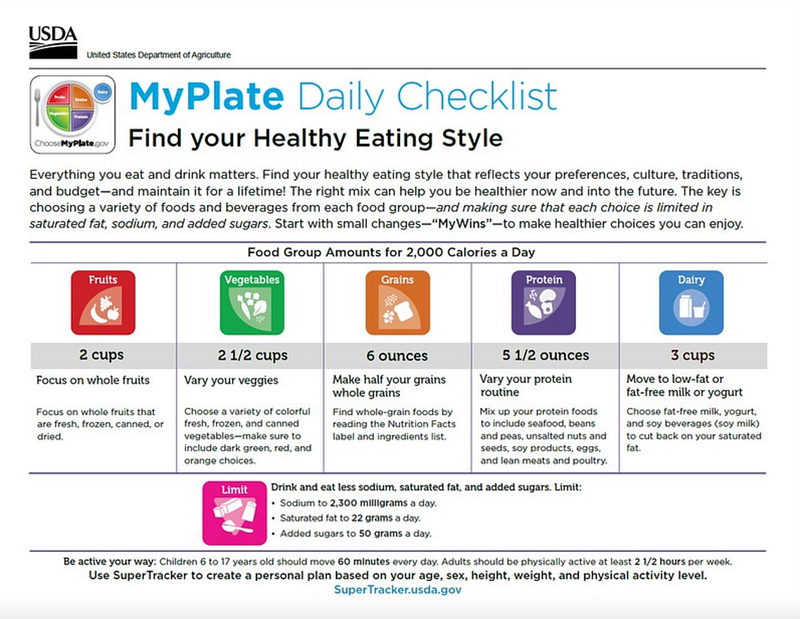
You see the problem. It’s not that we don’t care, it’s confusing!
As a young mother of five children, I really wanted to prepare nutritious, tasty foods. I checked out Adelle Davis’s book Let’s Have Healthy Children. Much to my kids’ dismay I cooked calf brains, opted for carob over cocoa, and fed them brewers yeast.
The best thing I did was enroll in a Seventh Day Adventist food preparation class. I learned the basics of plant-based cooking, since this faith is vegetarian. Whole grain cooking, yep! Food storage, yep! Budget, cooking, ditto. It was a huge help in getting me off on the right foot even though we owned a hog farm at the time, and ate entirely more pork than was good for us.
The Seventh Day Adventists still offer food preparation classes nationwide and I highly recommend them. Don’t worry, no religious commitment is required.
Enter the era of the Internet and food apps.
Way back then, I tried to figure out the nutrient values of each food but it was hard to find the information. Among the wonders of our modern era is we almost all live with the equivalent of the Library of Congress on our desktops and phones. We can access the data we need.
To make life even easier and remove our last obstacles, enter food info apps. Yep, you know I love fitness technology and I have one more to suggest: Cronometer. No, I’m not a shareholder but I am an avid fan. It’s helping me learn more about nutrition, fine-tune my diet, and…it’s free! Yes, really.
From the website: Cronometer is the most accurate, comprehensive nutrition tracking app on earth. Unlike other apps on the market, our nutritional data is curated from verified, accurate sources. We aim to provide a complete solution — no matter what diet you choose to be on.
What I love about this program is that you don’t really need to use it every day. Perhaps I enter information a couple of times a week but I learn a ton of valuable information.
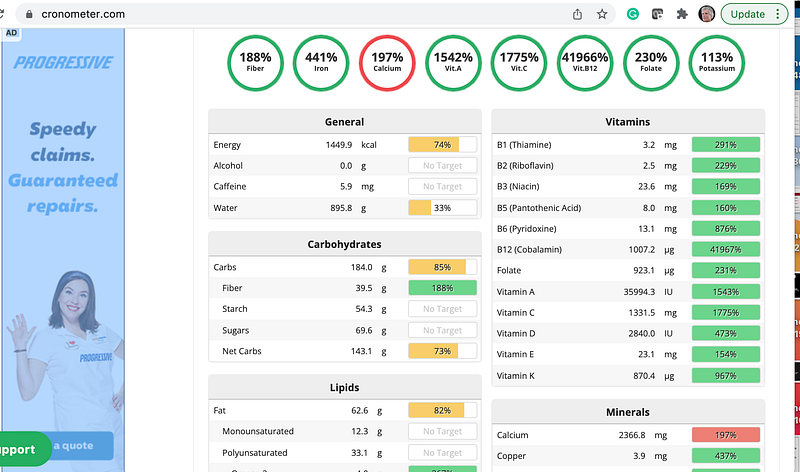
Even with the free plan, you can add your height, weight, activity level, age, and more so that it customizes your requirements. Less important than calories, is how well we are meeting our nutrient needs?
Hover over any nutrient and valuable info pops up telling me which foods contain that nutrient. Did you know mushrooms and tree nuts are high in selenium?
No, I am not an affiliate I just find this app so helpful. Please check it out for yourself. Trust me, it’s really fun to use.
Long story short, as the saying goes, we’re a long way from just having to guess at what we should eat. Sadly, ten percent of Americans have Type 2 diabetes and another 30% are prediabetic. Since poor diet has become the leading cause of preventable death—worldwide—we all need to learn more.
What do you think? Would an app like this help you improve your nutrition? What are your best tips to eat well?
References: How Crisco toppled lard — and made Americans believers in industrial food Wikipedia-Margarine Back to Basics: All About MyPlate Food Groups Cronometer 30 Days to Tame Type 2 Diabetes: A step-by-step guide to use diet and exercise to manage blood sugars
Cindy is passionate about well-being and loves to read, study, and write about what she learns. Sign up for her short weekly emails to hear what’s new and interesting in Dripping Springs, Texas.