
Most Chicks Run Away When You Approach Them — These Ones Did the Opposite
They then taught me hidden nuggets about businesses and evolution in only 6 weeks
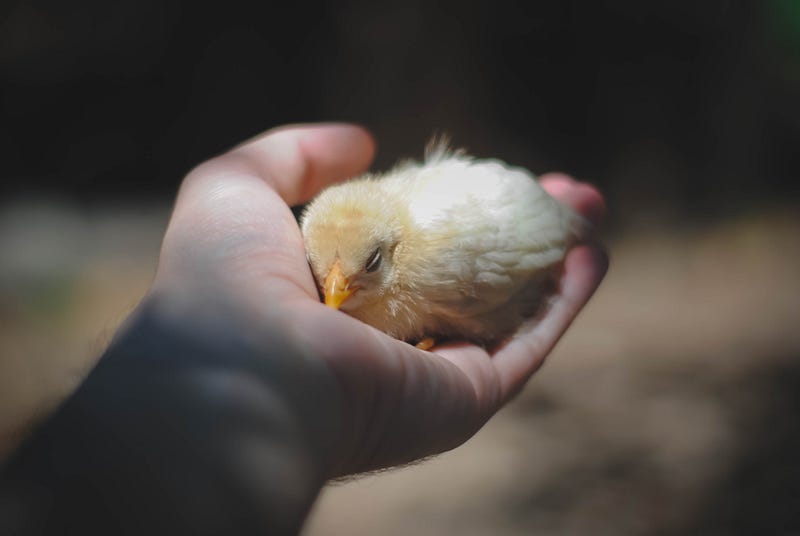
They were one day old when I first got them.
I bought around 24 of them.
After weeks of preparation, I had a plan.
I was going to be rich!
And these chicks would be my golden geese. At the very least, their feathers looked golden.
I had planned to start a golden chicken-churning project.
Before execution, I had to do my homework. I knew of a friend who was doing the same. With every visit, he told me about his greatest challenges and potential remedies.
In short, by the time my chicks arrived, I knew I was ready.
Every day, I’d disassemble a palette and use the pieces of wood to build my chicken coop. One plank at a time, I built my idea into a reality.
Businesses don’t read business plans
The first week was terrible.
One of the chicks almost died. It was from an unexpected risk of trying to be ‘smart’.
I had planned to use warm water, stored in closed bottles.
But as they cooled, they could easily be tipped into falling. Built-up pressure inside these bottles could then force open bottle tops.
The spilled water would then counter my initial intention. And it did more than that.
I could not keep the chicks outside. Nights could get extremely cold.
So, I kept them in my room.
Picture a room of someone in his twenties.
The pile of dirty clothes is larger than the clean ones. The clean ones are not folded. The windows are hardly ever opened. The only aeration comes from opening the door.
You never know how bad your room smells until it meets fresh nostrils.
Now I have a box with chicks, pooping every second.
Still, I never felt there was any difference. In contrast, it felt cozier. And I grew closer to them.
When one of them died, I never felt it would hurt me as much as it did. Seeing the once innocent and curious chicks pecking on the wounds of their dead kin left a permanent mark.
Far crazier was how quickly I moved on because those that were alive filled up a good part of my day.
I’d stay in bed the whole day, reading. Occasionally, I’d wake up to stretch, and return with water for my chicks.
In less than 4 weeks, they had matured.
Too big for my small box, I moved them from my room to their coop, outside the house.
I’d make visits to the carpenter and amass as much sawdust as I could. I had to keep the house clean, not out of choice, but because my mother would insist on it.
It seemed like she had other plans though. She even discussed with me, how we could scale the business once the chicks start selling.
Here’s another shocking reality I never anticipated — unplanned costs.
Past 6 weeks, if they are not moving about, their weight becomes too much for their legs to carry around.
Things were not going according to plan
You see, the plan was to sell all the chicken by the fourth or at most, the sixth week.
I had not factored in the possibility of incurring costs past this time. But It happened.
Time and money were now spent making sure these overgrown chicken don’t get sick.
My account was getting drier by the day. I had to find a market for them. Fast.
This was one of the biggest lessons I learnt when starting a business.
Capital is not the biggest hurdle. Demand is.
You can have all the capital poured into your idea, but without demand, it is a museum. In fact, museums are better, because the work they preserve gains value with each passing day.
My twenty or so fat chicken weren’t.
The world was not waiting for one random guy on some corner along Mombasa Road to put up a chicken business and supply the ‘much-starved’ people of the world.
I never heard restaurants complain about the lack of chicken. How would my business ever thrive? Suppliers already existed. I was getting into a stable market, with nothing new to offer.
I ended up selling the chicken to family and friends.
I then vowed never to start a business without a whiff of a growing or persistent demand. If I would, I’d have to introduce something new, unique and hit the ground running before somebody else replicates it.
Unexpectedly, these chicks taught me a lot about evolution
I’ll summarize them into three.
1. First lesson — It is only a single person who discovers, not an entire group.
I remember the first time I set a bottle top with water, and none of them approached it.
It wasn’t until a curious one poked around it only to find it was water. The rest followed and started scrambling for it.
Curious, I then changed the colour of the bottle-top, just to see if they could identify the water in it.
Same reaction.
Nobody bothered until one of them tested it out.
It seemed like they had initially associated water with the colour and shape of the first bottle top. The second bottle top was different.
Only one person was needed to shift the idea of the whole group.
It is the most powerful leverage point. Changing the paradigm. A paradigm shift.
2. Second lesson — Not all chicken are afraid of humans
I’d never seen it.
The usual reaction when you approach chicken is they scatter. They only surround you when you have food to throw at them.
This bunch never feared me. They’d do the opposite. When I opened the door, whether I had food or not, they’d run towards me.
It felt good. I’d changed what I had always believed. That also felt good.
It took having chicks to have a paradigm shift.
3. Third lesson — Genes don’t count past a certain age.
I used to think a mother would defend you always until I raised my chicken.
As I said, my mother had other plans. She wanted the chicken coop to house other chicken, including her own.
One half of the coop housed my chicks. In the other half, my mother’s mother hen...and her chicks. Let’s call her Elsa.
Elsa had chicks following her everywhere. The curious bunch would remind me of my young ones when I hosted them in my ‘tidy’ room.
There would be times when Elsa would let out a sharp cluck and her chicks would huddle under her plumage. She would then crane her neck, make a quick sweep, and then lower it and continue with its regular clucking. The chicks would then come out to rummage their surroundings for food.
In the next couple of weeks, this love completely faded.
I mean completely!
Anytime you would share food with them, the mother chased the adolescent hens would get chased away. Violently.
Genes did not matter. Survival did. And Elsa wanted to survive.
She had to…let them go.
At times, after laying eggs, Elsa would poke at them. New children did not matter. Survival did.
It led me to the last bit — a paradigm shift in understanding evolution
The most important lesson from all this was letting go of long-held ideas — and embracing new ones
I later discovered something similar happens among lions.
The older ones chase the young ones due to inadequate food. I discuss some aspects of this in my book.
I learnt that there must be more to understanding organisms besides genes. And I found an explanation which suited me.
Letting go of one idea helped me embrace another with ease. I had to shed the sunk costs for a new, better idea.
These chicks were part of the reason — nay, the evidence, for developing a new theory of evolution.
They were also the reason for understanding supply-demand dynamics. I learnt that businesses don’t go to school. They are the school.
You really can’t tell where your ideas can come from.
But for you to see that, you’d have to forget long-held, previously beloved ideas.
You have to let it go.
Subscribe to the lightest newsletter on the Internet for a one-four-all & all-four-one weekly feed, because all you need is one alternative view, only one, to edge you closer to extreme value creation, but I give you four.


