
Morton Feldman transcribes Rothko’s chilling paintings into meditative chamber music
A review of Morton Feldman’s tribute album, ‘Rothko Chapel’
“Rothko Chapel” is a tribute from one legendary talent to the next. The muse for this album is Mark Rothko, who was a famed painter from the mid-20th century. He specialized in art that made powerful commentary on societal issues. From an oblique obsession with war to the lack of spiritual connectiveness Rothko expanded the conversation around society’s image both social and cultural. His work simplified over the years and has evolved into the blocked colored hues that he is known for today. The focus has always been color and form with an expansive canvas that rivals the grandiose ambition of cinematic films. Morton Feldman, the legendary composer, took the liberty to celebrate Rothko’s work by reflecting it in a uniquely meditative and chilling chamber piece.
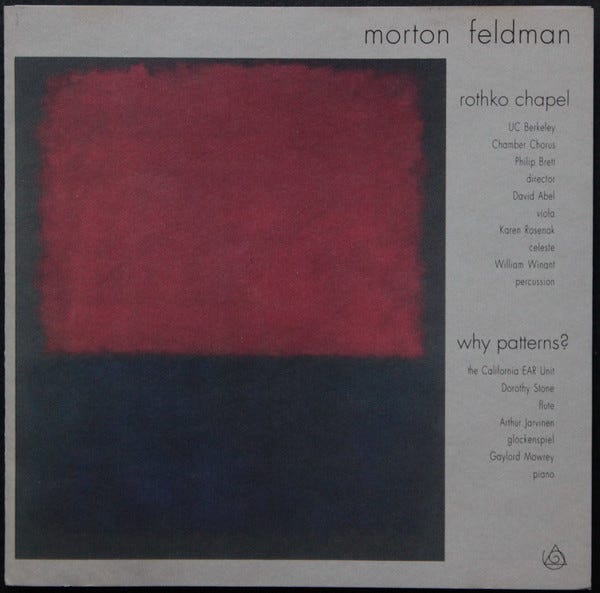
“Rothko Chapel” is a tribute to the abstract texture of Mark’s work. Morton Feldman’s unique approach to chamber music came to his benefit here. On “Rothko Chapel,” Feldman’s music is as attentive to form as Rothko’s socially conscience works were. The music is compelling even when it drags. Sometimes the distant keys even feel random until their repetitive pattern are unleashed and their creepy nature is apparent. Some of the songs, like “What Pattern?” are exceptionally long and overwhelming. However, taken apart piece by piece and the genius behind the transitions and the overall chilling atmosphere of the music brings the message from Rothko’s works alive.
The entire project is the furthest thing from pleasant and warm. Like Rothko’s haunting paintings the album features dark vibes from isolated sounds and yawning strings. From start to finish the unanticipated sounds leave the listener on edge. Like an Agatha Christie novel the music here leaves something to be discovered. Either that or the sensations make the listener feel like something is discovering them. By the last note played on “Chapel” your world can feel like its in a trap, with no way out. While Feldman brings brilliantly unnerving clarity to the chamber music world not everything sounds like the soundtrack to “The Exorcist.” Sometimes Rothko’s paintings contained bright color hues. At the beginning of “Chapel 4,” for instance, the music takes a turn for the sublime. There are some heavenly pleasant flute notes bellowing into the ether reminiscent of Sia on the Kanye West track “Wolves.” As transcendent as these moments are they come too few and far between on an album that feels too placid at its low points and too off-putting at its best.
While the album suffered from rocking too steady the overall vibes from the album is unbelievably compelling. Rothko’s work sometimes settled comfortably in its own obscurity. It took a lot to see what laid behind the curtain of his work. No matter what his message was, finding it in his work was a familiar challenge. With that inspiration Feldman did a great job at reflecting those mellow inclinations and the immense atmosphere of mystery. Over the years this album will continue to reveal itself as well as the messages that lie within it.
Album: “Rothko Chapel”
Artist: Morton Feldman
Genre: Chamber Music
Review date: 5/23/19
Album drop date: 1973
6 songs, 53 minutes
Lyrical content: N/A
Theme: 9
Production quality: 9
Song development: 7
Context in genre: 8


