
Morningstar StockInvestor Newsletter: Complete Review (2021)
A top-tier newsletter for wide-moat and value investors


I’m always hunting for high-quality investing ideas, research, and education that can improve my profits. After exploring dozens of stock newsletters, I’ve found a handful that stand out above the rest.
Launched in 2001, Morningstar’s StockInvestor is a long-running, high-quality investment newsletter with strong market-beating returns. In an industry filled with unproven operators, StockInvestor stands out as one of the most trustworthy and high-performing investment services available.
Let’s start with an overview of how the Morningstar StockInvestor newsletter works, review their two portfolios, and then dig into the pros and cons of the service.
Morningstar StockInvestor: Overview
The heart of the StockInvestor is its two portfolios: the Tortoise and the Hare. Let’s look at each in detail below.
StockInvestor’s two portfolios are based around a few core concepts:
- They’re both model portfolios, which experts agree provide the best performance transparency and replicability for followers. Model portfolios are simulated portfolios with trade timing and allocation amounts.
- All stock holdings are graded based on six criteria: star rating, moat, moat trend, stewardship, fair value, and fair value uncertainty.
- Trade recommendations are made at any time based on what’s best for performance rather than adherence to a strict recommendation schedule.
- David Harrell is the Editor of the newsletter; Michael Corty, CFA is the manager of the Tortoise portfolio; and Matt Coffina, CFA is the manager of the Hare portfolio.
Each monthly issue of StockInvestor summarizes recent trades, performance, composition, and relevant news across both of the portfolios. Plus, Morningstar sends a weekly summary email with news on their holdings and real-time alert emails for any trade action.
Each monthly issue includes excerpts from Morningstar’s latest research, a watchlist of potential portfolio additions, and several stock “spotlights.” For education-minded investors looking to learn more about stock picking, the StockInvestor team regularly shares their strategy and decision-making process.
Both portfolios are managed using a Warren Buffett-like philosophy: the managers look to buy and hold high-quality, wide-moat stocks that are currently undervalued.
Warren Buffett has a long track record of success applying this approach, and Morningstar seems to have captured some of his magic in their portfolios.
However, each portfolio has a very different strategy and performance profile, depending on the stage of the economic cycle.
StockInvestor: Tortoise Portfolio
The Tortoise holds 31 stock positions (plus a cash position) and claims the following goal:
“Morningstar’s Tortoise Portfolio seeks long-term capital appreciation by investing in select common stocks of undervalued companies with durable competitive advantages and strong balance sheets. The Tortoise’s benchmark is the S&P 500 index.”
That summary is a bit vague. Based on my experience, the Tortoise is a defensive portfolio designed to outperform during bear markets and large pullbacks and underperform during market rallies.
The portfolio’s cumulative return since its 2001 launch is quite impressive:
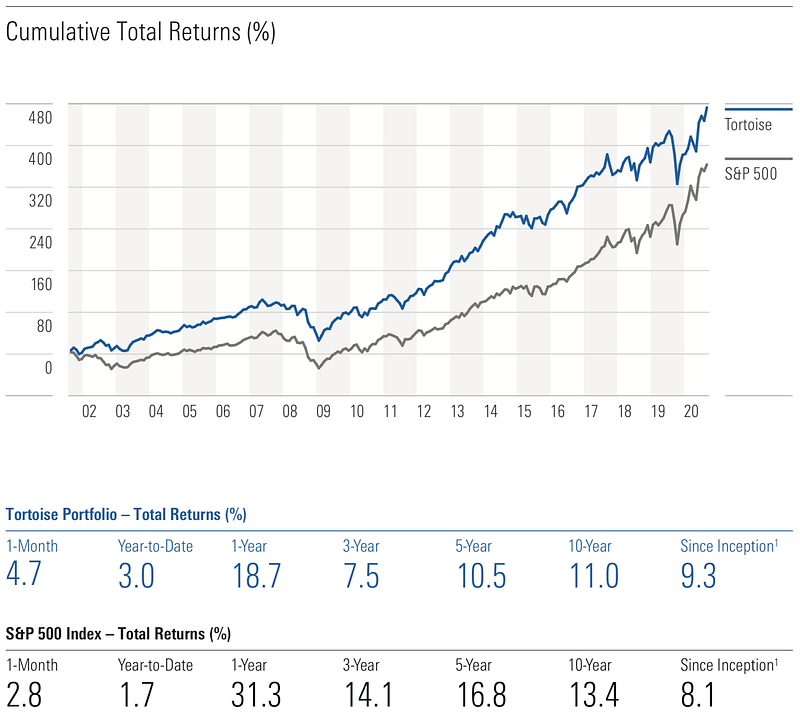
The Tortoise has returned 9.3% per year over the last 18 years compared to just 8.1% per year for the S&P 500. To beat the market by 1.2% per year is no easy feat, and it compounds to a 475% total return for the Tortoise since inception vs. just 364% for the S&P 500.
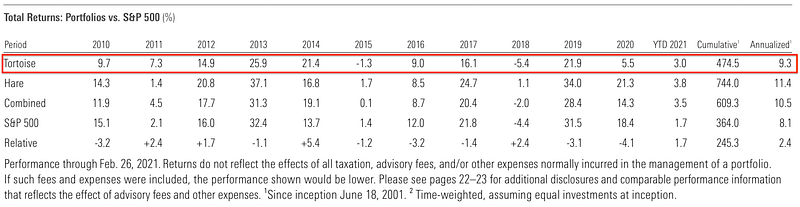
While that performance is incredible, there’s a catch with the Tortoise: it underperforms during strong bull markets. As a defensive portfolio, this is somewhat by design.
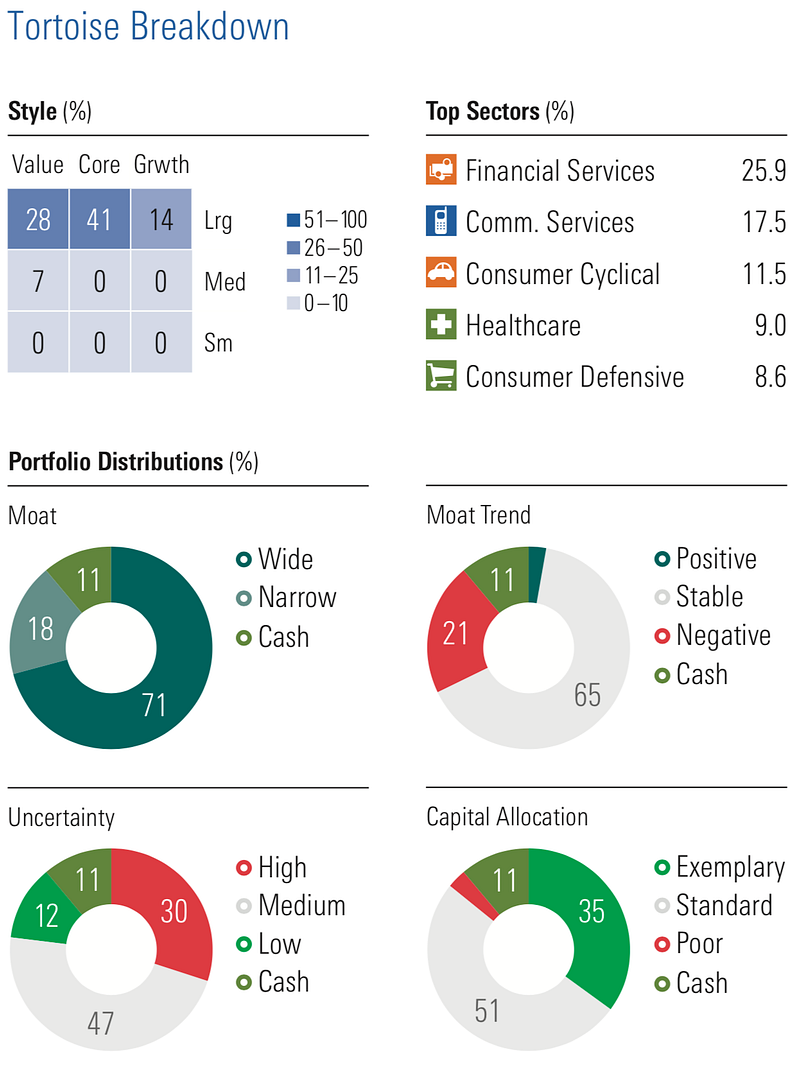
The portfolio leans more towards large cap value stocks with wide moats and low uncertainty ratings, meaning Morningstar is highly confident about their valuation.
The Tortoise has lagged the S&P 500 over the last 3, 5, and 10-year periods. Its large outperformance gap since launch comes from an early breakaway and a decline of just -22% during the 2008 crash vs. -37% for the S&P 500. Since then, its performance has lagged.
If you’re willing to trail the S&P 500 in exchange for extra safety or you’re concerned the market may soon turn south, the Tortoise could be a good fit for you. But if you’re a more aggressive investor looking to consistently beat the market, the Hare is a better bet.
StockInvestor: Hare Portfolio
The Hare holds 25 stock positions (plus a cash position) and claims the following goal:
“Morningstar’s Hare Portfolio seeks long-term capital appreciation by investing in companies with strong and growing competitive advantages. The Hare uses a ‘growth at a reasonable price’ strategy, looking for companies with above-average earnings-per-share growth whose stocks are trading at reasonable multiples of long-term earnings potential. The Hare’s benchmark is the S&P 500 index.”
The Hare is the more aggressive of the two portfolios, and it shows in the performance:
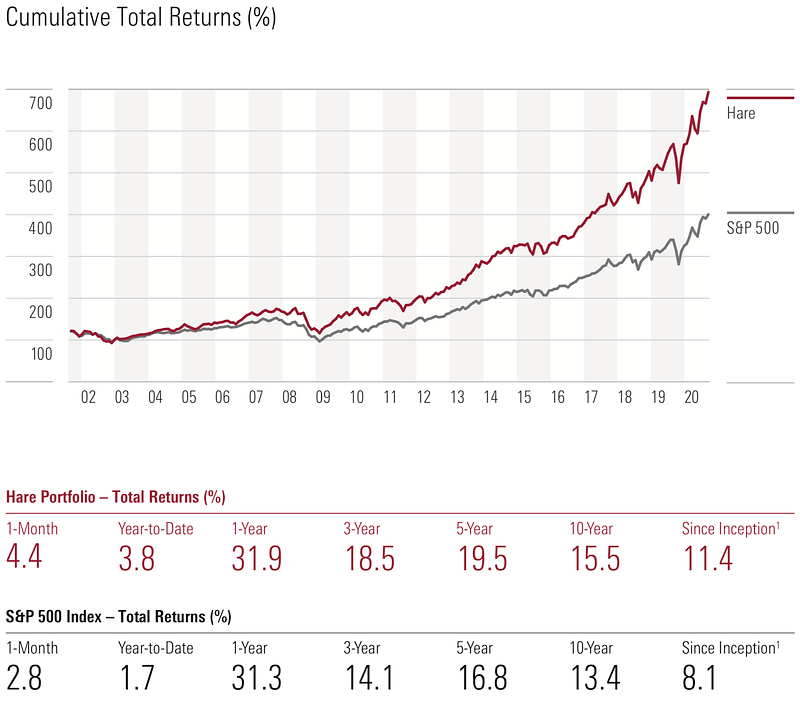
The Hare has returned 11.4% per year over the last 18 years compared to just 8.1% per year for the S&P 500. This 3.3% annual excess return really adds up, resulting in a total return of 744% for the Hare since inception in 2001 vs. 364% for the S&P 500.
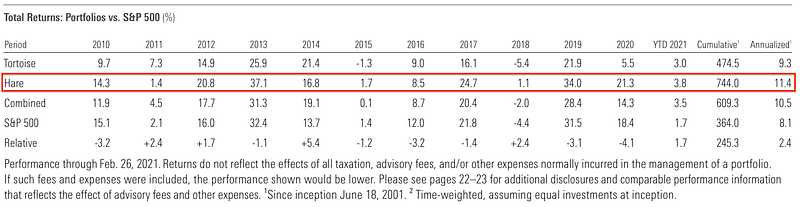
And, unlike the Tortoise, the Hare has handily outperformed its benchmark across the 1, 3, 5, 10, and 18 year time horizons. When the market crashed -37% in 2008, the Hare declined just -32%. Very impressive for a growth-oriented portfolio.
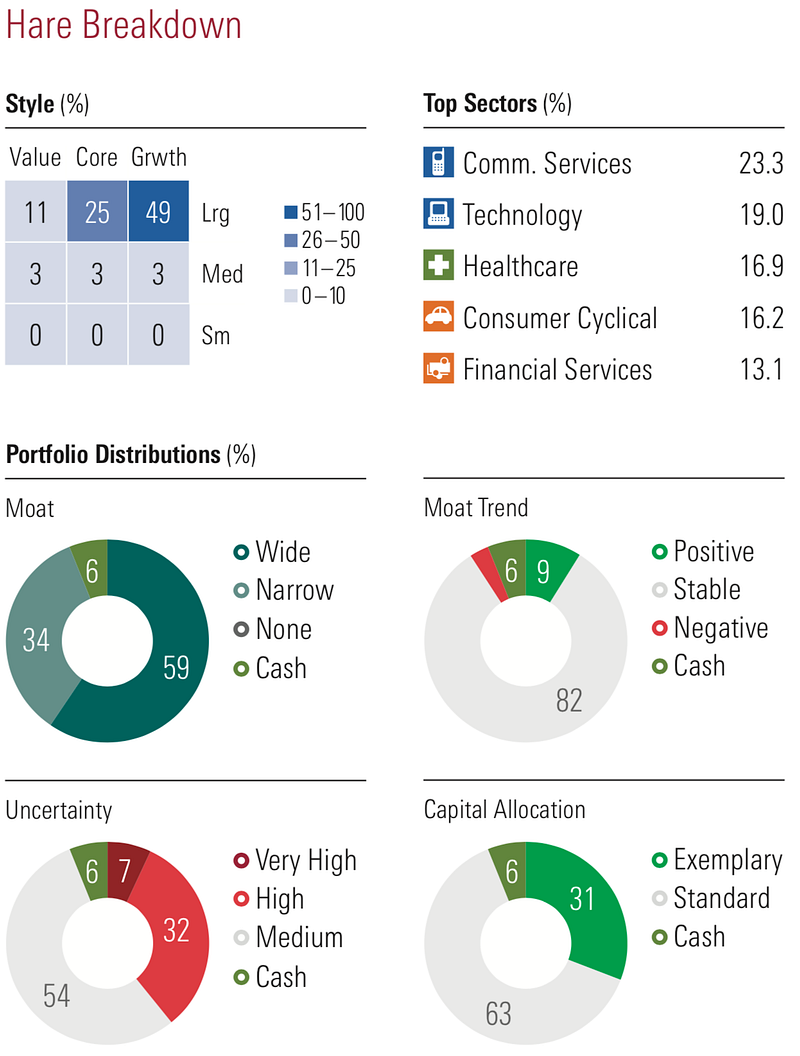
Compared to the Tortoise, the Hare leans more towards growth and technology stocks, and roughly a third of the portfolio has a high uncertainty rating. That said, the holdings are still mostly large, reputable companies with stable moats.
The two StockInvestor portfolios each provide a market-beating strategy, but the newsletter offers much more than just stock picks. Let’s look at the full package in more detail.
Morningstar StockInvestor: Pros & Cons
I’ve followed Morningstar’s StockInvestor for many years now and there’s a lot to love in their service. That said, there are a few things I’d like to see improve.
Let’s review the major pros and cons.
StockInvestor: Pros
Here are a few things that make the StockInvestor newsletter best in class:
- An army of analysts: Morningstar employs dozens of analysts who carefully research companies and build valuation models to assign fair values. This objective process employs a healthy mix of art (industry dynamics, earnings calls, stewardship assessments, etc.) and science (discounted cash flow models).
- Fair value ratings: Since each portfolio holding has a fair value, Morningstar calculates a simple “price / fair value” metric, which helps you decide if the stock is on sale. A company valued at $100 per share but trading at $75 has a P/FV of 0.75 and is trading for 25% off. This is reflected in the company’s star rating, which also incorporates the uncertainty of Morningstar’s fair value estimate. Morningstar StockInvestor offers fair value ratings not just for their portfolios, but for 100+ additional stocks on the portfolio managers’ Watchlists.
- In-depth writeups: StockInvestor portfolio managers offer clear and detailed write-ups on trade decisions and you can review in-depth company profiles and earnings results on the Morningstar website.
- Constant communication: Between the monthly newsletter, weekly portfolio updates, and real-time trade alerts, you always know exactly what’s happening with the portfolios.
- High-quality design: The monthly newsletter has a clean and modern look, making it easy to read and navigate.
- Multiple formats: StockInvestor’s monthly newsletter is available as a digital PDF, mailed paper, and interactive iPad app. Additional content is available on their website.
- Orientation docs: StockInvestor offers excellent new-subscriber documentation explaining their methodology, philosophy, and how to get started.
- Professional tone: In an industry flooded by excessive hype, Morningstar strikes a balanced and professional tone.
- Additional research and education: StockInvestor also offers in-depth stock profiles, a 120-stock watchlist, and regular research into relevant trends and strategies.
StockInvestor: Cons
While StockInvestor is an exceptional service, there are a few things that could be improved:
- Technical jargon: For a beginner investor, StockInvestor may contain too much “Wall Street jargon” and complex analysis. While it’s certainly not an institutional service, you do need some basic understanding of the stock market to jump in.
- Light on macro: StockInvestor focuses heavily on individual stocks but rarely examines macro-level themes that impact the overall market. Some investors may want more macroeconomic discussion.
- No bear market trades: StockInvestor’s two portfolios are long-only, meaning they don’t offer bear market trades. They don’t try to spot trouble ahead and move to neutral or short trades, instead they just decline with the overall market and focus on the long term. Some investors may like this approach while others may wish for the ability to react to bear markets.
- No technical analysis: StockInvestor doesn’t consider any technical analysis when making individual stock or overall portfolio decisions. This may not matter to “buy and hold” investors, but could be frustrating to investors who like to consider technical elements.
- Missing individual position performance: A few years ago, Morningstar redesigned their monthly newsletter as part of an expansion of their managed accounts product. As part of the redesign, they removed the performance of individual portfolio positions, claiming it was for legal reasons. This was a huge loss, as there’s now no way to see how each stock has performed since recommendation. Position return is a fundamental piece of data that should be readily available.
- Low portfolio turnover: Turnover in the portfolios is fairly low, as the managers clearly believe in a “buy and hold” approach. The Hare still has some positions bought in 2004 and 2006, and the Tortoise has some positions bought in 2001 and 2003. That said, most positions are from the last 3–5 years. In order to achieve low turnover, StockInvestor will sometimes hold stocks that have a price to fair value as high as 1.25 (or more), meaning the company is trading for 25% over its fair value. That could be a tough pill to swallow for value-minded investors.
- Slow on certain trends: Stocks and industries are evaluated and rated first by Mornigstar’s analysts and then by the portfolio managers. Despite excellent qualitative and quantitative analysis, they sometimes seem a bit behind the curve on certain trends, holding losing companies too long and buying winning companies too late.
- Large cap bias: Nearly all the positions across both portfolios are large cap companies. Even with nearly 8,000 stocks trading in the U.S., StockInvestor only buys companies covered by Morningstar analysts. That list is fairly small compared to the total market. As a result, StockInvestor ignores most mid and small cap stocks. This not only hurts the subscriber’s ability to discover new companies, but it also likely hurts performance. Much research has shown small companies outperform large companies over time.
Morningstar StockInvestor: Summary
Between their transparency, abundant communication, thoughtful education, proven investment philosophy, and market-crushing performance, StockInvestor is a must-have subscription for the “buy and hold” investor.
Anyone from an intermediate investor up to an institutional manager can benefit from their analysis and recommendations. That said, brand new investors may want to start with a simpler service (see my top recommendation below).
Having read, followed, and analyzed dozens of investment newsletters, I can say with confidence that Morningstar’s StockInvestor is one of the best in the industry.
Disclaimer: This article is provided for informational or educational purposes only and is not any form of individualized advice. All information is obtained from sources believed to be reliable but cannot be guaranteed for accuracy or completeness. Use this information at your own risk.


