Morning Pages or Journaling: Benefits for Creativity and Mental Health
Morning pages, the practice of journaling, or simply writing without thinking, is a wonderful way to understand and express oneself, define felt emotions, and calm the mind. In this article, I talked about the benefits of journaling both as a writer on the creative path and psychologically in my daily life.
“There is an artist within you that you don’t know… If you know, say yes right away since the beginning of the universe.” — Rumi
Hello,
Today, I want to talk to you about “journaling” or “morning pages,” one of the creativity practices mentioned in the book “The Artist’s Way.”
Journaling, as the name suggests, is the act of keeping a diary. As you may know, when we use English names for everyday actions in Turkish, it seems more sophisticated than their Turkish counterparts. Therefore, in this article, I will refer to it as morning pages because I want to use this term in line with how Julia Cameron, the author of “The Artist’s Way,” describes it in the book, even though journaling and keeping a diary are essentially the same thing.
Julia Cameron, in her valuable book “The Artist’s Way,” talks about morning pages as follows. The reason she calls it morning pages is because they are written without talking to anyone as soon as you wake up. However, I believe that if making it perfect stresses you out and you won’t do it if you don’t do it first thing in the morning, you can do it at any time of the day. Still, it’s essential to remember that the original practice is to do it in the morning before your mind fully wakes up and before contacting anyone.
What are morning pages? In simple terms, morning pages are three handwritten pages where everything that comes to mind is written down: “Oh God, is it morning again? I have nothing to say. I need to wash the curtains. Did I finish the laundry yesterday? Etc., etc., etc.” This can be crudely referred to as a brain leak; indeed, that’s the main purpose.
There is no wrong way to do morning pages. These journaling scribbles do not equate to art. It is not about writing; it is just one of the methods. Pages are only for the hand to move on the page and write whatever comes to mind. Nothing is too mundane, too silly, too stupid, or too weird to write.
Morning pages don’t have to be clever, but sometimes they might be. However, most of the time, they won’t be, and no one else will know. No one else can read your morning pages. In fact, don’t read what you write for the first eight weeks. Write three pages and put them in an envelope. Or write in a notebook but don’t go back and read. Just write these three pages… and write three more pages the next morning.
Years ago, while scrolling through Instagram, I came across a message from a beloved storyteller, Judith Malika Liberman. This metaphor of letting cold water run for hot water to come has always stayed with me. I even find myself thinking of this metaphor every time I take a shower and wait for the hot water to come.
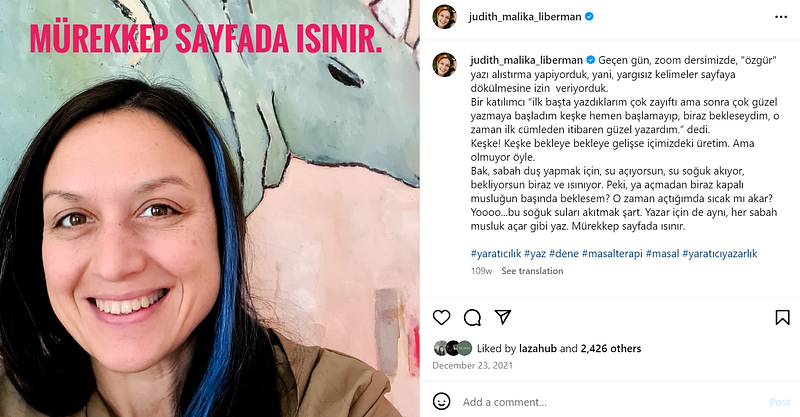
“The other day, during our zoom class, we were doing ‘free’ writing exercises, allowing words to spill onto the page without judgment. A participant said, ‘At first, what I wrote was very weak, but then I started writing beautifully. I wish I had waited a bit before starting; then I would have written beautifully from the first sentence.’
Well, you can’t! You can’t wait and let creativity flow. But it doesn’t happen that way. Look, to take a morning shower, you turn on the water, and it’s cold, you wait a bit, and it warms up. What if I wait a bit at the closed faucet before opening it? Will it flow hot when I open it? No… it’s necessary to let the cold waters run. It’s the same for a writer; write like turning on the tap every morning. The ink warms up on the page.
It’s been 109 weeks, almost 2 years. And I haven’t forgotten this metaphor. Here, we see how effective Judith’s pen and creativity are, especially as a writer who writes outside of her native language. For those who don’t know her, I highly recommend her to anyone genuinely walking the path of writing or storytelling. She provides many helpful tips on her page.
Beyond morning pages, if we talk about therapeutic journaling activities, this method is simply about writing whatever comes to mind — thoughts, problems, questions, answers, comments, basically anything without thinking, changing, or judging. It’s crucial that these writings are not shown to anyone, at least not with the mindset of showing them while writing.
You know, we often talk about spending time with ourselves. For a healthy mind, based on my own experiences, there is one thing I can say: being alone, staying with myself, is not just a desire but an inevitable need. When I didn’t allow myself this time of being alone, observed a disruption in my mind and relationships, and setbacks in achieving the goals I wanted, I realized that escaping to myself whenever possible has been the most crucial tool in regulating my relationship with myself in recent years. Writing, keeping a journal, has been one of the activities that has worked best for me during this time alone.
Since I learned to write, I have always sought refuge in my notebook from the chaos in the house or a boring lesson. Sometimes to organize the emotional explosions I didn’t know what to do with, sometimes to decipher the main cause beneath the felt emotion, and sometimes with that sweet creative energy and desire to produce something after experiencing and digesting an emotion. In fact, I don’t know how many years, but I’ve always had a small notebook and pen with me, even if it’s tiny. There have even been days when, not having them with me, I went to a cafe when I was alone, asked for a pen, and took notes on a napkin.
Today, the fact that this habit has a name and is recommended as a practical way to open up creativity, as a young writer living with the desire to earn a living from creative activities like writing for the entire life (using this definition still excites me a lot), pleases me because this practice has found such a significant place within me as an emotional need.
Journaling, morning pages, keeping a diary — call it what you want — using paper and pen, handwritten pages. Of course, it can be written on a computer, and this will still have mental benefits; it depends on how these individuals form their writing habits. I write by hand because, as I mentioned, my experience with this method, even if unconscious, has always been using paper and pen since my childhood. Also, the feeling of those hands not keeping up with the speed of the mind, and the handwriting almost becoming unreadable has always amused me a lot.
In fact, back in high school (at that time, I was interested in communism, and like every communist youth from Kadıköy, I loved reading Nazım Hikmet), I remember writing such an absurd short story.
There was something like a parallel universe, and instead of writers, they were holding their pens captive. Because only those who held the pens were the writers, and the pens decided what to write. Those punished were not the ones who wrote the stories, but the pens. Because I was experiencing this in myself; I took the pen, and the story began. Sometimes I couldn’t keep up with the speed of my mind, sometimes I wrote quickly not to lose the thread of the story.
Now, I want to share with you the handwritten text I decided to write about journaling. I know, I am writing in my mother language and I believe its better to do with our mother language because is the easiest one for reconnect from our subconcienty. And also I know, maybe you will not understand what it’s saying there but anyway i believe it’s enough for sharing and you can see my how is my handwriting while I am doing journaling. I thought of transferring the entire text here, but to make this article more explanatory, I preferred to do a bit more research and rewrite it more properly. Still, I want to share the pages of my notebook with you to see the complexity of my handwriting and take a look at the writings. I wrote these pages in Ciutadella Park, a large, green park full of people and parrots, in Barcelona.
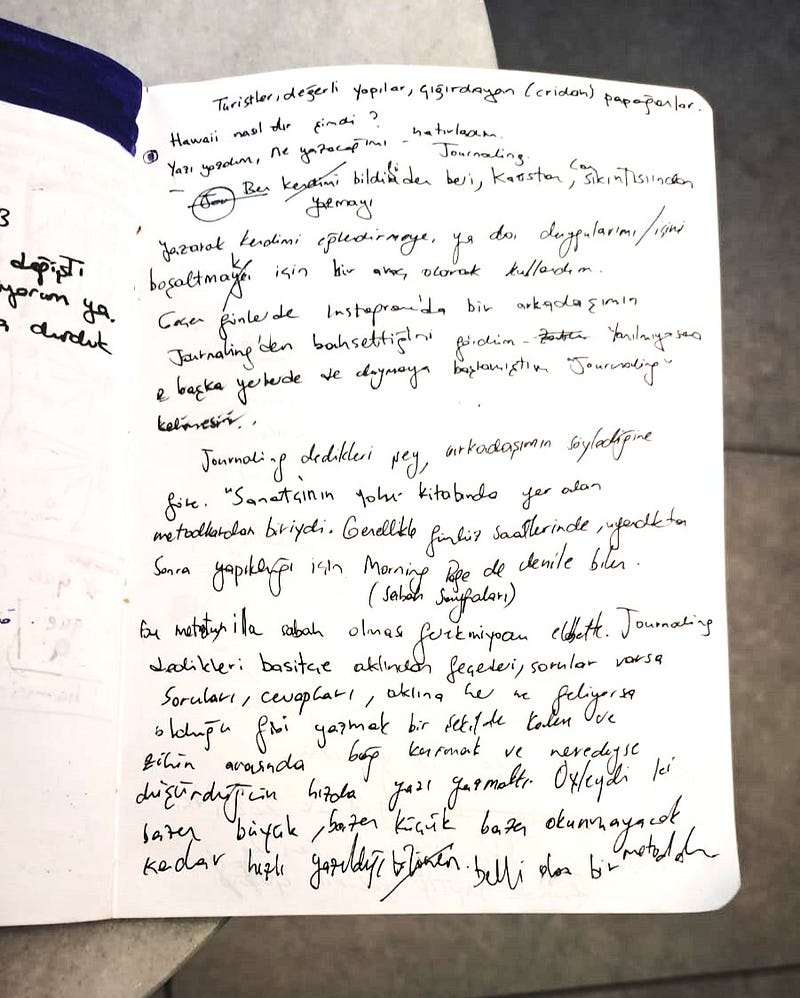
The complexity of handwriting, corrections… All results of the effort to match hand speed to mind speed.
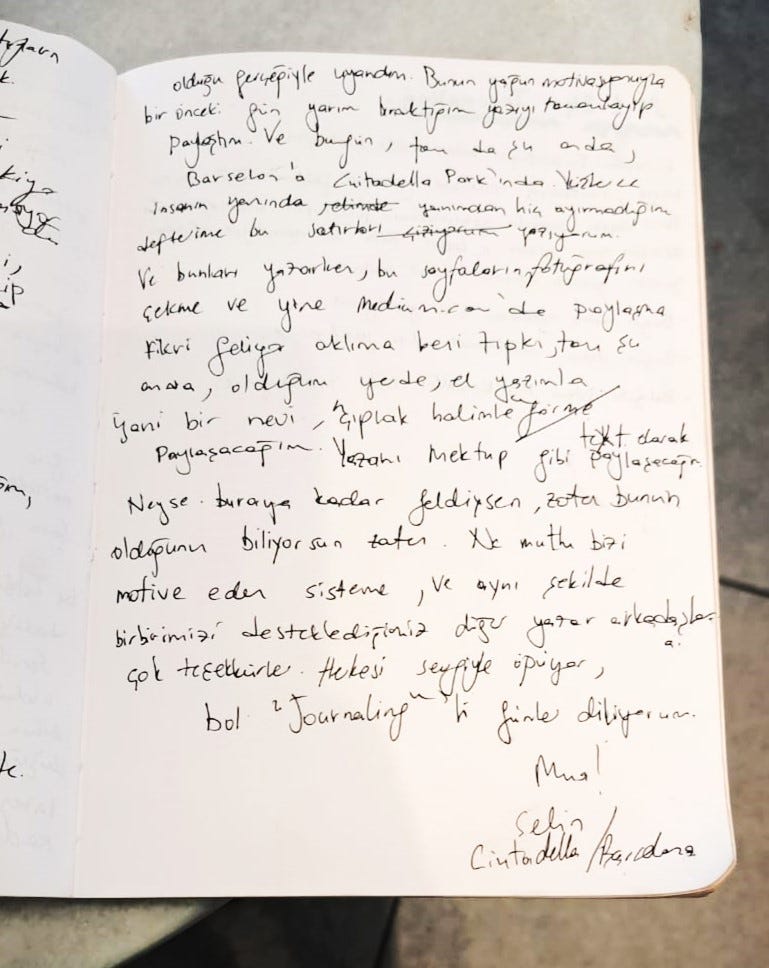
I just want to quote this part:
“And as I write these, the idea comes to my mind to take a photo of these pages and share them on Medium.com. I will share myself right here, right now, in my ‘naked’ form, so to speak. Anyway, if you’ve come this far, you already know that. Thanks a lot to the motivating system and the other writer friends who support each other in the same way. Kissing everyone with love, wishing you journaling-rich days.”
Look, I find the description of “naked form” very interesting. Because it is a mirror that presents human emotions and state with all its nakedness. And when written by hand, even the size of the writing can send a message about how I feel. Finally, to give this habit, whose benefits are unquestionable, a bit more of a scientific atmosphere (the playful side was emerging again), I want to add some benefits mentioned in an article titled “The Mental Health Benefits of Journaling,” published by WebMD Editorial Contributors and Dan Brennan on January 25, 2021.
Mental Health Benefits of Journaling
It can reduce your anxiety. Journaling about your feelings is linked to decreased mental distress. In a study, researchers found that those with various medical conditions and anxiety who wrote online for 15 minutes three days a week over a 12-week period had increased feelings of well-being and fewer depressive symptoms after one month. Their mental well-being continued to improve during the 12 weeks of journaling.
It helps with brooding. Writing about an emotional event can help you break away from the nonstop cycle of obsessively thinking and brooding over what happened — but the timing matters. Some studies show that writing about a traumatic event immediately after it happens may actually make you feel worse.
It creates awareness. Writing down your feelings about a difficult situation can help you understand it better. The act of putting an experience into words and structure allows you to form new perceptions about events.
It regulates emotions. Brain scans of people who wrote about their feelings showed that they were able to control their emotions better than those who wrote about a neutral experience. This study also found that writing about feelings in an abstract way was more calming than writing vividly.
It encourages opening up. Writing privately about a stressful event could encourage some to reach out for social support. This can help with emotional healing.
It can speed up physical healing. Journaling may also have an impact on physical health. A study on 49 adults in New Zealand found that those who wrote for 20 minutes about their feelings on upsetting events healed faster after a biopsy than those who wrote about daily activities. Similarly, college students who wrote about stressful events were less likely to get sick compared to those who wrote about neutral topics like their room.
But researchers also noted that writing about negative emotions may increase anxiety and depression levels.
However, researchers also note that writing about negative emotions may increase anxiety and depression levels.
Thank you very much to all the friends who have read me this far. As you know, you can reach me on Instagram @bostanciselin and via email at [email protected]. Your comments are very valuable to me.
Sending lots of love to everyone, Selin!