
Morning Pages is the Best Workout for Shaping those Creative Muscles
Even though it sounds at first like woo-woo internet self-help crap
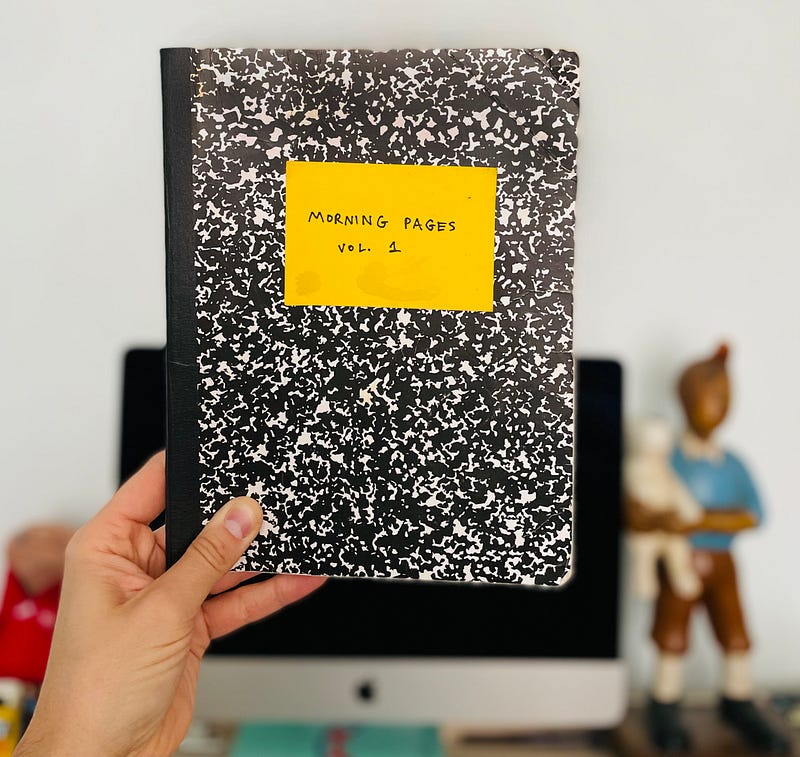
If you’ve spent any internet time perusing the creativity aisle, you’ve likely seen the row labeled “morning pages” in the journaling ideas section.
I first heard about morning pages several years ago but passed over them without much interest. The prosaic title didn’t draw me in and my perfunctory understanding placed it in the category of prompt-based introspection. It didn’t help that I had distanced myself from journaling, my insights starting to feel a bit stale from having spent my 20’s and part of my 30’s making obsessive notes from my navel-gazing observatory.
I finally decided to give the practice a try when I heard it mentioned on an episode of How to Write Funny, the comedy podcast of former The Onion editor-in-chief Scott Dikkers. The tipping point was his anecdote about how a few days of morning pages helped bust up a bad bout of writer’s block. I also tend to deal with the same self-doubt that leads to constipated writing sessions. It was intriguing.
If you don’t know what morning pages are all about, it’s a very simple creative workout that Julia Cameron debuted in her creativity method book The Artist’s Way. Here’s the foundational practice of the exercise: three pages of stream-of-consciousness writing without pausing to edit.
The goal you’re aiming for with morning pages is forward momentum, instantly started and smoothly sustained.

The idea is that with practice, the act of first draft composition stops looking like whipping a beleaguered donkey up a mountain trail and starts resembling a vigorous cycle through unexplored hill country.
It works by tempering the main obstacle to creative writing: editing as you compose. You’ve got two brains as a writer, creating brain and editing brain. Becoming a better writer means growing and refining your editing brain, but the catch is that letting it get too zealous chokes out the rest of the garden.
Morning pages add a volume knob to editing brain, which keeps it from shouting down creative brain’s voice. It gives creative brain the right-of-way in your first draft to do what it does best, venturing into the deep strata of your subconscious and emerging with unexpected treasures.
The guiding principle that keeps the practice effective is to keep the pen moving, full stop. No editing. No backtracking. No pausing. The words themselves are not valuable.
You’re not building the house right now, you’re lifting bricks and putting them back down.
When I started in August 2021, the pages of my first couple of weeks were incomprehensible gibberish. It’s a good thing my wife already knows I’m crazy, because if she didn’t know better, they would become my looney bin passport.
Those first weeks were a grand slam success, though, because the process is the product. It’s why I use 99-cent composition books and 50-cent gel pens from Walmart — this is not the time to bring out the presidential stationery and heirloom fountain pen. When you’re starting out with morning pages, even a half-ounce of preciousness will quickly feel like a hundred pounds.
Wow, I’m going for a hard sell on this thing! Let’s close the pitch on morning pages with…
Three main improvements I’ve experienced thanks to morning pages
1. Morning pages greased the rusty wheels of my drafting process
As I mentioned earlier, I used to heavily self-edit. Every little group of letters I put down was a flipping Fabergé egg.
It overloaded my drafting process because it combined too many drafts at once — I was trying to choke down a purée of rough draft, structure draft, grammar and syntax draft, style draft, finesse draft, and so on. My morning pages practice of simply barfing on the page burst this perfection bubble.
Now, it doesn’t mean I don’t steer my first drafts. Unlike with morning pages, I do have a road map when I’m creating a composition — with fiction, I spontaneously cut jungle trails with the mountain peak in view, and with non-fiction, I fill up a bucket for each arranged outline point.
It’s just that now I trust the ol’ creative brain to drive the first stretch while editing brain helms the road trip playlists and dishes out the snacks.
2. Morning pages gave me an (optional) daily personal check-in
I mentioned earlier that after a few weeks, I began to creak out a coherent string of thoughts in my morning pages.
It got to the point where I was able to start working out knotty problems or dig up and examine emotions I’d been smelling all week. I started to look forward to my morning pages time because I treated it like a little oasis where I could tease out some sanity from the churning, gloppy bog that I call my mind.
But I think this only works because there’s no pressure for introspection. I could drool out straight-up drivel from January to October and that would be OK. Perfect, even. The door to insight is open and the porch light is always on, but there’s no such thing as a no-show.
It’s comforting to know that I have a daily outlet if I need one. (These days, even a little bit of comfort goes a long way.)
3. Morning pages gave me a strong anchor point for my daily routine
I’ve always been an obsessive journal keeper. Recording in a notebook lights up my brain like the funnel cake stand at the county fair.
Morning pages were a very easy daily habit to adopt, but there are plenty of other stubborn habits that make me feel like I’m trying to push a freight locomotive from behind.
The momentum from my morning pages runs over into other pursuits. I’ve been able to add a handful of daily wellness/maintenance core habits like exercise and mindfulness meditation. Those trains still aren’t moving super fast and get pretty easily disrupted by the circus I call my life, so they don’t really power themselves independently quite yet. But I’m able to jump back in even after missing two weeks because morning pages whips out the jumper cables and gets their engines turning over with minimal effort.
All right, I want to hear from you all — who has tried morning pages? Did it soar or faceplant? Do you think it has benefits or do you think it’s baloney?


