
Morning Pages: Memories Bring Joy in the Midst of Pain
It came out of nowhere one day, when I was thinking about nothing, with nothing really important to do, nowhere to go. The memory filtered into my consciousness, as it does now and then, of my brother’s car accident when he was twenty, I was ten, way back in the days when the Chevy Corvair was a deathtrap. It was January, Kansas, icy roads, late night, racing against a curfew: a recipe for disaster. Three of the four college students in the car died, and the fourth barely survived. The story hit the AP wire and spread through the midwest. That was the beginning of 1968.
A half century later I still feel the loss, still recall the hazy days following the accident, when my brother was flown with massive head injuries to the Wichita medical center and my parents flew down the highway to be with him. There are conflicting stories about whether he regained consciousness before he died, but I choose to believe my father’s, which was that at one point Danny opened his eyes and commented on the daylight streaming through the window with a small smile and the word, “sunshine.” I don’t remember Dad saying whether Mom was there or not at that moment. I hope she was.
The tsunami wave of shock that rippled across our family ocean had its impact on each person who had known my brother, but the most visible to me was what losing her son did to my mother. She was 51 at the time, with two children still at home — the result of later-life adoptions of my sister and me. She had been raised a Dutch Methodist, becoming a Lutheran when she married my father. Both she and my father were competent, disciplined and experienced parents by the time they adopted us, having had three biological children before. Still, there was one thing that all those strong foundations could still be shaken by, and this was it. She required medication, there were no sophisticated grief therapy services available back then; you had your pastor and church and family to surround you, but pills eased the suffering, allowing for sleep, at least.
Unfortunately, the medication options weren’t very good at that time. Our small-town doctor prescribed for her a very strong anti-psychotic medication (I wasn’t to learn this, or the fact that she remained on it, until a random incident decades later). This medication was part of the reason for the changes that became obvious to me as a child. She was much more reserved, quiet, showed much less emotion. She had less energy, and her petite and trim frame began putting on weight. I didn’t understand the complex set of sources and my mother’s new self was confusing to me and a little intimidating. It was to have a long-lasting impact on my self-confidence and our relationship.
Memory’s a funny thing. It doesn’t tell its stories to you in chronological order, or with a beginning-middle-ending structure. I think of memory stories as little movie clips, like trailers, that appear at random moments — or at least they seem random; far be it from me to pretend I understand how the human brain works. Sometimes there are triggers that do make sense — you heard a song playing over the mall PA system; you smelled wood smoke on a walk by the river; you heard the late-night yipping of a pack of coyotes — and these sensory reminders flood your brain with a related memory.
In my case, a memory recently graced me with its presence: It was a series of miniature scenes in quick succession, like a sequence in scriptwriting. And it was so beautiful, so filled with joy and tranquility that I stopped in my tracks to savor it, to let it bring me peace.
— My mother, father, and younger sister are all on our bikes. We are cycling somewhere. I have my banana seat and my ape-hanger handlebars. It feels like I am maybe eight or nine. It is summer, and very warm.
— I look over at my mother on her bike and she is smiling, laughing.
— Our bikes are parked on a sandy shoal of Cow Creek. A blanket is spread on the sand, littered with the remains of a picnic lunch and a big brown woven basket, open and tipped over on its side.
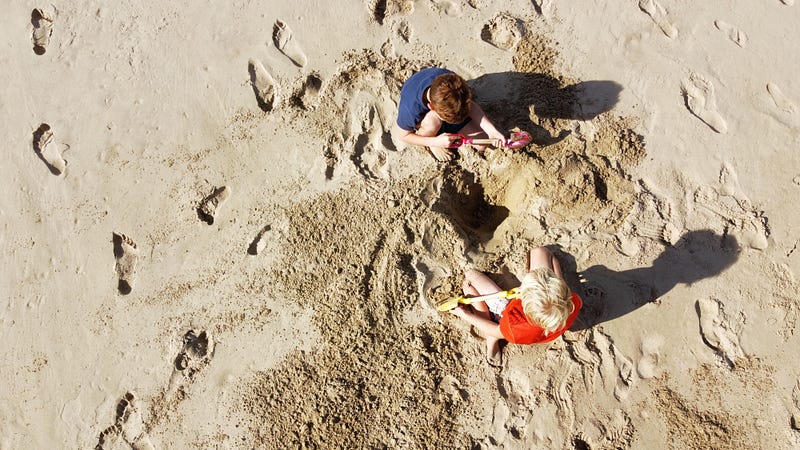
— My little sister and I are digging in the sand with small blue metal shovels, like kid’s gardening tools. We are digging for crawdads. She is five or six, and has her infamous pale blue cat-eye glasses on, which she keeps pushing up with one sandy finger.
— My mother is laughing somewhere on the beach with my father; they laugh as carelessly as a long-haired gal would toss her locks over her shoulder. Their laughter fills the universe.
—It is hot, we are tired, there is a sweet somnambulance in the air, we are lulled by it. We have packed up and are cycling back home. The sun is setting and Dad tells us to giddy up or we won’t be home by dark.
Regardless of how or why memories show up when they do, you might see only moments; scenes, sometimes, if you can stay suspended in that magic recall space long enough. But those moments can be as powerful as entire novels. Sometimes those memories, out of the vast and misty past, can enlighten you, change your understanding, create peace or joy, or terror.
For me, this time, it was an opportunity to glimpse my mother as I had not remembered her: before she lost her son, when she was healthy and joyful, feeding on, and giving back to, the universal energy. It was a gift from the universe.
Thank you, Universe.


