
MORE Thoughts on Medium’s New Terms, and Why It Matters
So that you can make an informed decision before agreeing to them.
Let me start by saying that I believe Medium’s intentions are good.
I wrote, the other day:
Medium responded promptly with reassurances — their email has been added to the story above. However, no reassurances given in email or published by Medium in a separate story have any legal force and effect whatsoever.
Understand that the Terms of Service (and the additional agreements linked to at the bottom) are the only contractual agreement between Medium and you, unless you’re a big gun who’s able to negotiate a separate one — as stated in their “unless otherwise agreed in writing.” That means a meeting between minds, expressed in a contract. That doesn’t mean “something we post in a story.”
The following contains hypothetical situations that may seem far-fetched, probably will never happen, but generally illustrate why the new terms are cause for concern and why they ought to be changed — in the Terms of Service, which is the only contract between Medium and its contributors. Good intentions, expressed in a published tale on Medium, are just that — good intentions. They have no legal force or effect.
Licensing and Sublicensing
ICHI.PRO is just one of several sites, recently, that have brazenly scraped most of Medium, including stories that have been placed behind the Medium Partner Program paywall. This latest theft includes at least all of the main and somewhat popular publications — and they are removing author bylines, credit blurbs, and other links to make it harder to detect. Below, you will see some of the evidence that they are doing this.
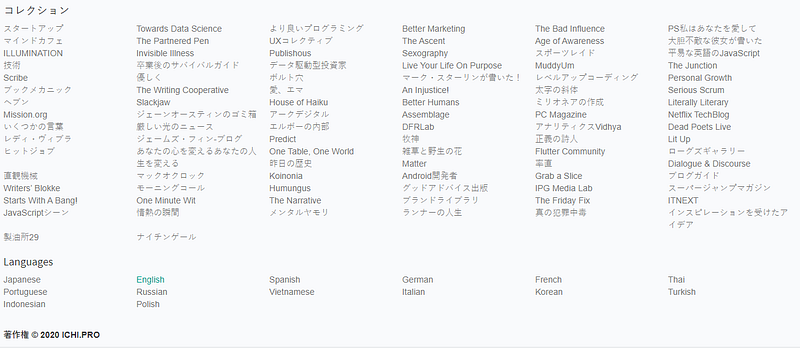
Isn’t it cute, that ICHI.PRO is claiming copyright, themselves? It’s like a thief, coming into your house, stealing your car, then trying to get you arrested if you find it and take it back.
Here is an example of one of my articles, published only on Medium, at
And here it is on ICHI.PRO:
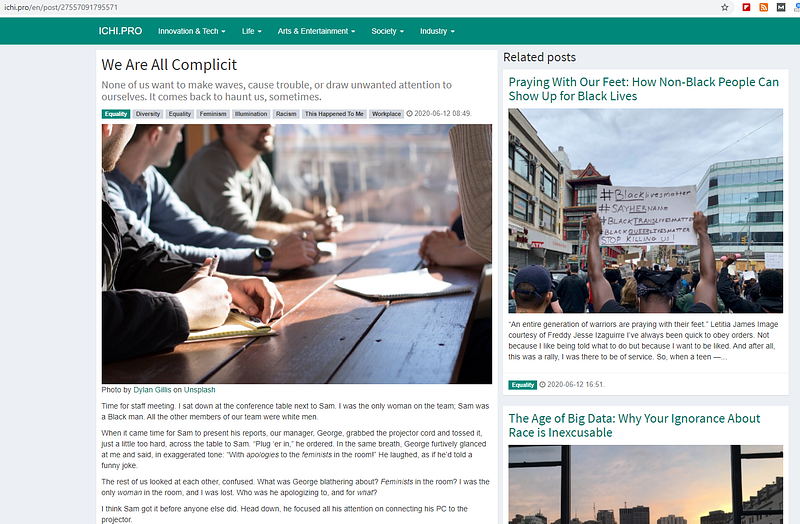
Following the General Instructions described in this story, it appears that the proper recipient for DMCA take-down notices, this time, is [email protected]. If your work is affected, please click the link above, follow the General Instructions, and submit a DMCA take-down request. (You can only file a DMCA take-down request for material you own and legally affirm you own the copyright to, in order to prevent frivolous claims from copyright trolls. I have cc’d Medium Support on my latest, so they should be aware if they were not, already.) If you find another writer’s work anywhere on the web, and believe that it may have been stolen, have the professional courtesy to notify them, please.
Now, imagine for a moment, that “sublicensing” clause in Medium’s new terms.
What IF…
Medium decided these fly-by-night content scrapers were too much trouble to deal with, and offered to allow them to do this — by licensing and sublicensing all of Medium’s content — for a fee? Now, all that work that is normally behind the paywall isn’t — and Medium owes us nothing, but could, themselves, legally earn a fee for “sublicensing” the content.
In that case, if we filed our own individual DMCA take-down requests, a site like ICHI.PRO could actually countersue, claiming that Medium had sublicensed our content to them and they had every right to use it. That’s not what I agreed to when I posted here. How about you?
What IF…
Medium were sold to News Corporation (owned by Rupert Murdoch)? Or Disney? Or any other large media outlet that may see fit to “change the direction” of the Medium platform, and now owns a perpetual license to our content? After all, it’s great that Medium swears, today, that it is committed to remaining ad free, but that intention would not be binding on a buyer. And what value does Medium bring to a buyer — without content?
What IF…
You posted a marvelous story on Medium, and someone wanted to produce it as an animated feature film? Medium could sublicense your story to them (for a fee or not, “without compensation” to you) and it could be the next blockbuster hit, like “Frozen.” And you’d be out in the cold.
Technically possible. And let’s get real — if you’re a blogger or if you’ve ever posted anything on social media, anywhere, you’ve probably blithely signed away these rights without blinking.
The difference, here, is that Medium is a publisher. And they recently made a change to surprisingly author-friendly terms in order to make them very author-UNfriendly terms. Make no mistake — this was not a newbie move, copying some bit of cover-your-ass boilerplate just to make sure you’ve covered all the bases. Medium has lawyers. They know what they’re doing.
So, why now? Why this change?
Derivative Works
Under U.S. Law (17 U.S. Code § 101 — Definitions)
A “derivative work” is a work based upon one or more preexisting works, such as a translation, musical arrangement, dramatization, fictionalization, motion picture version, sound recording, art reproduction, abridgment, condensation, or any other form in which a work may be recast, transformed, or adapted. A work consisting of editorial revisions, annotations, elaborations, or other modifications which, as a whole, represent an original work of authorship, is a “derivative work”.
For anyone here who wonders why I refuse to give anyone blanket rights to translate my work (or otherwise “modify” or “adapt” it in any way), you have only to look at this rip-off of one of my poems. Here’s the original:
While the ICHI.PRO scraped our work in English, and actually offers the original English if you click that language or add /en/ after ICHI.PRO, all other versions are machine translated. The default is in Japanese. If you’re using Chrome, you will probably get a pop-up offering to translate the page, as shown below:
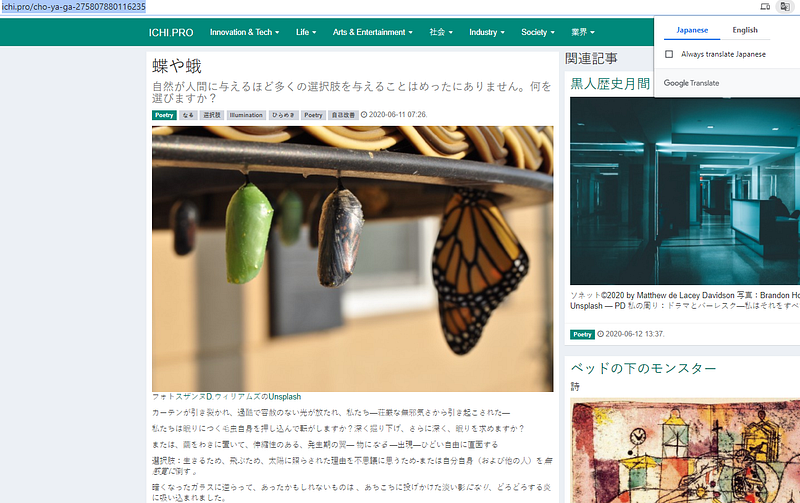
And here’s what mine looks, translated back into English:
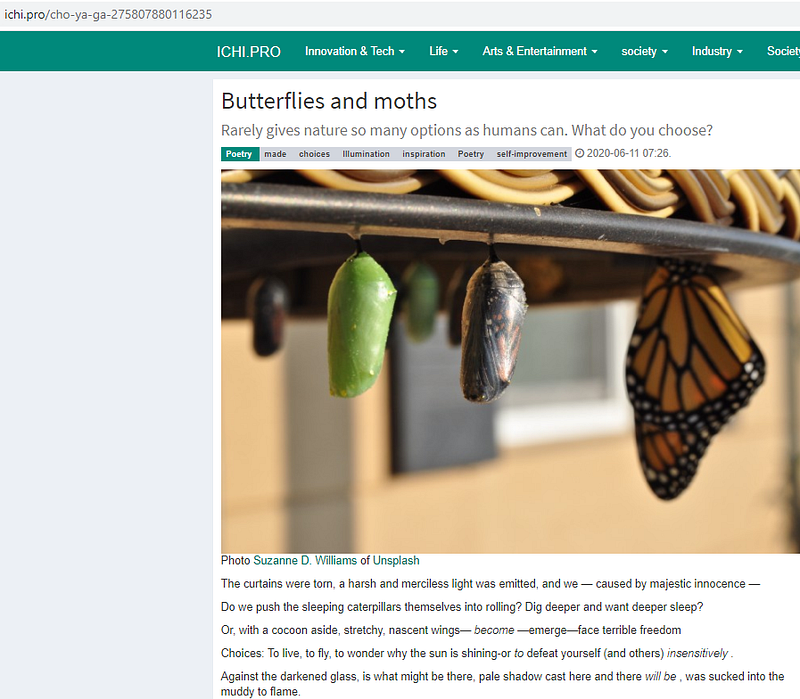
In short, mangled.
I do not give consent to anyone to mangle my work. Nor do I give them any right to strip my name off of it or earn money for it “royalty free” or “without compensation” to me.
But again, re-read what I wrote, above, about sublicensing.
New Media
Ask writers and actors how they feel about giving up future, possibly severable rights to their work “in all media formats and distribution methods now known or later developed without compensation to you.”
First, you have to understand the value of what you’re giving up — but you can’t, if they’re not known to you (“later developed”). Early big screen writers and actors did not foresee TV broadcasts and reruns; early TV writers and actors did not foresee home video and DVD, or Internet streaming services, when they negotiated for royalties and payments in their contracts.
Sure — you retain ownership of copyright. That, in and of itself, has some value, but within “copyright,” there are severable “rights.” For example:
- First North American English print rights
- First worldwide electronic display rights (you gave this up already, just by posting your work here)
- First [language] translation rights
- Movie rights (Does this include DVD, streaming services, downloadable content? All negotiable, by contract.)
- Audio rights (e.g., podcasting, audiobooks)
- Product rights (plush toys, games, mugs, t-shirts, posters, etc.)
So carefully consider this before agreeing to the new Terms of Service — not just on Medium, but also on any of the platforms where you publish your writing, your art, your music, your podcasts, etc.
Should I Stay or Should I Go?
It’s not my intention to demonize Medium or convince anyone to remain or to leave. This isn’t #MedExit. But know what you’re giving up, legally, if they refuse to back away from some of the changes to the Terms of Service, and make an informed choice.
UPDATE (8/19/2020):
The TOS has been modified to incorporate language addressing our biggest areas of concern. I’m satisfied. Read the changes, and decide for yourself.


