
More Revealing Truth About Our Memory Banks
We Reach Our Final Destination — Long-Term Memory
In the last story, we ended where Brain, the customs officer, has allowed entry of the memory packets and forwarded them to our distribution center — the hippocampus, where a short-term memory hangs around for 20–30 seconds and then disappears if we don’t engage our working memory, in other words pay attention.
(I recommend you read this story first before taking a stroll with me down our long-term memory lanes. It maps out how we got here or you may feel a little lost.)
Okay, we’ve activated our working memory to deposit whatever we are studying, reading, hearing, seeing, smelling into our long-term memory.
Where to now?
We travel into the vaults of two different banks in long-term memory where we can lock away our valuable new memories in safety deposit boxes.
It may surprise you when what you withdraw differs from what you think you remember you deposited. Those boxes aren’t always as safe as you think — it depends which bank you use.
(The consequences can be tragic, as you will see in the story I share later about wrongful convictions based on eye witness testimony.)
“If you can’t explain it simply, you don’t understand it well enough.” — Albert Einstein
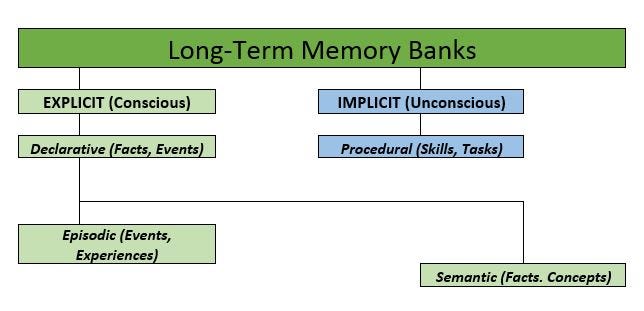
Taking heed of what uncle Albert said, I designed this graphic by myself in Excel — I enjoyed learning something new — and hope you find it helpful as you read on.
The Implicit Bank (Unconscious)
I’ll start with this memory bank as it only has one branch.
Procedural
It stores skills and tasks you have learned in the past.
Hence, whatever you’ve stored in there is retrievable at the inquiry counter without thinking about it; similar to driving a car with automatic transmission.
This memory is accurate and reliable, bar any injury to Brain which may interfere with the motor cortex, basal ganglia or cerebellum.
For example, we learned how to walk, how to talk, how to ride a bike (I never mastered that!), how to hold a pen and write, how to drive a car.
Once you have learned these motor skills, you never forget them.
Your deposit boxes are tamper-proof.
And you can store more by learning new skills, new tasks, and (drum roll) — new habits!
The Explicit Bank (Conscious)
It may seem counter-intuitive that this conscious bank is where things can go horribly wrong!
Surely that would be a component of our unconscious bank?
Not so!
“It is singular how soon we lose the impression of what ceases to be constantly before us. A year impairs, a luster obliterates. There is little distinct left without an effort of memory, then indeed the lights are rekindled for a moment — but who can be sure that the Imagination is not the torch-bearer?” — Lord Byron
Our implicit bank is the “Knowing How”.
Our explicit bank is the “Knowing What”.
Referring back to the graphic, you’ll see the explicit bank has a declarative branch — facts and events — and each of these has a sub-branch.
Events and experiences are deposited into our episodic memory.
Facts and concepts are deposited into our semantic memory. (This is where, as Lord Byron says, our imagination can lead us astray.)
The first sub-branch
Episodic memory is a timeline of specific events in our lives coupled with our experiences of those events — times, places and associated emotions. Because we are the actor, we recall not only the event itself but the emotional charge it triggers. The greater the emotional intensity, the more likely we are to retain and retrieve that memory — even a false memory!
(More on that later!)
- Do you remember what you had for dinner last Friday?
- Do you remember what you had for dinner last night?
The likelihood is you answered “No” to the first question and “Yes” to the second, as the latter is recent and therefore more vivid, though it will decay and disappear soon.
But if you replied “Yes” to the first question, I bet last Friday was a special occasion — a birthday or celebratory outing at a restaurant. You remember because of the emotional experience attached to the event.
The second sub-branch
Semantic Memory is the recollection of facts gathered over time from the world around us, together with concepts and beliefs, and is not associated with emotional or personal experience.
We know that grass is green, what a dog is, our birth date, how to put words together to form a sentence, the names of colors, spaghetti is a type of rice.
(Who told you that?)
(I was testing you. I know its a type of pasta!)
We gain conceptual knowledge about concrete objects through experience. We know, for instance, that lemons are yellow and sour or that Paris is in France. (Although there are about 53 cities around the globe called Paris!)
Our semantic memory also maps word associations — we know that oranges and apples are fruit and politicians are (fill in the blank here…………….)
Semantic knowledge determines how we understand and interact with our world.
Our semantic sub-branch is the culprit that creates interference when we retrieve our deposit boxes from the vaults.
This is where things can go wrong!
Fictional Memory and Other Stories
In my previous story I shared the results of a research study conducted in the UK in 2018 in which the first memory from their childhood was a false one in 40% of respondents.
Daniel Schacter of Harvard University explains:-
“When someone first records a memory, the viewer incorporates his or her own reactions and inferences about the event. As a result, the viewer can color or distort the memory from the very beginning.”
Other distortions can occur when we retrieve a memory.
(A brief recap here on how Brain stores memory. Brain encodes little bundles of neurons and deposits them in the vault. Each recall is then re-encoded by a similar, yet not identical, set of neurons — the changes occur at the synapses, the junctions between neurons.)
Schacter says:-
“When you recall a memory, it is not just simply read out, you have to store and consolidate [stabilize] it again.During this process, the recalled memory becomes vulnerable to outside influences and can be distorted by them.”
Word Games — The DRM Paradigm
This is a method used in cognitive psychology to study false memories, based on word lists.
I’m going to give you two groups of words to read and memorize. No peeking!
Jot down your answers, then check back here to see if you wrote down a word NOT in the group.
Sill, Shade, Screen, Ledge, Sash, Door, View, House, Glass, Shutter, Frame, Breeze, Curtain, Pane, Open.
Jazz, Horn, Concert, Orchestra, Rhythm, Sing, Piano, Band, Note, Instrument, Art, Sound, Symphony, Radio, Melody.
If you came up with a word not listed, that’s your semantic memory at play — using word association and concepts to help you remember.
That’s not a crime but in some cases it can create negative outcomes. The following story shows how.
False Eye-Witness Accounts
Memory expert, Elizabeth Loftus, has shown how easy it is to trigger false memories and thus how unreliable eyewitness reports are. She has appeared as an expert witness in hundreds of court cases to bolster defendants where criminal charges relied on eyewitness testimony alone.
With the advent of DNA testing around 1986, the possibility of wrongful convictions based only on eyewitness accounts has declined.
Thank God!
But how does the eye witness get it wrong?
Here are two examples.
Let’s take the case of a man, we’ll call him Joseph, who was wrongfully convicted of rape pre-DNA days. The community in his neighborhood was up in arms when the police arrested him — they couldn’t imagine his being a rapist.
The police kind of thought he matched the description of the perpetrator, so presented the witness with a photo line-up of five suspects — four black-and-white photos and one color photo of Joe.
Be honest — which photo would attract your attention? The color one. And each time the witness eyed the photos, the one of Joe embedded itself into the memory of the witness reinforcing their certainty he was the one.
(This story is from The Innocence Project and although Joseph is out on parole, he is still fighting for acquittal as the rape kit is missing???)
Loftus shares a case in her TED Talk in 2013, where she tells the story of Steve Titus, a restaurant manager who was returning home from a romantic dinner with his fiancé when his car was pulled over by the police.
The car sort of resembled one driven earlier that evening by a man who raped a female hitchhiker and Titus kind of resembled the rapist.
The police took a picture of Titus and included it in the photo line up they later showed the victim.
She pointed at his photo and said, “That one’s the closest.”
Based on that evidence alone, Steve Titus was put on trial for rape. When the victim got on the stand she said, “I’m absolutely positive that’s the man.”
Titus was found guilty.
(For the full tragic story on Steve’s case, you can find it on TED Talk. The video is about 18 minutes — too long to include here.)
These examples show how paying attention reinforces the memory. Where we may not be 100% certain at first, each time we recall, we re-code the memory until we convince ourselves it’s true.
Déjà Vu
There is no definitive theory on how and why this occurs.
Michelle Hook PhD, assistant director in the department of Neuroscience and Experimental Therapeutics at Texas A&M Health Science Center College of Medicine, says:-
“It is very difficult to study déjà vu in a laboratory. Understanding how memory storage works may shed some light on why some experience déjà vu and others do not.”
The literal French translation is “already seen”.
We all believe we have been somewhere before, met someone before, seen something before. Déjà Vu is triggered by a sensory memory.
Let’s say you sit down in a restaurant with checked blue and white tablecloths. As your eyes record the tablecloth in your visual memory, the waiter drops a tray, temporarily distracting your attention.
When you look down to straighten your cutlery, you spot the tablecloth and Brain whispers “You’ve seen this before.” Well, in theory you have, but only a few seconds ago — the experience of already seen!
The sensory memory has transferred to short-term memory but because it’s the second time around, you believe you’ve been to that restaurant before!
I hope you enjoyed this journey into our memory banks and look forward to your answers on the Word Games.
Thank you for reading!