
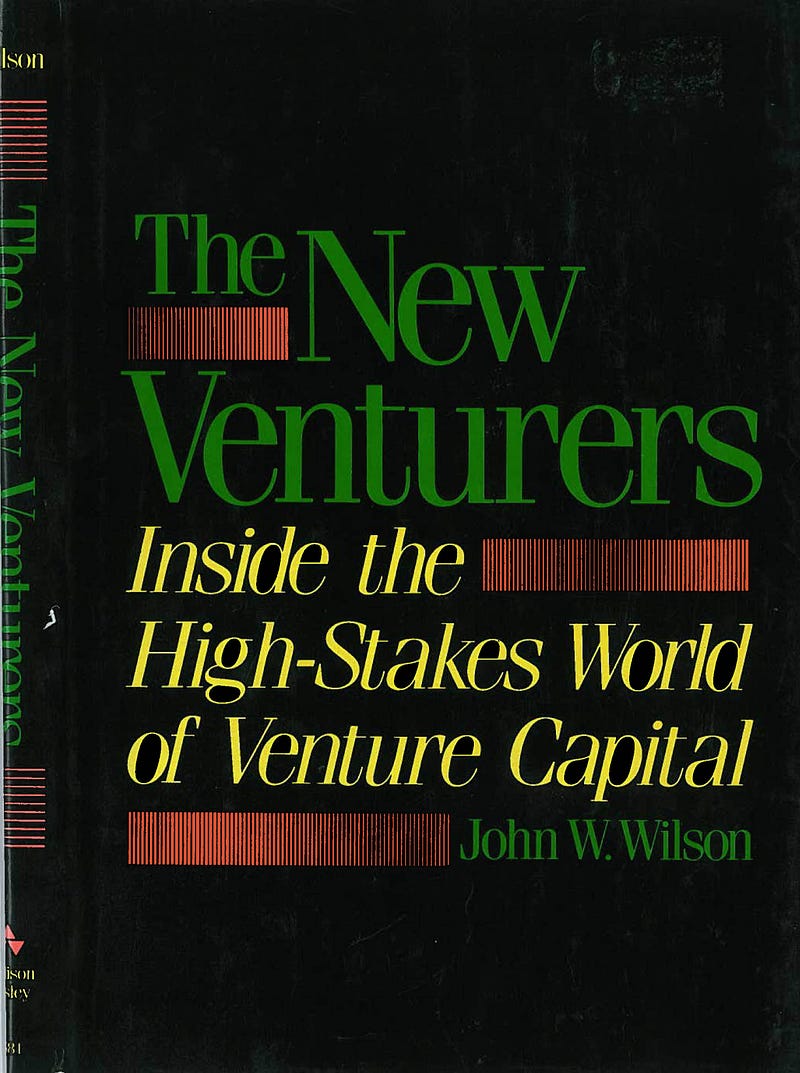
Reading Rainbow Review: The New Venturers

“The venture capital process, one of the least understood but most important business developments of the postwar era”
Some say to know where you are going it is best to know what happened in the past. That’s why I decided a few weeks back to read John W. Wilson’s The New Venturers. During my time reading, I felt the book was the Venture Capital Old Testament that chronicles the early decades of the industry — the 60s, 70s, and early 80s. The book features anecdotes and tall tales about stalwarts such as Arthur Rock, Tom Perkins, and Don Valentine. This book is a historical account of the venture capital industry that would be a great compliment to the documentary Something Ventured that essentially screamed: “hey the entrepreneurs needed our help!”
What I found most interesting about the book was that for the most part, the characteristics of the venture business describe in the book during the 1980s and prior mirrored what I see now in 2016. Similar themes — with respects to a VC career track, the role’s influence on the ecosystem, and best practices on investing in startups — that I found from the 51 articles I read in February were confirmed in The New Ventures. Below, I wanted to provide a few insightful quotes that display how the venture capital industry today maintains qualities and gaps that were visible within its first thirty years.
On VCs role in innovation because their decisions have an influence on what has the potential to scale.
“[Venture capitalists] are brokers of risk, agents of a new style of financial service that is crucial to [the country’s] ability to transfer resources from fading industries and technologies to the goods and services that will dominate a restructured world economy in the next century.”
On what VCs look for in a venture deal
Thomas J. Davis described his firm’s philosophy of investing in a speech entitled “ ‘How to Pick a Winner,’ in which he stated The Principle as simply, ‘Back the right people.’ Who are the right people? Davis listed six characteristics: Integrity, motivation, market orientation, technical capability, accounting ability, and leadership…the most important was motivation.”
“Kleiner Perkins’s secret to picking good venture deals is no secret at all. ‘If you have good people, proprietary technology, and a high growth market sector, you’ll win every time.’ ”
On what background is best suited for venture capital
“But Kramlich maintains background alone is no measure of a venture capitalist’s ability. ‘To me,’ he says, ‘understanding issues, defining goals, being able to communicate policy with people at the board level — that is the role of the venture capitalist. I think it overshadows whether you come from a technical background or an operating background or a financial background. There is no formula coming into this business.’ ”
On what are negative consequences of venture capital
The book also brought major criticisms to the industry of venture capital by pointing out the claims against “vulture capitalist.” These claims included:
“draining a few successful companies of their most productive managers and engineers, by pirating their technology, and by disrupting key departments and projects, venture capitalists damage the ability of those companies to innovate and to compete in international markets.” The book questioned the funding practices of VC firms stating “that by funding excessive numbers of similar companies, many with less than outstanding leadership, they are wasting money and talent, adding little to the progress of technology, and artificially creating over-competitive situations where no participant can make money.”
On where venture capital should venture to next
“There is an important role for the venture process in promoting minority business and in local and regional economic development, a role just beginning to be recognized but one that offers the only real hope that minority communities can become self-reliant and that regions such as the Midwest and the Pacific Northwest (clearly this was written in 1984) can break away from dependence on declining industries and begin to rebuild their base of jobs.”
Earnest Sweat is a Startup Adviser that specializes in mentoring startups within the fin tech, ed tech, and real estate tech sectors. If you have any questions, comments or requests please connect with Earnest through LinkedIn, Twitter, or AngelList.
If you liked what you read please ☞ tap or click “♥︎” to help to promote this piece to others.


