
‘Hannibal’ Was A Gothic Romance
Revisiting NBC’s criminally underrated TV show about a serial killer in love
Hannibal, considered in its entirety, is a masterwork of implication and sublimation. The best single example of this in the series is the seventh episode of the first season, “Sorbet,” written by Jesse Alexander and showrunner Bryan Fuller. Throughout the series, Hannibal Lecter’s sexuality remains (purposefully) ambiguous even while his desire for Federal agent Will Graham grows more explicit.
In “Sorbet,” the viewer is witness to Hannibal making the decisions that drive the series to its heady, operatic conclusion. Like all men, Hannibal wears a mask of masculinity. Unlike most men, Hannibal is acutely aware of this and uses this awareness for his own violent ends. Hannibal’s mask is only ever his own — until he decides he wants to share it with someone else. For viewers, this is a comedy. For Hannibal and Will, this is a romance. For everyone else, this is a tragedy.
The character Hannibal Lecter is perhaps best known from the Academy Award-winning film Silence of the Lambs (1991, Jonathan Demme) starring Anthony Hopkins as the aged Lecter terrorizing young FBI trainee Clarice Starling (Jodie Foster).
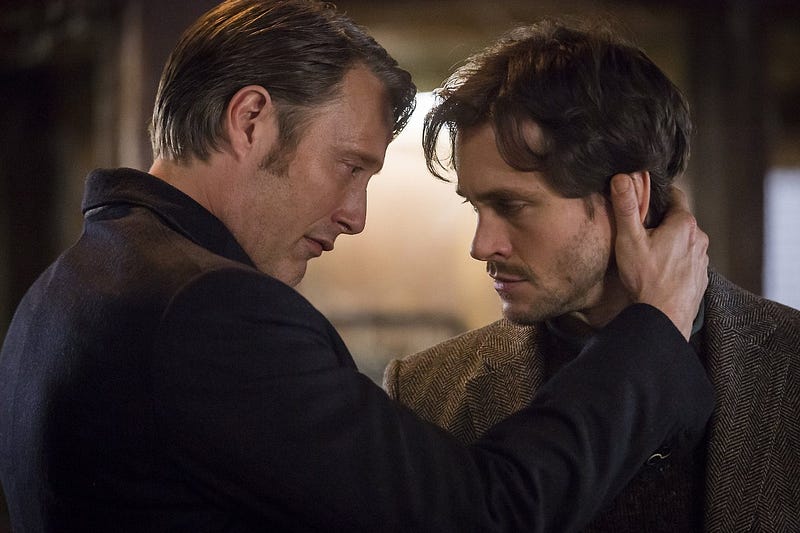
Hannibal, which ran for three seasons on NBC from the spring of 2013 to the summer of 2015, covers the events decades before Silence of the Lambs when Dr. Lecter was simply a suave psychiatrist assisting the FBI rather than notorious Hannibal the Cannibal. Instead of an FBI trainee, Hannibal (here played by Danish impresario Mads Mikkelsen) works with an FBI academy instructor and consultant Will Graham (Hugh Dancy, disguising a Disney prince countenance behind shaggy grooming and a flannel heavy wardrobe) to catch serial killers. Specifically, “the Chesapeake Ripper” who just happens to be Hannibal himself.
As Hannibal killer of the week plots go, the central murders in “Sorbet” are fairly mundane — corpses throughout the DMV area are turning up without their kidneys, livers, hearts, and lungs. Organ theft. Positively ho-hum at the FBI’s Behavioral Science Unit (BSU). The BSU team are nonetheless split. Are these crimes are the work of a run of the mill cash-strapped organ harvester (“I love a good urban legend” the always amiable forensic tech Jimmy Price comments) or a sign that the notorious serial killer nicknamed “the Chesapeake Ripper” has finally emerged from a long hibernation?
Will Graham, who opened the episode lecturing on the Chesapeake Ripper’s modus operandi to FBI academy recruits, is firmly in the former camp. He believes none of these murders come close to the heights of the Ripper’s flair and artistry — a corpse slumped in a hotel bathroom is certainly a far cry from one sitting in a church pew with its tongue as a page marker in the Bible. Will is half-right. The culprit, caught mid-act carving up another hapless would-be donor, is an EMT using his employer’s ambulances as mobile operating rooms, no more a genius serial killer than any other incompetent medical professional trying to make a quick buck under the table. Case closed.
Hannibal uses the convention of the crime procedural as scaffolding for the kind of story it actually wants to tell — the romance of the worst man in the world.
For the BSU team, especially it's head agent, Jack Crawford (Laurence Fishburne), this is more disappointment than triumph. Crawford, champing at the bit for an opportunity to avenge the missing Miriam Lass, the FBI trainee assumed dead at the Ripper’s hands and Crawford’s one time protege, is confident enough to ask Hannibal Lecter if he’d “care to help us catch the Ripper?” Hannibal, the perennial continental gentleman, replies with genuine delight — “How could I refuse?” Who wouldn’t want to meet their alter ego?
It’s not incorrect per se to call Hannibal a crime procedural, at least in the first season. Before the show tumbles into full-on gothic phantasmagoria, Hannibal uses the convention of the crime procedural as scaffolding for the kind of story it actually wants to tell — the romance of the worst man in the world. While the rest of Hannibal’s cast sweat over missing viscera, the man himself goes to a charity concert and holds a dinner party (where, of course, nothing is vegetarian).
The organ harvester is a fortuitous coincidence for Hannibal — someone else throws the FBI off his tail while he goes shopping for groceries in the chests and bellies of Baltimore’s rudest citizens. And yet despite everything going Hannibal’s way, the episode ends with a bittersweet note. Will drops by before the party with his regrets and a bottle of wine. He can’t stay, unfortunately, because he “has a date with the Chesapeake Ripper.” Mads Mikkelsen, master of the microexpression, gives Hannibal a flicker of wistfulness behind a genial mask. “If only,” a viewer can almost hear him reply.
Hannibal Lecter reveals very little about his inner life in either expression or mannerism. His psychiatrist, Bedelia Du Maurier (Gillian Anderson), characterizes him in this episode’s session as “wearing a very well-tailored person suit.” It’s up to Hannibal itself to show what’s happening in the psyche of its title character. It does so expertly in “Sorbet,” most notably — and hilariously — with the help of music.
Mid-episode, a lost-in-fugue-state Will misses his therapy appointment with Hannibal. “Lacrimosa” from Mozart’s Requiem plays as Hannibal looks at his closed office door, paces the room, and finally sits at his desk, appointment book open to the entry “Will Graham.” “Lacrimosa,” for those of us not educated in classical ecclesial music, takes its name from the Virgin Mary’s title “Our Lady of Sorrows,” used by Church teachings to connote her time grieving the death of her son Jesus Christ. The mismatch between the cosmic drama of the music and the decidedly down-to-earth nature of Hannibal’s disappointment comes with hysterical results. Hannibal Lecter, monster, longs for a mortal man.
Hannibal doesn’t kill the cruel, only the rude.
It’s more than a bit of an understatement to say that Hannibal isn’t like other men, even if you discount the cannibalism. His sartorial stunts alone qualify him as an unusual character — no one does power clashing quite like Hannibal Lecter. His home is a baroque museum piece (apart from the kitchen, which is more like a showroom). He plays the harpsichord, not the piano, and speaks fluent medieval Italian. Everything Hannibal does or says, simply put, is always exquisite, never ordinary. Anything less than a full acknowledgment of this is a mortal insult. Hannibal doesn’t kill the cruel, only the rude.
In “Sorbet” this repeating subplot takes an unusual form. All but one of Hannibal’s victims in “Sorbet” are faceless bodies on a gurney. Andrew Caldwell, an independent medical examiner, is singled out for a special performance. A flashback sequence shows Caldwell drawing Hannibal’s blood for an insurance physical. In so many words, Caldwell accuses Hannibal of having HIV (“You seem convinced I’m diseased” “I was asking a broader question. A disease is an infection. An infection isn’t always a disease.”) An undignified end for an impertinent suggestion.
This is not to say that Hannibal himself is opposed to unmaking repression. Hannibal outright asks his patient, the forever grasping Franklyn Froideveux if he desires his (male) friend sexually. Froideveux replies hurriedly no (with the caveat that he was in a fraternity in college and “tried things”) — he only wants to be needed, to be able to save someone from himself. Hannibal carries this prompt to his own session with Du Maurier. He muses on the construction of his public self, the previously mentioned “human suit” by Du Maurier’s reckoning and “human shield” by Hannibal’s own. Is loneliness his only option or is there a possibility of letting some special someone in? Du Maurier refuses to answer the question. She sees a glimpse of him under the disguise and for her, that’s enough. At the end of their session, Du Maurier offers Hannibal a choice of wine — red or white? Hannibal chooses his own, third option: “I think something pink. Don’t you?”