avatarGenius Turner

Free AI web copilot to create summaries, insights and extended knowledge, download it at here

5713

Abstract

al destination.</p><p id="5ae6">Aha! No wonder <a href="https://www.psychologytoday.com/us/blog/shift-mind/201203/is-our-society-manufacturing-depressed-people">in Psychology Today</a>, Mel Schwartz asks, “Is our society manufacturing depressed people?” After all, days ago a friend of mine told me she went on a date with a guy, from Hinge.</p><p id="7063">“Everything was going great,” she said. “And then, he slides that hideous iPhone X on the table. Ugh! So embarrassing.”</p><p id="d446">I winced. And to think, we live in a society that’s become soooo superficial and prizes status symbols soooo highly that, heck, versions of telephones have now become deal-breakers.</p><p id="6af0">Ouch!</p><p id="cb34">But, hey, what more can we expect in a society that prizes a “perfection of means and confusion of goals”?</p><h1 id="1e4e">IV. The ‘Root of all Evil’ Lies in Fallacy, not in Money</h1><figure id="bb2a"><img src="https://cdn-images-1.readmedium.com/v2/resize:fit:800/0*P3AsE6HPhzZ4wMBc.jpg"><figcaption>Pic: <a href="https://m.media-amazon.com/images/I/51n+OLwJLtL.jpg">media-amazon</a></figcaption></figure><p id="7c24">For ages, money’s been called the root of all evil. Hmmm…</p><p id="84a4">…But upon closer inspection, it’s apparent <i>why</i> money can’t possibly be the root of all evil. After all, as Socrates noted, “the only evil is ignorance.”</p><p id="ecc2">Because <b>ignor</b>ance always lies at the root of <b>ignor</b>ing our best interests, we usually commit the following blunder.</p><p id="9231">You see, because happiness comes in countless forms, ranging from the delight of buying gifts for family to the pleasure of sliding a sparkly girl’s best friend on a girlfriend’s ring finger, money’s power seems limitless.</p><p id="ed44">Money, then, serves as a substitute for actual happiness.</p><p id="2b3b">Or to put it simpler, money is happiness in the abstract. Like the mutant “shapeshifter” Mystique, an X-Men character armed with the power to change into various forms — from humans to animals — money also carries this superpower.</p><p id="7cda">Perhaps Einstein’s favorite philosopher put it best:</p><blockquote id="1e0e"><p>People are often reproached for wishing for money above all things, and for loving it more than anything else. But it is natural and even inevitable for people to love that which, like an unwearied Proteus, is always ready to turn itself into whatever object their wandering wishes or manifold desires may for the moment fix upon.</p></blockquote><blockquote id="0441"><p>Everything else can satisfy only <i>one</i> wish, <i>one</i> need: food is good only if you are hungry; wine, if you are able to enjoy it; drugs, if you are sick; fur for the winter; love for youth, and so on. These are all only relatively good. Money alone is absolutely good […] It is an abstract satisfaction of all.</p></blockquote><blockquote id="6dde"><p>— Arthur Schopenhauer</p></blockquote><p id="d25c">Such is the allure of money!</p><p id="4e73">Notice <i>why </i>each monetary gift comes packaged with a curse. Yet most people seemingly ignore (<b>ignor</b>anc<b>e</b> <b>→ ignore) </b>it.</p><p id="6cbd">Because buying temporary happiness wears countless masks, I’ll go so far as to say money is like soda pop — the more you drink, the thirstier you become.</p><p id="2c48">Perhaps the richest person in history put it best:</p><p id="af2d" type="7">“How much money does it take to make a man happy? Just one more dollar”</p><p id="ef94" type="7">— John D. Rockefeller</p><p id="f9b5">Bingo!</p><h1 id="cf1f">V. An Outward Means Can’t Buy an Inward Good</h1><figure id="036e"><img src="https://cdn-images-1.readmedium.com/v2/resize:fit:800/0*U56Ek2sqSPGjHI-o.jpg"><figcaption>Life’s three most rewarding forms of being: being grateful, being patient and being yourself. (Pic: <a href="https://www.flickr.com/photos/h-k-d/">Hartwig HKD </a>on <a href="https://www.flickr.com/photos/h-k-d/7758674308">Flickr</a>)</figcaption></figure><p id="ab0d">Buddha called <i>contentment</i> the greatest wealth of all. And what more is contentment than the supermodel named Happiness — after the fashion show … now without her makeup?</p><p id="bad2">“Happiness” is the sexy word we use for <i>satisfaction</i> … for <i>gratitude</i> … for <i>contentment.</i> Perhaps this explains why Socrates argued feeling “rich” is but a nickname for feeling satisfied.</p><p id="0558">Perhaps what I’m groping with here is how to best distinguish true wealth and happiness, which both lie internally within individual perception, from outward objects.</p><p id="196e">Appearances are deceptive indeed!</p><p id="666e">“Money,” said Alan Watts, “simply represents wealth in rather the same way that the menu represents the dinner.”</p><p id="8583">If the name of life’s game is happiness, shall not we all wish for lasting peace and happiness? Clearly, then, money’s magic lies in its capacity for shapeshifting from one form of pleasure to another.</p><p id="20fe"><i>Abracadabra!</i></p><p id="3e45">But we mortals don’t want to enjoy life sometimes. No, no. We want enjoyment always.</p><p id="ac64">Armed with the Socratic method, it’s apparent the word “<b>en</b>joy” breaks down to <i>in</i> + joy.</p><p id="b5c3"><i>En</i>, pardon, In-joy where?</p><p id="facf"><b>In</b>side our own heads — the only conceivable place where enjoyment can live. Happiness is a state of mind, after all.</p><p id="46f5">Because happiness is a <i>state</i> of mind, not of body or of riches, it must be the case:</p><p id="8f03" type="7">Inside ourselves — the only place where a State of Mind can possibly reside — seems to be the last place most pursuers of happiness search.</p><h1 id="652

Options

b">VI. The Takeaway</h1><figure id="1a84"><img src="https://cdn-images-1.readmedium.com/v2/resize:fit:800/0*TuJQClZK9VMV_P_Z.jpg"><figcaption>Better a painful truth than a comforting lie. Pic: <a href="https://www.kingjamesbibleonline.org/Matthew-6-24_Inspirational_Image/">Kingjamesbibleonline</a></figcaption></figure><p id="52af">From <b>A</b>ardvark to <b>Z</b>ebra, over 5,000,000,000 different species have graced the world’s stage. Yet chew on this: we humans are the <i>only</i> species that pay to live on the very planet on which we’re freely born.</p><p id="9bc8">Think about that for a sec…</p><p id="6948">…In fact, Rousseau’s famed passage puts it best:</p><blockquote id="f371"><p>The first man who, having enclosed a piece of ground, bethought himself of saying <i>This is mine</i>, and found people foolish enough to believe him, was the real founder of civil society.</p></blockquote><blockquote id="2777"><p>From how many crimes, wars and murders, from how many horrors and misfortunes might not anyone have saved mankind, by pulling up the stakes, or filling up the ditch, and crying to his fellows, “Beware of listening to this impostor; you are undone <b>if you once forget that the fruits of the earth belong to us all, and the earth itself to nobody</b>.”</p></blockquote><p id="45d6">Dear reader, in this piece, please forgive my heavy-handedness with the philosophy. I must admit, my love of Sophia trumps my love of Mammon. But I’ve been warned now, as was I as an undergrad, philosophy bakes no bread.</p><p id="2dad">No wonder in record numbers today’s students are abandoning humanities majors. They’re instead <a href="https://www.theatlantic.com/ideas/archive/2018/08/the-humanities-face-a-crisisof-confidence/567565/">focusing on degrees</a> believed to yield far better job prospects. Capitalism is as capitalism does!</p><p id="2d74">Google search the word “God.” Then search “Happy.” Then search “Money.” And because men <i>tell </i>lies … women <i>tell</i> lies … numbers <i>tell</i> truths, it’ll become clear why the number of results yielded in each search whispers: “<b>Money has become the new god</b>.”</p><figure id="fb28"><img src="https://cdn-images-1.readmedium.com/v2/resize:fit:800/0*GxTPld3c3DfeOQM2"><figcaption>Pic: <a href="https://www.quora.com/Has-money-become-the-new-God-of-mankind">Quora</a></figcaption></figure><p id="2ce6">Philosophy bakes no bread…</p><p id="7269">…But when my dreadlocked head touches my pillow each night, and I lie awake <i>locked</i> alone with my own thoughts — for thinking is nothing but the Soul chatting with itself, as Plato noted — I <i>dread</i> ignoring my own heart.</p><p id="09c4">After all, each night I overhear the Nazarene whisper in my third ear:</p><p id="4654" type="7">“What good is it to gain the world but lose your soul?” — Jesus of Nazereth</p><p id="dd9e">Perhaps I’m a bit out of tune with the times, an old Millennial still clinging to Wilde’s hunch that folks know the <i>price</i> of every damn thing but the value of nothing.</p><p id="db23">Ahh, in fact, so inspired am I by this present stream of thought, heck, I’m compelled to remove this story from behind the metered paywall altogether. <i>Paying</i> me attention far exceeds <i>paying</i> me money, anyhow.</p><p id="6d0f">Besides, this story captures the<i> zeitgeist</i> (German: from <i>Zeit</i> ‘time’ + <i>Geist</i> ‘spirit’) of…</p><p id="40c1">…the <i>zeitgeist </i>of that memorable Sunday afternoon when my pal and I roamed Union Square. “Hey…” Emma said while pointing at some frail, Asian lady being gently escorted by hand from her vehicle. “That’s Yoko Ono!” Emma nudged me. “<i>Lenny</i>, go tell her you’re a genius and your work embodies John’s ‘Imagine.’ ”</p><p id="5ae9">I gulped.</p><p id="94b6">Dressed in all-black, which coordinated with her black town car, Ms. Ono lightly touched my hand. “Well,” she said in just above a whisper, “use your time [<i>zeit</i>] wisely and carry on John’s spirit [<i>geist</i>] in your art, as did his art carry you to your art. The circle of life.”</p><p id="99f8">(<i>Silent prayer.</i>)</p><p id="3d33">Sure, the assassin’s bullet may have left a hole in John’s imagination, as did it MLK’s dream and Gandhi’s vision, but I can still hear ole <i>Lenny </i>hum:</p><blockquote id="6a5e"><p>Imagine no possessions I wonder if you can No need for greed or hunger A brotherhood of man</p></blockquote><blockquote id="dd05"><p>Imagine all the people Sharing all the world…</p></blockquote><blockquote id="c214"><p><i>John Lennon</i></p></blockquote><p id="dc87">Perhaps Einstein had it right all along…</p><p id="1d03">…“Money only appeals to selfishness and always tempts its owners irresistibly to abuse it,” Einstein argued. “Can anyone imagine Moses, Jesus, or Gandhi armed with the money bags of” Musk or Bezos or Arnault?</p><p id="1c4f">But given that money has become the new god, names like Jesus and Gandhi have been exchanged for Musk and Bezos.</p><p id="6d82">By the way, if you’re counting at home, the above three mortals have a combined net worth that exceeds $500,000,000,000. But keep in mind, each night, a <a href="https://www.worldvision.org/hunger-news-stories/world-hunger-facts#:~:text=Up%20to%20811%20million%20people,regularly%20go%20to%20bed%20hungry.">whopping 811,000,000 of our fellow humans go to bed hungry.</a></p><p id="7791">In short, the real reason money can’t buy lasting happiness is simple: it was never designed to! As for <i>why</i> we’re intent on thinking it should, Einstein answered the riddle:</p><p id="ac58" type="7">“Perfection of means [money] and confusion of goals [self-development] seem to characterize our age.”</p></article></body>

Money Can’t Buy Happine$$. Why? It Wasn’t Designed to

“Whoever thinks a lot of money will make them happy never had a lot of money” — Mike Tyson

Even if the richest man counts the most money, he still can’t buy what really counts. (Pic: Teepublic.com)
  • *Soul Sunday Edition

I. Best Things in Life

“Happiness is the meaning and the purpose of life, the whole aim and end of human existence”

— Aristotle

Recently I caught up with a few old college buddies. As we caught the Chiefs’ game, my buddy Vince mentioned, “Mahomes gets paid half a billion just to play a game.”

“He’s living the dream,” E.P. added.

With eyebrows raised, I seized the chance to play devil’s advocate. After all, the issue concerned money — that so-called “root of all evil” — and someone getting paid to play.

“But how do you know he’s happy?” I asked while scooping a chip in avocado dip.

“Bro, because he’s filthy rich!” Vince fired back.

I nodded. “Soooo, you’re saying money can buy happiness, eh?”

“Of course,” E.P. answered for him. “I mean, that’s common sense.”

I watched the play unfold. “Of course, common sense also says — the best things in life are not only free, but they’re not even things. After all,

Though we all know what love feels like … has any hand ever felt love?

Though we all know what happiness looks like … has any eye ever seen happiness?

Though we all know what peace and quiet sound like … has any ear ever heard peace and quiet?

“In short,” I continued, “if rich is synonymous with best and the best things in life are priceless, well, it must be the case:

To truly feel rich, one merely has to add up everything that money can’t buy.

Bingo!

II. Once Again, Einstein Knew Better
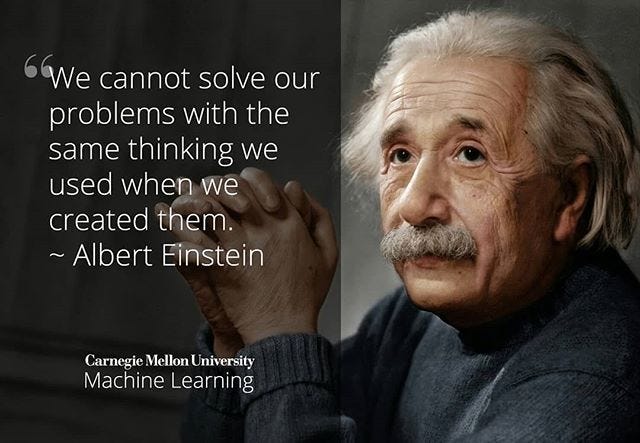
Pic on Twitter

In 1933, Albert Einstein was the most famous scientist in the world.

When Princeton University asked him to name the salary he wanted, Einstein “reportedly said $3,000 per year. [Yet] his wife stepped in and renegotiated it to $15,000.”

Throughout his life, Einstein treated money as a means to an end, not the end itself. In his eyes, having money was no different from having any other means of transportation — a mere vehicle designed to carry travelers from point A to B.

Ahhh, but what happens when travelers misidentify point A with the actual destination?

Perfection of means and confusion of goals,” answered Einstein, “seem to characterize our age.”

Bingo!

Indeed, in this glorious age of ours, the millionaire rapper who rhymes Cat with Hat is far more celebrated than the quantum physicist whose experiments reveal how Schrödinger’s cat superpositions itself in a hat.

Perhaps this explains why in Einstein’s famous essay “The Meaning of Life,” he writes: “the ordinary objects of human pursuit — property, outward success, luxury — have always seemed to me contemptible.”

In short, Einstein knew better than to confuse the monetary means with the goal.

III. Like Everything Else — Money has One Purpose
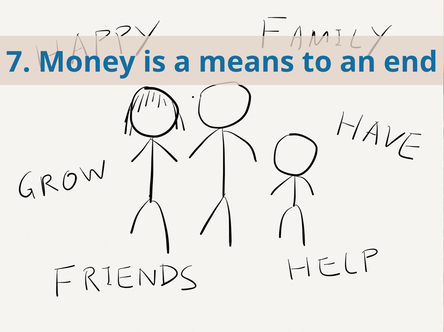
Money is a rich servant but a poor master. (Pic: diaberistic.com)

Because everything we do is for happiness, clearly, then, it’s not what you have but rather it’s how you feel that counts.

Right?

Perhaps the chief reason so many of us overrate money stems from overlooking the very nature of money itself.

“The beginning of wisdom,” said Socrates, “is the definition of words.”

Armed with the Socratic method, it’s apparent why money is defined as “a medium of exchange.”

A medium is a bridge … a stairway. Yet when that monetary stairway leads to a pot of gold, Led Zeppelin reminds us why “there’s a lady who’s sure all that glitters is gold, and she’s buying a stairway to heaven.”

By nature, money was designed to help us realize our highest potential. Yet unfortunately our society prizes the bridge over the actual destination.

Aha! No wonder in Psychology Today, Mel Schwartz asks, “Is our society manufacturing depressed people?” After all, days ago a friend of mine told me she went on a date with a guy, from Hinge.

“Everything was going great,” she said. “And then, he slides that hideous iPhone X on the table. Ugh! So embarrassing.”

I winced. And to think, we live in a society that’s become soooo superficial and prizes status symbols soooo highly that, heck, versions of telephones have now become deal-breakers.

Ouch!

But, hey, what more can we expect in a society that prizes a “perfection of means and confusion of goals”?

IV. The ‘Root of all Evil’ Lies in Fallacy, not in Money
Pic: media-amazon

For ages, money’s been called the root of all evil. Hmmm…

…But upon closer inspection, it’s apparent why money can’t possibly be the root of all evil. After all, as Socrates noted, “the only evil is ignorance.”

Because ignorance always lies at the root of ignoring our best interests, we usually commit the following blunder.

You see, because happiness comes in countless forms, ranging from the delight of buying gifts for family to the pleasure of sliding a sparkly girl’s best friend on a girlfriend’s ring finger, money’s power seems limitless.

Money, then, serves as a substitute for actual happiness.

Or to put it simpler, money is happiness in the abstract. Like the mutant “shapeshifter” Mystique, an X-Men character armed with the power to change into various forms — from humans to animals — money also carries this superpower.

Perhaps Einstein’s favorite philosopher put it best:

People are often reproached for wishing for money above all things, and for loving it more than anything else. But it is natural and even inevitable for people to love that which, like an unwearied Proteus, is always ready to turn itself into whatever object their wandering wishes or manifold desires may for the moment fix upon.

Everything else can satisfy only one wish, one need: food is good only if you are hungry; wine, if you are able to enjoy it; drugs, if you are sick; fur for the winter; love for youth, and so on. These are all only relatively good. Money alone is absolutely good […] It is an abstract satisfaction of all.

— Arthur Schopenhauer

Such is the allure of money!

Notice why each monetary gift comes packaged with a curse. Yet most people seemingly ignore (ignorance → ignore) it.

Because buying temporary happiness wears countless masks, I’ll go so far as to say money is like soda pop — the more you drink, the thirstier you become.

Perhaps the richest person in history put it best:

“How much money does it take to make a man happy? Just one more dollar”

— John D. Rockefeller

Bingo!

V. An Outward Means Can’t Buy an Inward Good
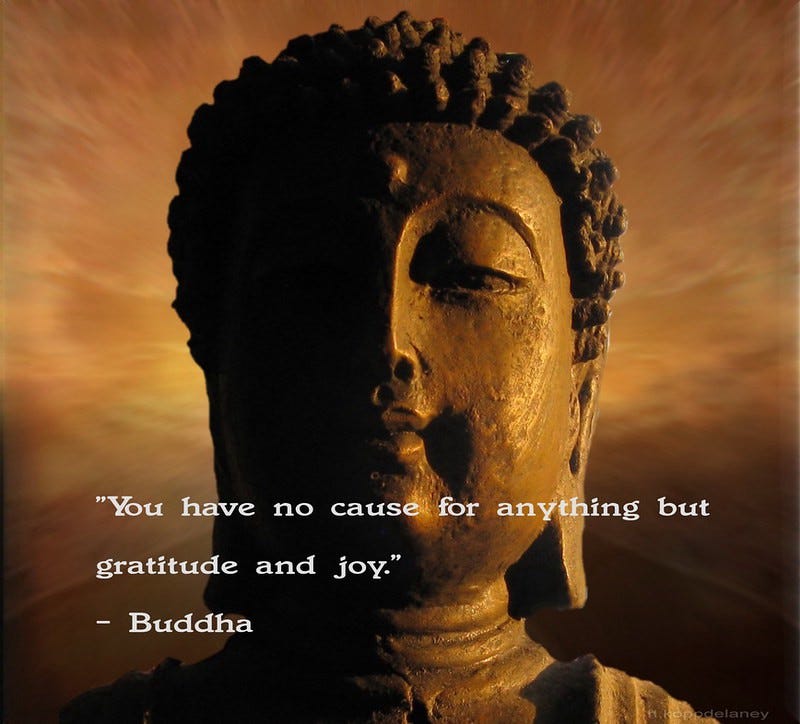
Life’s three most rewarding forms of being: being grateful, being patient and being yourself. (Pic: Hartwig HKD on Flickr)

Buddha called contentment the greatest wealth of all. And what more is contentment than the supermodel named Happiness — after the fashion show … now without her makeup?

“Happiness” is the sexy word we use for satisfaction … for gratitude … for contentment. Perhaps this explains why Socrates argued feeling “rich” is but a nickname for feeling satisfied.

Perhaps what I’m groping with here is how to best distinguish true wealth and happiness, which both lie internally within individual perception, from outward objects.

Appearances are deceptive indeed!

“Money,” said Alan Watts, “simply represents wealth in rather the same way that the menu represents the dinner.”

If the name of life’s game is happiness, shall not we all wish for lasting peace and happiness? Clearly, then, money’s magic lies in its capacity for shapeshifting from one form of pleasure to another.

Abracadabra!

But we mortals don’t want to enjoy life sometimes. No, no. We want enjoyment always.

Armed with the Socratic method, it’s apparent the word “enjoy” breaks down to in + joy.

En, pardon, In-joy where?

Inside our own heads — the only conceivable place where enjoyment can live. Happiness is a state of mind, after all.

Because happiness is a state of mind, not of body or of riches, it must be the case:

Inside ourselves — the only place where a State of Mind can possibly reside — seems to be the last place most pursuers of happiness search.

VI. The Takeaway
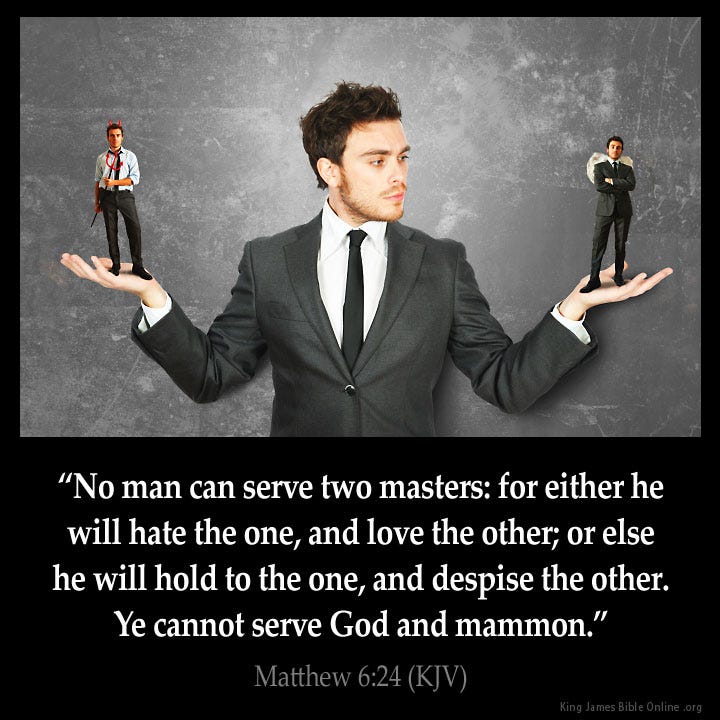
Better a painful truth than a comforting lie. Pic: Kingjamesbibleonline

From Aardvark to Zebra, over 5,000,000,000 different species have graced the world’s stage. Yet chew on this: we humans are the only species that pay to live on the very planet on which we’re freely born.

Think about that for a sec…

…In fact, Rousseau’s famed passage puts it best:

The first man who, having enclosed a piece of ground, bethought himself of saying This is mine, and found people foolish enough to believe him, was the real founder of civil society.

From how many crimes, wars and murders, from how many horrors and misfortunes might not anyone have saved mankind, by pulling up the stakes, or filling up the ditch, and crying to his fellows, “Beware of listening to this impostor; you are undone if you once forget that the fruits of the earth belong to us all, and the earth itself to nobody.”

Dear reader, in this piece, please forgive my heavy-handedness with the philosophy. I must admit, my love of Sophia trumps my love of Mammon. But I’ve been warned now, as was I as an undergrad, philosophy bakes no bread.

No wonder in record numbers today’s students are abandoning humanities majors. They’re instead focusing on degrees believed to yield far better job prospects. Capitalism is as capitalism does!

Google search the word “God.” Then search “Happy.” Then search “Money.” And because men tell lies … women tell lies … numbers tell truths, it’ll become clear why the number of results yielded in each search whispers: “Money has become the new god.”
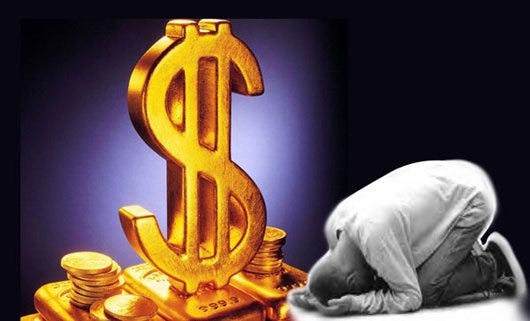
Pic: Quora

Philosophy bakes no bread…

…But when my dreadlocked head touches my pillow each night, and I lie awake locked alone with my own thoughts — for thinking is nothing but the Soul chatting with itself, as Plato noted — I dread ignoring my own heart.

After all, each night I overhear the Nazarene whisper in my third ear:

“What good is it to gain the world but lose your soul?” — Jesus of Nazereth

Perhaps I’m a bit out of tune with the times, an old Millennial still clinging to Wilde’s hunch that folks know the price of every damn thing but the value of nothing.

Ahh, in fact, so inspired am I by this present stream of thought, heck, I’m compelled to remove this story from behind the metered paywall altogether. Paying me attention far exceeds paying me money, anyhow.

Besides, this story captures the zeitgeist (German: from Zeit ‘time’ + Geist ‘spirit’) of…

…the zeitgeist of that memorable Sunday afternoon when my pal and I roamed Union Square. “Hey…” Emma said while pointing at some frail, Asian lady being gently escorted by hand from her vehicle. “That’s Yoko Ono!” Emma nudged me. “Lenny, go tell her you’re a genius and your work embodies John’s ‘Imagine.’ ”

I gulped.

Dressed in all-black, which coordinated with her black town car, Ms. Ono lightly touched my hand. “Well,” she said in just above a whisper, “use your time [zeit] wisely and carry on John’s spirit [geist] in your art, as did his art carry you to your art. The circle of life.”

(Silent prayer.)

Sure, the assassin’s bullet may have left a hole in John’s imagination, as did it MLK’s dream and Gandhi’s vision, but I can still hear ole Lenny hum:

Imagine no possessions I wonder if you can No need for greed or hunger A brotherhood of man

Imagine all the people Sharing all the world…

John Lennon

Perhaps Einstein had it right all along…

…“Money only appeals to selfishness and always tempts its owners irresistibly to abuse it,” Einstein argued. “Can anyone imagine Moses, Jesus, or Gandhi armed with the money bags of” Musk or Bezos or Arnault?

But given that money has become the new god, names like Jesus and Gandhi have been exchanged for Musk and Bezos.

By the way, if you’re counting at home, the above three mortals have a combined net worth that exceeds $500,000,000,000. But keep in mind, each night, a whopping 811,000,000 of our fellow humans go to bed hungry.

In short, the real reason money can’t buy lasting happiness is simple: it was never designed to! As for why we’re intent on thinking it should, Einstein answered the riddle:

“Perfection of means [money] and confusion of goals [self-development] seem to characterize our age.”

Self
Self Improvement
Philosophy
Money
Life Lessons
Recommended from ReadMedium