
Modernizing Art With Blockchains
Openlaw debuts new tools to create fractional ownership of creative works, tokenized licenses, and smart contract powered royalty payments.
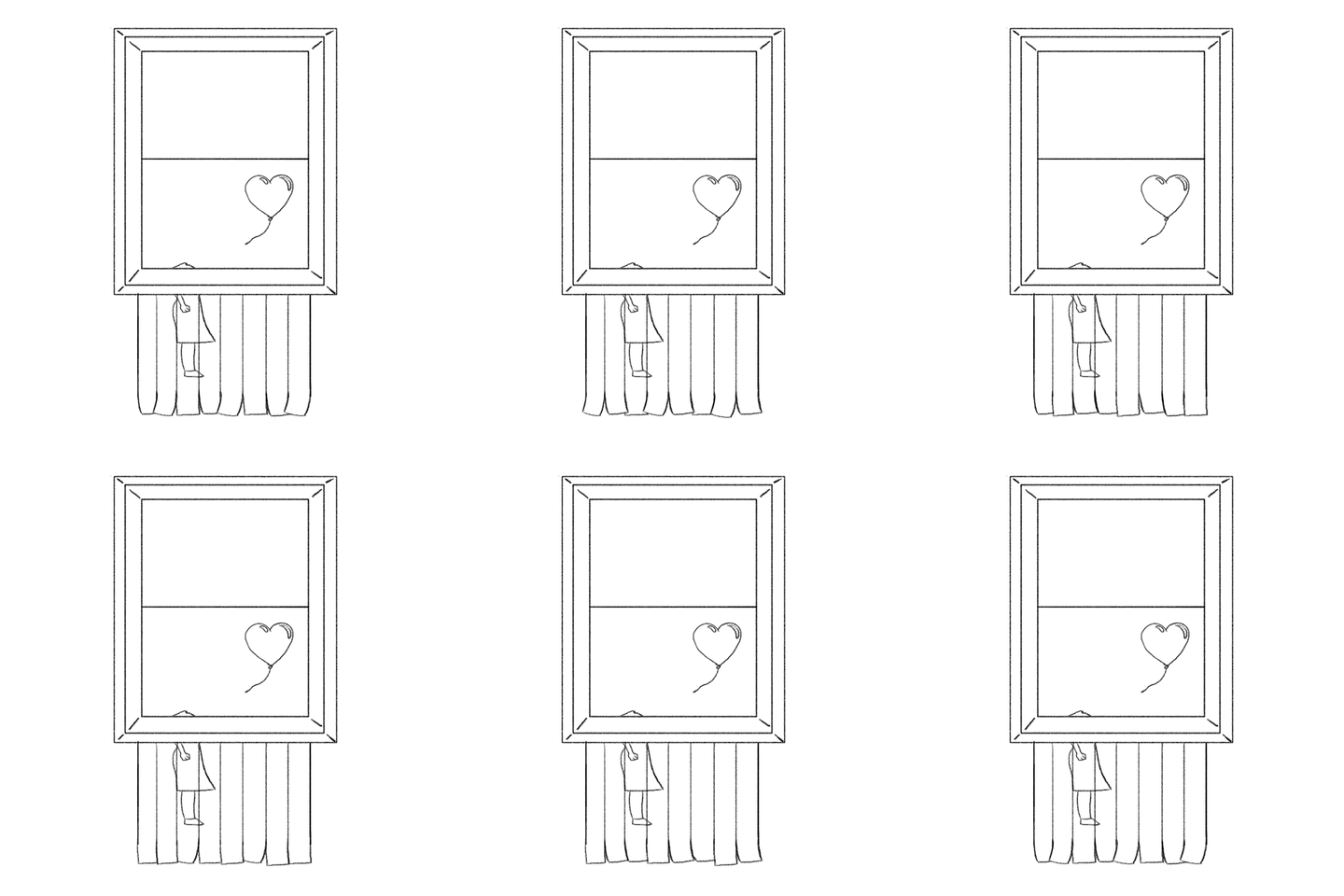
Well-defined and enforced property rights are essential to economic growth and prosperity. They anchor economies and help people break free from poverty by putting productive assets to use. One reason why blockchains are so powerful is that they enable us to define and enforce the metes and boundaries of property rights without depending on a centralized, antiquated governmental record keeping system.
These capabilities hold out the promise of opening new business opportunities for artists and the media industry, where the proliferation of freely available digital copies undermine the ability of content owners to monetize and distribute creative works except through often distortive advertising- and subscription-based models.
The key blockchain-based innovation powering these new opportunities is the non-fungible token (or NFT for short). NFTs are a special type of cryptographic token which can be used to represent unique property on a blockchain, everything from CryptoKitties to artwork and other forms of real and intellectual property. NFTs are distinctly different from fungible tokens, primarily defined by ERC 20, which are fundamentally not unique.
NFTs exhibit rivalrous characteristics, which allows artists to prove that they are the original authors of creative works. And by transferring these tokens via a blockchain, it is now possible to automatically generate an accurate record of ownership, in a low-cost way, maintaining a clean chain-of-title.
New NFT standards (like ERC 888, and ERC 998, and ERC 1155) are rivalrous and — using the capabilities of the Ethereum blockchain — make it possible, for the first time in history, to model out robust property rights in the digital realm in a way that mirrors the real world.
These emerging NFT standards — when combined with the tools created by OpenLaw — will support the proliferation of smart contract powered licensing agreements, royalty payments, and other agreements managing and monetizing creating works. With OpenLaw and NFTs, parties gain the ability to tokenize exclusive and non-exclusive intellectual property rights, along with other ownership rights, and ensure that these rights are cryptographically tied to one or more legally enforceable agreements.
Today, we’re debuting an early end-to-end vision of this future, showing you how artists can prove ownership, issue content licenses, split and sell ownership rights, and receive royalty payments automatically using smart contracts — all in a highly automated way. These tools will help forge a new era in art — one that is fairer, more efficient, and one that ensures ongoing compensation for artists when their work appreciates and is resold.
As shown in the below video, using OpenLaw and Ethereum, an original piece of artwork can be uploaded to IPFS and automatically represented as an ERC-721 NFT. Once uploaded, an artist can create an unlimited number of licensing rights, including issuing tokenized non-exclusive licenses and fractional ownership interests for a given piece of artwork. Property and ownership interests are represented by the NFT token and can include different classes of ownership, licensing rights, and resale royalty rights in the original artwork.
OpenLaw’s tools open up new possibilities for fractional ownership for artwork. For example, if an artist decides to sell an ownership interest in their digital artwork with each fractional share representing 1% of the ownership, they now have the ability to do so. By tying smart contracts to the token, the artist can ensure the constant receipt of a royalty (i.e., 10% of the sale price) each time the tokenized license is transferred to another buyer.
And, as in previous demonstrations, we’ve turned legal requirements into code. Using a combination of our powerful markup language and the smart contract supporting the NFT, we provide artists with the ability to receive royalty payments on re-sale in a way that is aligned with requirements in European Union (under EU Directive 2001/84/EC) and the United Kingdom (under Artist Resale Rights Regulations 2006).
We also use NFTs to represent licensing rights. By attaching metadata to the token and referencing the metadata in the terms and conditions for each license in an OpenLaw generated agreement, tokens can represent non-exclusive licensing rights, which that can be freely traded, bought, and sold, like any other crypto-asset.
A new future for digital art is beginning — one that promises to help reduce the distortions of the first Internet wave and ensure greater compensation for artists across the globe. With OpenLaw and NFTs, we’re giving content creators more power, which should, in turn, help build a fairer and more just creative landscape in the spirit of Web 3.0.
If you’re interested in learning more about OpenLaw or want to help us explore a new future for art and media, drop us a note at [email protected]. We’ll be releasing more about our API and other product enhancements (including our mainnet launch) shortly.


