
Modernity and the Anguish of Artists
How science, capitalism, democracy and digital tech trivialize art
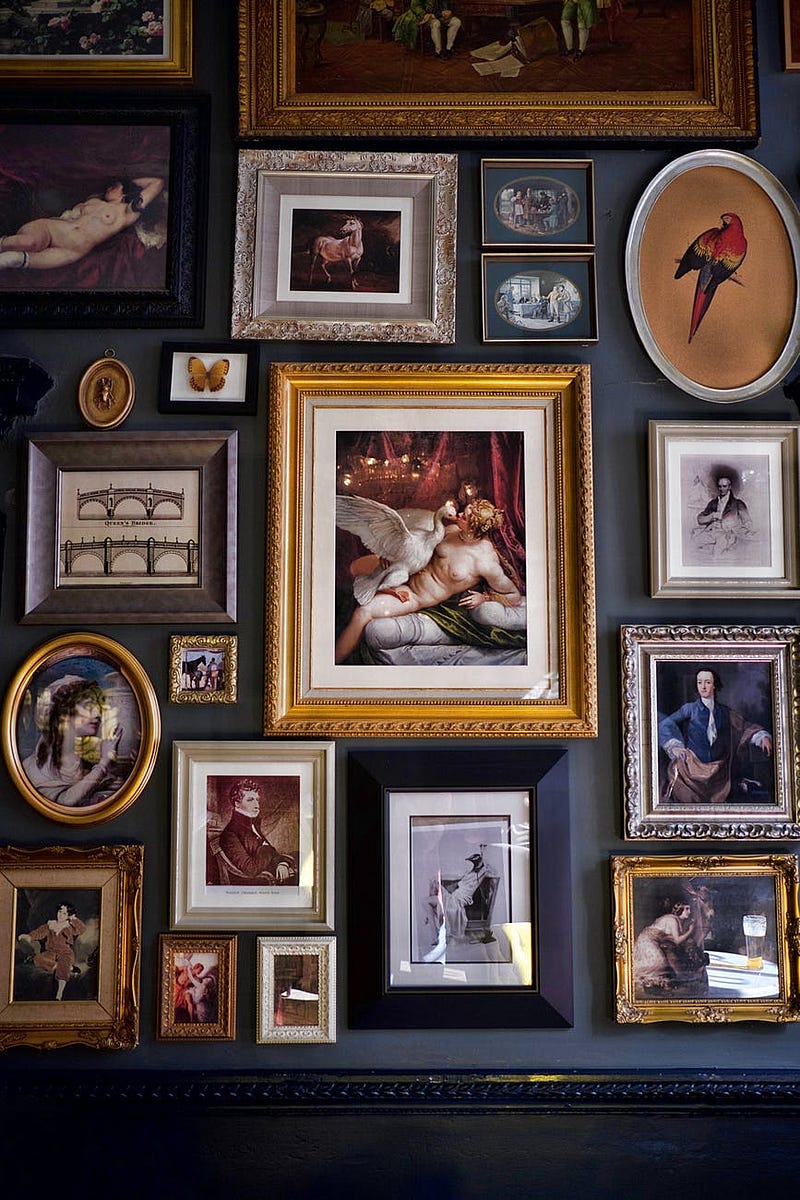
Starving artists suffer from an inner hunger too, because of the modern ennui. The developed world trivializes art and prevents us from appreciating art’s purpose.
To understand this conundrum, we should remind ourselves how art was once driven mainly by a religious purpose, and how modernity consists largely of four engines of “progress” that undermine art.
A Brief History of Western Art
Art likely began as an expression of religious experience. Artistic inspiration was a function of shamanism and of magic, as in the prehistoric cave paintings and megaliths, although some early art was decorative and utilitarian rather than inspired as pure art. The difference between art and craft has persisted throughout the history of art.
At any rate, the more profound early art presupposed something as sacred. In ancient Greece, for example, theater grew out of the festivities of the cult of Dionysus. Attic tragedy was thus modeled on the freedom and ecstatic inspiration associated with inebriation. If you consume a certain amount of wine, you lose your inhibitions and bypass your rational mind’s censorship of your thoughts. As the ancient Greeks saw it, you seem to become a plaything or an avatar of Dionysus. In the tragic plays, the chorus represented the voice of the gods which was channeled also in drunkenness and in religious ecstasy.
Greek sculpture likewise had a religious aspect, since the Greeks deemed form itself as sacred. As Luc Ferry explains in The Wisdom of the Myths, the Olympian gods were tasked with holding back the Titans to preserve the cosmos, the natural order, from the threat of a collapse into chaos. Thus, the gods were conceived of as having human form, and Greek sculpture focused on the contours of the human body by way of emphasizing the sacredness of the natural order; by extension, the realistic sculptures celebrated virtue, the golden mean, and the fulfillment of divine purpose.
Artistic inspiration was similar also to prophecy, as found in Zoroastrianism and ancient Judaism. The prophet spoke or wrote as if possessed by a vision of the future or of an unveiled higher reality. The mundane fell away as the prophet was consumed with a theophany which he struggled to put into words.
In each case, then, whether it was religious experience, intoxication, or the artistic pursuit of these themes, the driving force was a peak state of consciousness, a perception of the sacred that contrasted with profane awareness which Eastern mystics compared to sleepwalking or to bedazzlement by illusions, known as “Maya.”
Ancient societies were theocratic in that their regimes imposed an official religion that limited people’s artistic expressions. Christianity controlled Western art for a millennium until the Protestant Revolution coalesced with the Italian Renaissance and ushered in the scientific and industrial revolutions.
The sacred took a backseat to the profane or disappeared altogether as “natural philosophers” disenchanted the natural order, relying on reason and the ordinary senses for their inquiries rather than trusting in so-called peak states or mystical modes of consciousness.
Artists faced the prospect of being mere craftsmen, slaves to the real where reality was inherently meaningless and interpretations of meaning and purpose were subjective, as in arbitrary matters of taste. Moreover, artists were increasingly subject to capitalism and had to sell their work not to an aristocratic patron who was supposed to have appreciated the sacred order of being, but to an unenlightened mob for selfish profit.
There was a Romantic backlash, an attempt to view nature as re-enchanted by emotions and the imagination which could still overwhelm reason in flashes of insight into nature’s sublime, awesome, inhuman scale.
But while there are still traces of Romantic thought in Max Weber, the Frankfurt School, and the later existentialists, the literary and artistic revolt against industrialism lost favor towards the end of the nineteenth century, largely for political reasons. Instrumentalism went along with the rise of nationalism, as the European empires competed to carve up the world, using their newfound technological facility.
That competition led in turn to the two global wars, to the horror and zenith of reason, even as science and technology advanced, producing nuclear weapons, spaceships, computers, the internet — and the present debacle for artists.
Four Facets of Modernity
There are four major pressures on late-modern art: science, capitalism, democracy, and technology. All four are central to what we think of as modernity, as the most developed way of living after the collapse of medieval feudalism that had attempted to preserve a semblance of the ancient cultures. Let’s briefly go over how each facet of modernity trivializes art.
Science, of course, undermines the notion of the sacred, paving the way for atheism and for stale or hollow, secular idols. Without the religious basis of art, artists can only cast about for some half-way dignifying and even humanizing motive for creating art, the alternative being surrender to industry, to utilitarian craft, and to the business of competing for profit in a ruthless, amoral marketplace.
Capitalism drives home a materialistic concept of value, according to which objects that can be bought and sold are what are most important in life; the higher the price, the higher the value. That which is priceless, such as air, water, or the planet as a whole doesn’t have transcendent value so much as the status of being a raw material to be combined with human labor to produce a “good.” The good that’s validated by capitalism, then, is a worthy material object, one that’s been intelligently designed and constructed and that can be possessed or owned according to the rule of law and the obligation to accumulate wealth.
This economic factor casts artists as producers and consumers. Hitherto, artists in the quasi-religious sense had been outsiders, caught in the grip of altered states of consciousness. They were like prophets or daemon-possessed conduits of the apocalypse, of a revelation of celestial reality that blows the doors off of mundane conceptions.
Democracy, the modern world’s political dimension eliminates the Great Chain of Being in favor of the Enlightenment’s implicitly egalitarian view that all people are equally worthy due to their inherent, psychological rather than spiritual potential. Human dignity isn’t ordained by God but is based on the nature of personhood, on every person’s capacity for rational, autonomous self-awareness which liberates her more and more from the animal’s evolutionary life cycle.
Political power should rest, then, with the mob of voters, but democracy goes further in casting doubt on all elitist hierarchies, including the social divisions between spiritual master or priest and layperson, and between artistic genius and nonartist. As a result, the only thing separating artists and nonartists is freedom of choice. Anyone who chooses to produce art becomes an artist, because no one is inherently more adept or worthy than anyone else, according to democratic (and Protestant individualist) principles.
Technological “progress” has led to the internet and to social media, which have greatly empowered content-creators. Anyone now with access to ubiquitous First World technologies can try their hand at creating music or movies and at publishing their writing. Technological advances eliminate the intermediaries and gate-keepers, in deference to the founding idea of the post-medieval period, which is that every individual person deserves to be king.
The downside of this high-tech power is evidently that it creates a deluge of content. The market has become oversaturated and thanks to the predominance of capitalistic standards of value, the oversupply reinforces a lack of demand.
Moreover, the digitization of content spotlights the codes of creation, the computer programs and the owners of these means of production, all at the expense of the products that stream through cyberspace. Digital content is like fool’s gold or the magician’s hand wave that distracts the audience members while he secretly hoodwinks them.
As in what Thomas Kuhn called “normal” as opposed to “revolutionary” periods of science, technological advances tend to present more efficient means of implementing the culture’s presumptions — until technology revolutionizes society and opens up a strange, new lifestyle.
In this case, individualism via the institutions of capitalism and democracy called upon technological applications of scientific understanding of the world to treat everyone as equally worthy of respect. Artists were no longer akin to prophetic outsiders or talented, troubled geniuses who were burdened by their gifts and insights and whom the masses preferred not to imitate. The artist’s mystique was lost, the standards of excellence were lowered, and everyone could play at being an artist, because there was no longer such a struggle involved in the creation of art.
After all, the computerized technologies began to do more than half the work. For example, autotuning prevents the singer from singing out of tune, the colour-picker in digital art programs allows the artist to match colours exactly without the need to eyeball them, and the internet’s network of computers enables anyone to self-publish his or her novels, poems, or articles.
Art as Preparation for Posthumanity
The question that late-modern artists face is what all of this art is for anymore. What’s the point of creating content now that art has lost its religious or sacred significance? Modernity has thoroughly trivialized art in four redundant processes, from scientific empiricism and the disenchantment of nature; to capitalistic materialism, egoism, and Philistinism; to democratic individualism and mass dilettantism; to the big tech facilitation of these conceits and the gross overproduction of “art.”
Of course, the artist can answer that question by appealing to the modern standards, but most real artists — excluding the dilettantes — would languish nevertheless, because those standards no longer inspire confidence. The secular versions of religion are pale imitations, just as adult fun is a pathetic pretender to childhood wonder and innocence. This was the Nietzschean problem of the death of God, and the Romantic’s second thought about modern progress.
Mind you, the trivialization of art is only a small part of a greater calamity. Those four facets of modernity are liable to make our entire species obsolete, as the automation of labour threatens to put both blue-collar and white-collar workers out of a job, and as we despoil the environment and thus are apparently in the process of destroying ourselves.
As William Deresiewicz writes in The Death of the Artist, the oversaturation results in a system that “rewards the few and leaves the rest to fight for scraps. It’s virality or bust, stardom or oblivion.” Artists are enslaved to the modern systems in which most of the profits are siphoned off by the top one percent, leaving not just artists but the middle class in general to wonder about that myth of historical progress. Somehow, the primitive social structure of the dominance hierarchy shines through all our “enlightened” labours. (See this video interview with Deresiewicz.)
It’s as though modernity were an instrument of a higher power all along and we, the so-called beneficiaries of these systems were only instruments in turn. Perhaps we’re like those hapless workers who’ve been fired and whose last job is to train their replacements. We invent these modern systems and presume they’re working for our advantage, but maybe we’re only laying the groundwork for a posthuman state of affairs, for technology to run itself, to enslave us with its algorithms or to cast us aside as faithless, worthless baggage.
How would we deserve to survive our onslaught against the planet and to prevail in a competition with our superhuman machines, if we’ve grown up and lost faith in religion or any sense of the sacred? Worse, how would we triumph if we’ve failed to grow up, existentially speaking, and been infantilized and turned into human cattle for the predatory upper class?
Art might have shown us the way, but once art itself is commodified and trivialized, that escape hatch too seems locked shut.
Art was supposed to have been the footprint left behind, as it were, by intrepid explorers of higher or inner realities. If the more obnoxious, Western religions were frauds and rightfully humiliated by philosophy and science, we’re still obliged to reckon with our unconscious potential and with our status as creatures that have been cursed to recognize their absurdity. Instead of resorting to the tainted notions of sacredness or spirituality, we can speak at least of the fundamental and of the universal, as in the common aspects of our humanity, our mortality, and our role in a godless world.
Artists might be driven to grapple with those existential problems, not by presupposing answers that defer to the four facets of modernity, but by posing radical, philosophical questions and testing answers in artistic form. For that to have a chance at redeeming modernity or at least of saving us from ruin and for some renaissance to come, art had better not be reduced to a mere appendage of the modern megamachine, of the technoscientific acceleration of the madness of being people in the wilderness.
The Apeiron Blog — Big Questions, Made Simple.
We know that Philosophy can seem complicated at times. To make things simple, we compile together the best articles, news, reading lists — and other free resources to guide you on your journey. To continue with us, follow us on Medium and sign up to our free mailing list.


