
Modelling Climate Change
Do-it-yourself climate modelling with Netlogo.
About Climate Models
Climate scientists extensively measure temperature and heat flows across land and ocean under sea and ice.
Captured data fed into multiple climate models, Models validated by matching observations against predictions, Once validated models can make, Within limits, Predictions for recommendations tackling climate change.
Many climate model predictions from last century now realities, Speed of change underestimated, Extreme weather events more intense and frequent than predicted.
Wanted understanding of principles behind climate modelling, Because of major push in world economy to tackle climate change, Also been asked to teach modelling.
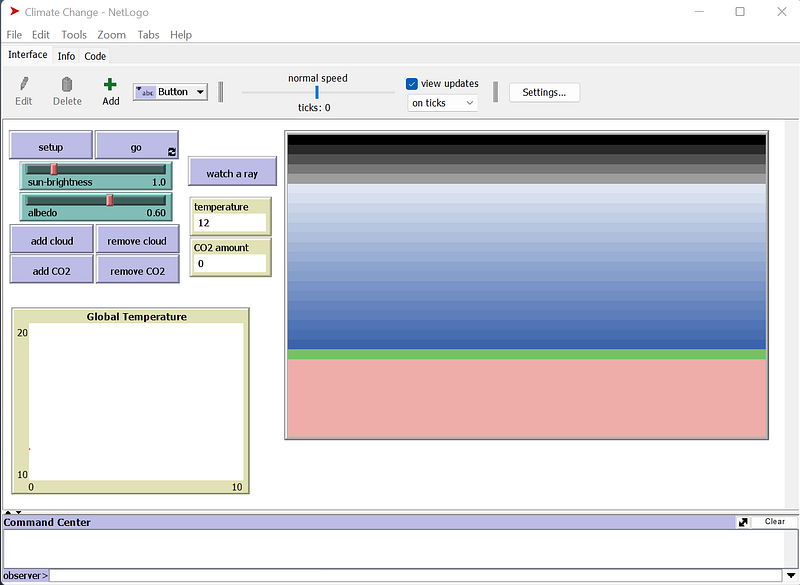
Netlogo’s Climate Change Model:
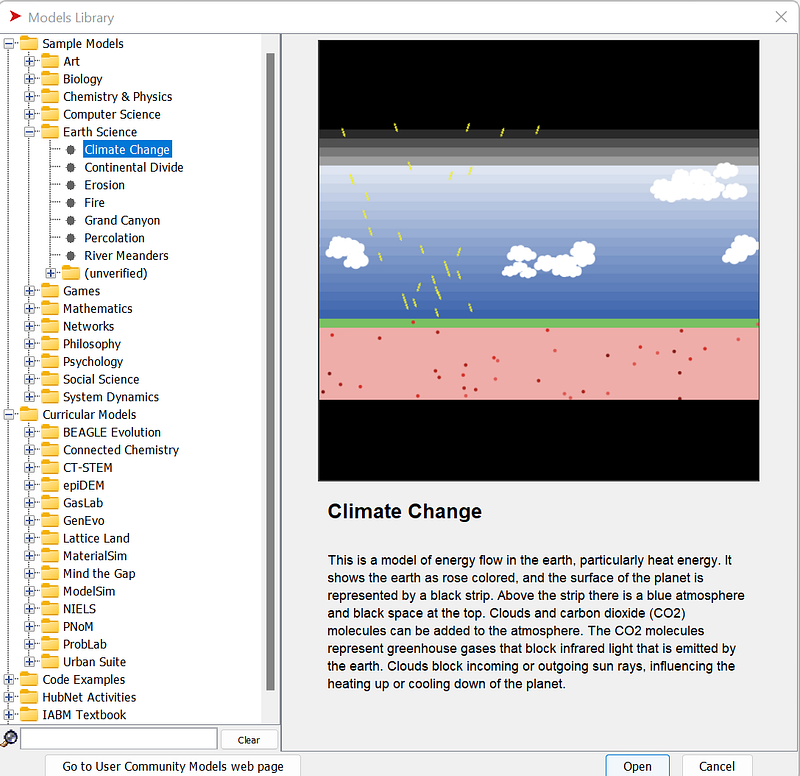
Great if you’d have fun experimenting, Wrote article introducing modelling, Gives information on how to setup and run pre-installed library models.
Tutorials and more models at North Western University’s Netlogo homepage.
Putting Things Into Context
Like to relate model to something familiar, Like my apartment in city surrounds, Gives me something to think about as model predicts blistering hot apartment.
Change Albedo setting for urban heat island effect, Created by replacement of natural surfaces with hard impervious materials that are generally dark and absorb large amounts of solar radiation.
What is Albedo?
Albedo measures diffuse reflection of solar radiation out of total solar radiation, Value from 0 no reflection to 1 all radiation reflected.
Ocean surface has low albedo and ocean absorbing heat contributes to rising sea levels, Warming ocean leads to heavy rains Flooding Australia.
Forests have low albedo, Desert areas high albedos, Cloud cover increases albedo, Complex interactions.
Earth’s average surface temperature due to albedo and greenhouse effect is currently about 15 °C (59 °F).
Albedo and Climate Change
Amount of ice covering planet decreasing because global warming, Causes decrease in areas of white, Lowers albedo leading to less reflection and higher heat absorption then increasing greenhouse effect that further changes Earth’s albedo, Positive feedback loop, May have tipping point.
Netlogo Model
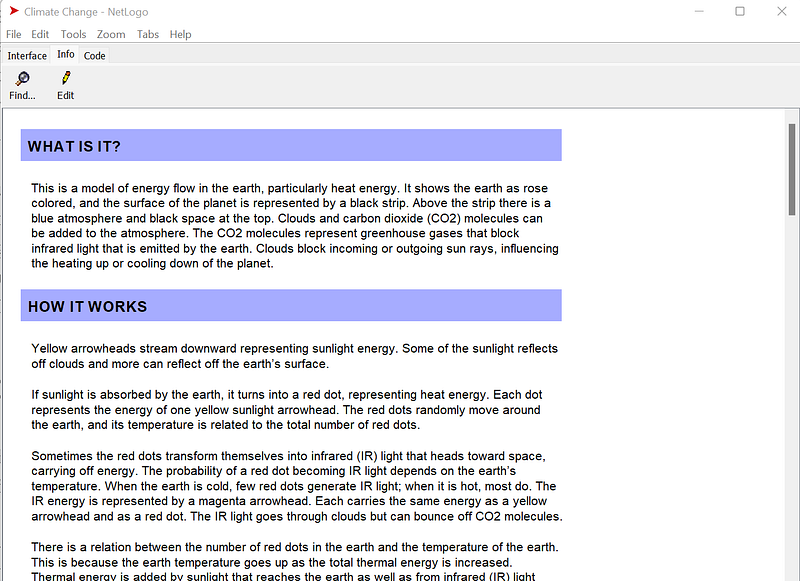
Model is about flow of heat energy.
Shows earth as rose colored with surface represented by thin black strip.
Above surface blue atmosphere, Black space at top.
Clouds and CO2 can be added, CO2 represents greenhouse gases blocking emission of infrared light emitted by Earth.
Clouds block incoming or outgoing sun rays influencing heating or cooling down of Earth.
Reflection.
In SE Australia, where I live, Extreme weather events happen frequently with floods all over state, No longer is climate change just product of someone’s fevered imagination, I hope model gives you feel for what is coming to every home.
Blessed be.
Citations
Climate Change Model: Tinker, R. and Wilensky, U. (2007). NetLogo Climate Change model. http://ccl.northwestern.edu/netlogo/models/ClimateChange. Center for Connected Learning and Computer-Based Modeling, Northwestern University, Evanston, IL.
NetLogo software: Wilensky, U. (1999). NetLogo. http://ccl.northwestern.edu/netlogo/. Center for Connected Learning and Computer-Based Modeling, Northwestern University, Evanston, IL.


