
Mobility: The Unknown Component to Getting Stronger
This is the 2nd in a series on getting stronger when over 40. (Secret: these tips apply to those under 40 as well!)
Our ability to move has become compromised.
The western lifestyle of being able to get through most days without moving is taking its toll.
Our bodies are meant to move. When we don’t move, we don’t do well.
Hip replacement, for example, is on the rise and becoming the norm.
Why is that happening know?
Could it be to a lack of movement in our lives?
Before pumping the weights randomly, I suggest the following 4 steps in your quest to get stronger:
1. Have a little bit of knowledge. Be empowered to understand the theory behind the practice. Then get to it.
2. Do something today, then tomorrow, then the next day. A daily routine. Could be small, could be big. But daily.
3. Be able to move. Maybe this should be step 1, 2, 3 and 4. Mobility. Without the ability to move, where are we?
If we don’t move enough, it no longer becomes a choice, and we can’t!
Our bodies are funny that way. Moving must be considered practice to be able to move better.
4. Add some resistance to movement. When done to a full range of motion & combined with the above will get you stronger.
This sequence is fundamental to making progress in getting stronger. You will find these steps covered in all good athlete preparation and training programs. In fact, many strength and conditioning specialists are now referred to as movement coaches.
In summary:
1. A little bit of knowledge
2. A regular routine
3. Mobility practice
4. Different ways of adding resistance to movements aka strength training.
We can easily apply these concepts, even if we are don’t think we are athletes!
Without consistency or mobility (rough definition: the ability to move!) we should not add resistance, and if we can not add resistance, making progress to get stronger becomes more difficult.
Before we go on, a more detailed definition.
Mobility is not just the ability to move, it is range of motion at a body joint. Hips, shoulders and ankles often get compromised due to lack of movement. Unfortunately, now being seen at younger and younger ages. Biggest impact is when we hit 40.
We can lose function due to injury, but also due to lack of movement. This is different than flexibility. Flexibility is the ability to push the range of motion through a body joint.
Being able to move through a full range of motion is the first step in keeping the privilege of moving independently.
It would be important in avoiding injury, for example, to not add a barbell on the back of your neck to squat if your hip and ankle mobility were not good. Many injure themselves by adding resistance before mobility. When that happens, other parts of the body (back, knees) take up the slack, and they are not designed for that. So injury occurs.
Restoring your hips’ mobility would be step 1 before a weighted squat.
How is that done? How do you make sure you have good hip and ankle mobility? You get into a body weight squat. (No added resistance!)
Here are some tips on getting into a deep squat:
If that does not work, meaning you can not lower yourself and hold in bottom position and come back up, then we need to work backwards.
We can start with a sit to stand. We can look to move more often. Simply avoiding long periods of time sitting helps hip mobility.
We can work on restoring full mobility.
What other ways can you test to make sure you have full mobility around the important joints?
Here are a couple of options.
Forward lunge and reach
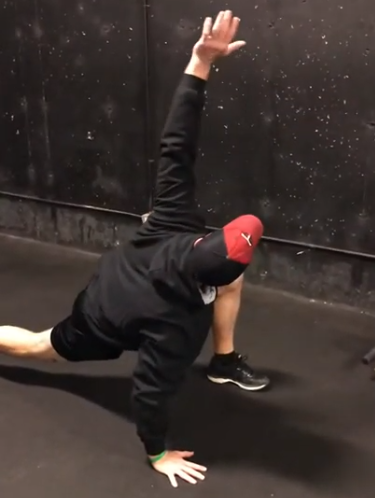
Push up plank to thoracic spine rotation
Incline yoga push up:
Hip mobility: Pidgeon pose
Ankle mobility
Performing these daily will restore and maintain mobility at key body joints. This is the building block to moving without soreness, and also to getting stronger as then you can add resistance to your movement.
NOTE: if any of these create pain, see your movement specialist.
“Don’t use it, you will lose it”.
Mobility training is a staple in the athlete training world. It is part of their daily physical preparation. Often it is part of their warm-up.
For the average Joe and Jill like you and me, a mobility routine can become our daily workout on those days we don’t have much time dedicated to exercise.
Put together a few deep squats, with some incline yoga push-ups and you have a micro workout!
A push up plank with thoracic spine rotation & forward lunge to reach, you have another micro workout!


